Prelims Paper II 2021 question paper Solutions UPSC Combined Geo-Scientist, Prelims · 2021 · Paper II, Chemistry
UPSC Geo-Scientist Prelims 2021 Chemistry (Paper II): answer key and solutions
All 120 questions of the 2021 Combined Geo-Scientist Prelims Paper II (chemistry), each with the answer and a short explanation in the hint-sheet style: the key fact first, numericals worked with units. Tap a number in the key to jump to the question; every question also has its own page.
Answer key 1 d 2 c 3 a 4 a 5 a 6 c 7 b 8 b 9 c 10 a 11 d 12 a 13 a 14 a 15 c 16 b 17 a 18 d 19 a 20 c 21 d 22 d 23 c 24 c 25 d 26 d 27 c 28 d 29 a 30 b 31 a 32 a 33 b 34 c 35 a 36 a 37 a 38 a 39 c 40 a 41 d 42 b 43 b 44 b 45 c 46 a 47 d 48 d 49 b 50 c 51 c 52 a 53 c 54 b 55 d 56 d 57 a 58 c 59 a 60 c 61 a 62 c 63 b 64 b 65 c 66 a 67 b 68 b 69 d 70 a 71 c 72 c 73 a 74 c 75 d 76 b 77 b 78 c 79 d 80 a 81 a 82 b 83 d 84 a 85 b 86 a 87 d 88 c 89 b 90 d 91 a 92 c 93 b 94 d 95 c 96 c 97 b 98 c 99 d 100 b 101 b 102 a 103 a 104 c 105 c 106 c 107 d 108 a 109 b 110 a 111 d 112 c 113 d 114 b 115 b 116 a 117 b 118 c 119 d 120 c Question paper: read or download the 2021 Paper II paper . Solutions are original work by VKC; question paper belongs to UPSC.
Q1 Atomic structure / nodes
The number of radial nodes for 2s, 3p and 3d orbitals, respectively are:
(a) 2, 1, 0(b) 2, 1, 1(c) 1, 0, 0(d) 1, 1, 0
Radial nodes = n − l − 1 . 2s: 2 − 0 − 1 = 1. 3p: 3 − 1 − 1 = 1. 3d: 3 − 2 − 1 = 0. So 1, 1, 0 → (d). Remember: angular nodes = l; total nodes = n − 1.
Read every answer and explanation of this paper with VKC Basic
VKC Basic (₹999 for 6 months) opens every solved answer, the notes, the handbook and the daily answer archive. Every Mains test series includes it.
See what is included Already a member? Sign in
Q2 Atomic structure / electronic configuration
What fraction of the total number of electrons is in the p-sublevels in Iron (Fe)?
(a) 50%(b) 49%(c) 46.15%(d) 47.82%
Answer and explanation with the VKC plan
Q3 s-block / hydration
Which is the correct order of degree of hydration among the following ions?
(a) Be²⁺ > Mg²⁺ > Sr²⁺ > Ba²⁺(b) Be²⁺ > Sr²⁺ > Mg²⁺ > Ba²⁺(c) Ba²⁺ > Sr²⁺ > Mg²⁺ > Be²⁺(d) Ba²⁺ > Mg²⁺ > Sr²⁺ > Be²⁺
Answer and explanation with the VKC plan
Q4 p-block / diagonal relationship
Consider the following statements regarding diagonal relationship of ‘B’ and ‘Si’:
The electronegativity values of both the elements are almost same Both the elements have almost identical values of their ionic potential Which of the statements given above is/are correct?
(a) 1 and 2(b) 1 only(c) 2 only(d) Neither 1 nor 2
Answer and explanation with the VKC plan
Q5 f-block / lanthanoids
Consider the following statements regarding Lanthanum:
It is a f-block element It is an inner transition element It is a transition series element It is a rare earth metal Which of the statements given above are correct?
(a) 1, 2, 3 and 4(b) 2 and 4 only(c) 1, 2 and 4 only(d) 1 and 3 only
Answer and explanation with the VKC plan
Q6 Noble gases / uses
Argon (Ar) is used in arc welding because of its:
(a) High calorific value(b) Ability to lower the melting point of metal(c) Low reactivity(d) Flammability
Answer and explanation with the VKC plan
Q7 Periodic properties / isoelectronic ions
Which one of the following represents the correct order of ionic radii among K⁺, S²⁻, Cl⁻ and Ca²⁺?
(a) Ca²⁺ > K⁺ > Cl⁻ > S²⁻(b) S²⁻ > Cl⁻ > K⁺ > Ca²⁺(c) Cl⁻ > S²⁻ > K⁺ > Ca²⁺(d) K⁺ > Ca²⁺ > S²⁻ > Cl⁻
Answer and explanation with the VKC plan
Q8 Chemical bonding / dipole moment
The dipole moments of H─C≡C─Cl, CO and HCl are in the directions:
(a) ←, ← and ← respectively(b) ←, ← and → respectively(c) →, → and → respectively(d) ←, → and ← respectively
Answer and explanation with the VKC plan
Q9 Chemical bonding / MOT of O₂ species
Consider the following pairs of species of oxygen and their magnetic behavior:
O₂⁻, O₂²⁻ → Both diamagnetic O₂⁺, O₂²⁻ → Both paramagnetic O₂⁺, O₂⁻ → Both paramagnetic O, O₂²⁻ → Both paramagnetic Which of the pair(s) of oxygen species given above represents the correct magnetic behavior?
(a) 1 only(b) 1 and 2(c) 3(d) 2 and 4
Answer and explanation with the VKC plan
Q10 p-block / oxides of nitrogen
Consider the following statements regarding the properties of Nitric oxide (NO):
Nitric oxide gas is paramagnetic but liquid nitric oxide is diamagnetic Nitric oxide gas is diamagnetic but liquid nitric oxide is paramagnetic Nitric oxide is a neutral oxide and is not an acid anhydride Which of the statement(s) given above is/are correct?
(a) 1 and 3(b) 1 only(c) 2 and 3(d) 2 only
Answer and explanation with the VKC plan
Q11 Chemical bonding / ionic character
Which one of the following substances has the greatest ionic character?
(a) Cl₂O(b) NCl₃(c) PbCl₂(d) BaCl₂
Answer and explanation with the VKC plan
Q12 Solid state / lattice energy
Consider the following statements regarding Madelung constant:
Which one of the following is correct in respect of above statements?
(a) Both statement-1 and statement-2 are true and statement-2 is the correct explanation of statement-1(b) Both statement-1 and statement-2 are true but statement-2 is not the correct explanation of statement-1(c) Statement-1 is true but statement-2 is false(d) Statement-1 is false but statement-2 is true
Answer and explanation with the VKC plan
Q13 s-block / Fajans' rule
Which one of the following represents the correct order of melting point among BeCl₂, MgCl₂, CaCl₂ and NaCl?
(a) BeCl₂ < MgCl₂ < CaCl₂ < NaCl(b) MgCl₂ < BeCl₂ < CaCl₂ < NaCl(c) BeCl₂ < MgCl₂ < NaCl < CaCl₂(d) BeCl₂ < CaCl₂ < MgCl₂ < NaCl
Answer and explanation with the VKC plan
Q14 Solid state / defects
What kind of defect(s) appear in AgBr crystal?
(a) Schottky and Frenkel(b) Frenkel only(c) Schottky only(d) Metal excess defect
Answer and explanation with the VKC plan
Q15 Chemical bonding / MOT
Consider the following statements:
N₂ molecule is paramagnetic O₂ molecule is diamagnetic CO⁺ has more bond order than CO NO⁺ has less bond order than NO Which of the statement(s) given above is/are correct?
(a) 1 and 4(b) 1 and 2(c) 3(d) 2 only
Answer and explanation with the VKC plan
Q16 Chemical bonding / VSEPR
The correct order of the bond angles among NH₃, NH₄⁺ and NH₂⁻ is:
(a) NH₃ > NH₄⁺ > NH₂⁻(b) NH₄⁺ > NH₃ > NH₂⁻(c) NH₃ > NH₂⁻ > NH₄⁺(d) NH₄⁺ > NH₂⁻ > NH₃
Answer and explanation with the VKC plan
Q17 s-block / superoxides
Consider the following statements:
Which one of the following is correct in respect of above statements?
(a) Both statement-1 and statement-2 are true and statement-2 is the correct explanation of statement-1(b) Both statement-1 and statement-2 are true but statement-2 is not the correct explanation of statement-1(c) Statement-1 is true but statement-2 is false(d) Statement-1 is false but statement-2 is true
Answer and explanation with the VKC plan
Q18 Chemical bonding / resonance
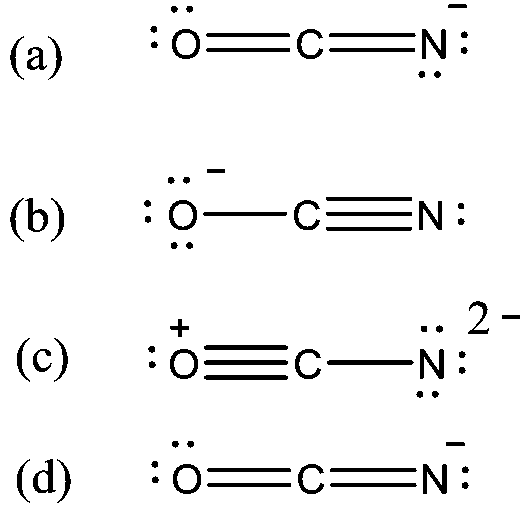
Which one of the following is NOT a resonance structure of cyanate (OCN⁻)?
(a) :Ö=C=N̈:⁻ (O two lone pairs, N two lone pairs, −1 on N)(b) :Ö:⁻–C≡N: (O three lone pairs with −1, N one lone pair)(c) :O⁺≡C–N̈:²⁻ (O one lone pair with +1, N three lone pairs with −2)(d) :Ö=C=N:⁻ (O two lone pairs, N only one lone pair, −1 on N)
Answer and explanation with the VKC plan
Q19 Coordination chemistry / magnetism
What are the spin only magnetic moments (in BM) for Ni (II) ion in a square planar and octahedral geometry, respectively?
(a) 0 (zero) and 2.83(b) 2.83 and 0 (zero)(c) 2.83 and 2.83(d) 0 (zero) and 0 (zero)
Answer and explanation with the VKC plan
Q20 Coordination chemistry / VBT
Which one of the following complexes is tetrahedral as well as diamagnetic?
(a) [Ni(NH₃)₄]²⁺(b) [NiCl₄]²⁻(c) [Ni(CO)₄](d) [Ni(CN)₄]²⁻
Answer and explanation with the VKC plan
Q21 Coordination chemistry / Werner theory
Which one of the following will NOT precipitate AgCl while reacting with excess of AgNO₃ solution at room temperature?
(a) CoCl₃.6NH₃(b) CoCl₃.5NH₃(c) CoCl₃.4NH₃(d) CoCl₃.3NH₃
Answer and explanation with the VKC plan
Q22 Coordination chemistry / Werner theory
Which one of the following complexes CANNOT be ionized in solution?
(a) [Pt(NH₃)₆]Cl₄(b) K₂[PtF₆](c) K₄[Fe(CN)₆](d) [Co(NH₃)₃Cl₃]
Answer and explanation with the VKC plan
Q23 Coordination chemistry / ligands
The maximum denticity of the polydentate ligand tetraethylene pentamine is equal to:
(a) 4(b) 2(c) 5(d) 3
Answer and explanation with the VKC plan
Q24 Coordination chemistry / nomenclature
The correct IUPAC name of K₂[Zn(OH)₄] is:
(a) Dipotassium tetrahydroxo zinc (II)(b) Potassium tetrahydroxo zinc (II)(c) Potassium tetrahydroxido zincate (II)(d) Dipotassium tetrahydroxido zincate (II)
Answer and explanation with the VKC plan
Q25 Coordination chemistry / isomerism
Which one of the following octahedral complexes does NOT show geometrical isomerism?
(a) [MA₂B₄](b) [MA₃B₃](c) [MA₄B₂](d) [MA₅B]
Answer and explanation with the VKC plan
Q26 Coordination chemistry / optical isomerism
Which one of the following will NOT show optical isomerism?
(a) [Cr(C₂O₄)₃]³⁻(b) Cis-[PtCl₂(en)₂]²⁺(c) [Co(EDTA)]⁻(d) [PtCl₂(NH₃)₂]
Answer and explanation with the VKC plan
Q27 Coordination chemistry / isomerism
How many isomers are possible for [Co(en)₂Cl₂]⁺ complex ion?
(a) 1(b) 2(c) 3(d) 4
Answer and explanation with the VKC plan
Q28 Chemical equilibrium / Le Chatelier
Which one of the following equilibria will shift to the left in response to increase in pressure?
(a) N₂ + 3H₂ ⇋ 2NH₃ + 22.2 Kcal(b) H₂ + I₂ + 12.4 Kcal ⇋ 2HI(c) N₂ + O₂ ⇋ 2NO – 43.2 Kcal(d) N₂O₄ + 14 Kcal ⇋ 2NO₂
Answer and explanation with the VKC plan
Q29 p-block / oxoacids of phosphorus
The correct order of the acidic strength of H₃PO₄, H₃PO₃ and H₃PO₂ is:
(a) H₃PO₂ > H₃PO₃ > H₃PO₄(b) H₃PO₄ > H₃PO₃ > H₃PO₂(c) H₃PO₄ > H₃PO₂ > H₃PO₃(d) H₃PO₃ > H₃PO₄ > H₃PO₂
Answer and explanation with the VKC plan
Q30 Acids and bases / proton affinity
Which one of the following substances has highest proton affinity?
(a) H₂O(b) NH₃(c) H₂S(d) CH₃COOH
Answer and explanation with the VKC plan
Q31 Ionic equilibrium / Ostwald dilution law
An aqueous solution of HN₃ was diluted two times, three times, four times and five times using required amount of water. Considering ‘α’ to be the ionization constant and ‘V’ as the final volume of diluted solution, choose the correct answer from the following:
(a) All the solutions will be acidic and the graph of α vs. V is non-linear(b) All the solutions will be basic and the graph of α vs. V is non-linear(c) All the solutions will be acidic and the graph of α vs. V is linear(d) All the solutions will be basic and the graph of α vs. V is linear
Answer and explanation with the VKC plan
Q32 Alcohols / acidity
Which one of the following represents the correct order of acidity of water and alcohols?
(a) H₂O > RCH₂OH > R₂CHOH > R₃COH(b) RCH₂OH > R₂CHOH > R₃COH > H₂O(c) H₂O < RCH₂OH < R₂CHOH < R₃COH(d) RCH₂OH < R₂CHOH < R₃COH < H₂O
Answer and explanation with the VKC plan
Q33 Ionic equilibrium / very dilute solutions
A student calculated the pH of 10⁻⁷ M NaOH solution and 10⁻⁸ M HCl solution to be 7 and 8, respectively. To verify, the student performed experiment in laboratory using pH-meter. The instrument displays the pH of former and later solutions as 7.3 and 6.9, respectively. Choose the correct answer from the following:
(a) The pH-meter is malfunctioned and the calculation results of the student are correct(b) The pH-meter is working properly and the calculation results of the student are incorrect(c) The pH-meter is malfunctioned and the calculation results of the student are wrong(d) The calculation results of the student are correct and the instrument is working properly only for acids
Answer and explanation with the VKC plan
Q34 Ionic equilibrium / pH
Which one of the following has the pH value NOT equal to one?
(a) 0.1 M HNO₃(b) 0.05 M H₂SO₄(c) 0.1 M CH₃COOH(d) 50 ml of 0.4 M HCl + 50 ml of 0.2 M NaOH
Answer and explanation with the VKC plan
Q35 Ionic equilibrium / buffer
What will be the pH of a buffer solution containing 0.20 mole of NH₄OH and 0.25 mole of NH₄Cl per litre?
(a) 9.161(b) 9.521(c) 8.161(d) 9.312
Answer and explanation with the VKC plan
Q36 Solutions / concentration terms
The molarity of concentrated commercial HCl with 36 % (w/w) HCl and density 1.19 g/cm³ is close to:
(a) 11.7 M(b) 10.6 M(c) 11.2 M(d) 11.5 M
Answer and explanation with the VKC plan
Q37 Analytical chemistry / primary standards
Which one of the following primary standard is usually used to standardize KOH by titration?
(a) Potassium acid phthalate(b) Sulphuric acid(c) Hydrochloric acid(d) Nitric acid
Answer and explanation with the VKC plan
Q38 Analytical chemistry / redox titration
While performing the titration between Mohr’s salt solution and potassium dichromate solution using diphenylamine as indicator, a student forgot to add o-phosphoric acid. Choose the correct answer from the following:
(a) The end point will be observed before the actual end point(b) The end point will be observed after the actual end point(c) The end point will never be observed(d) The end point will be observed at its actual end point as there was no need to add o-phosphoric acid
Answer and explanation with the VKC plan
Q39 Analytical chemistry / complexometric titration
Consider following statements in respect of titration between Ca²⁺ solution and EDTA solution using Eriochrome Black T as indicator (In):
The end point will be red in color The end point will be blue in color The end point depends on pH of solution which is controlled by adding ammonia –ammonium citrate buffer The end point is observed since metal–In complex is more stable than metal–EDTA complex Which of the statement(s) given above is/are correct?
(a) 1, 3 and 4(b) 2, 3 and 4(c) 2 and 3 only(d) 2 only
Answer and explanation with the VKC plan
Q40 Ionic equilibrium / indicators
In acid base titration the color change of an indicator is expressed by:\(pH = pK'_{In} + \log\frac{[In_B]}{[In_A]}\) \(In_B\) = Indicator in the basic form, \(In_A\) = indicator in acid form)
(a) \([In_B]/[In_A] > 10\) (b) \([In_B]/[In_A] < 10\) (c) \([In_A]/[In_B] > 10\) (d) \([In_B] = [In_A]\)
Answer and explanation with the VKC plan
Q41 Gaseous state / kinetic theory
Which one of the following comparisons of the average translational kinetic energy (K.E.) and the average molecular speeds of H₂ and N₂ gases at 300 K is correct?
(a) Average translational K.E.: H₂ = N₂; Average molecular speed: H₂ = N₂(b) Average translational K.E.: H₂ < N₂; Average molecular speed: H₂ > N₂(c) Average translational K.E.: H₂ = N₂; Average molecular speed: H₂ < N₂(d) Average translational K.E.: H₂ = N₂; Average molecular speed: H₂ > N₂
Answer and explanation with the VKC plan
Q42 Thermodynamics / response functions
The expression of isothermal compressibility factor is:
(a) \(K_T = \frac{1}{V}\left(\frac{\partial V}{\partial P}\right)_T\) (b) \(K_T = -\frac{1}{V}\left(\frac{\partial V}{\partial P}\right)_T\) (c) \(K_T = \frac{1}{V}\left(\frac{\partial V}{\partial T}\right)_P\) (d) \(K_T = -\frac{1}{V}\left(\frac{\partial V}{\partial T}\right)_P\)
Answer and explanation with the VKC plan
Q43 Gaseous state / Graham's law
An equimolar mixture of H₂ and N₂ is allowed to effuse through a hole. What is the ratio of rate of diffusion of H₂ to that of N₂?
(a) 1 : 3.7(b) 3.7 : 1(c) 1 : 14(d) 14 : 1
Answer and explanation with the VKC plan
Q44 Gaseous state / molecular speeds
The temperature at which the average velocity of Nitrogen (N₂) is equal to that of Oxygen (O₂) at 320 K is:
(a) 365.68 K(b) 280 K(c) 225 K(d) 300 K
Answer and explanation with the VKC plan
Q45 Gaseous state / Maxwell distribution
Which one of the following relations for three types of velocities is true for oxygen gas at 300 K?
(a) ⟨c²⟩^½ > c_p > ⟨c⟩(b) ⟨c⟩ > c_p > ⟨c²⟩^½(c) ⟨c²⟩^½ > ⟨c⟩ > c_p(d) ⟨c⟩ > ⟨c²⟩^½ > c_p
Answer and explanation with the VKC plan
Q46 Gaseous state / Maxwell distribution
Consider the following statements regarding the most probable speed of gas particles:
The most probable speed increases with increasing temperature and with decreasing molar mass and simultaneously distribution becomes broader The most probable speed increases with increasing temperature and with increasing molar mass and distribution becomes sharp The most probable speed decreases with the decrease of temperature and with increasing molar mass and simultaneously distribution becomes sharp Which of the statement(s) given above is/are correct?
(a) 1 and 3(b) 2 and 3(c) 1 only(d) 2 only
Answer and explanation with the VKC plan
Q47 Gaseous state / effusion
One hundred molecules of Oxygen (O₂) escape through a small hole on a container at a pressure of 1 torr and temperature of 300 K per second to vacuum. The number of hydrogen molecules that would escape per second through the same hole under the same conditions of temperature and pressure is:
(a) 1200(b) 800(c) 1600(d) 400
Answer and explanation with the VKC plan
Q48 Gaseous state / mean free path
The mean free path of a gas is:
(a) Independent of temperature but dependent on pressure(b) Independent of pressure but dependent on temperature(c) Independent of both pressure and temperature(d) Dependent on both pressure and temperature
Answer and explanation with the VKC plan
Q49 Thermodynamics / Maxwell relations
Which one of the following is NOT a Maxwell thermodynamic relation?
(a) \(\left(\frac{\partial S}{\partial V}\right)_T = \left(\frac{\partial P}{\partial T}\right)_V\) (b) \(\left(\frac{\partial S}{\partial P}\right)_T = \left(\frac{\partial V}{\partial T}\right)_P\) (c) \(\left(\frac{\partial V}{\partial S}\right)_P = \left(\frac{\partial T}{\partial P}\right)_S\) (d) \(-\left(\frac{\partial P}{\partial S}\right)_V = \left(\frac{\partial T}{\partial V}\right)_S\)
Answer and explanation with the VKC plan
Q50 Chemical kinetics / reversible reactions
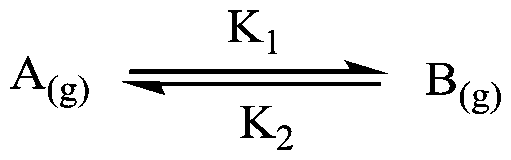
Consider the following first order elementary reaction:
(a) 0.693(b) 0.0693(c) 0.10(d) 10.0
Answer and explanation with the VKC plan
Q51 Thermodynamics / third law entropy
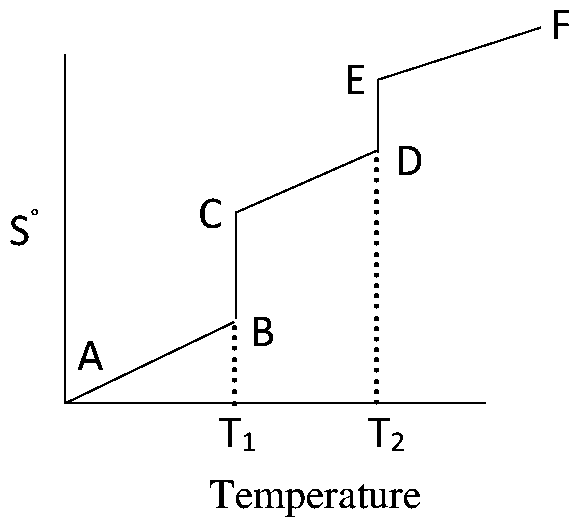
Consider the following figure representing the increase in entropy of a substance from absolute zero to its gaseous state with temperature change:
ΔS° (fusion) and ΔS° (vaporization) are respectively indicated by:
(a) AB and BC(b) BC and CD(c) BC and DE(d) CD and DE
Answer and explanation with the VKC plan
Q52 Thermodynamics / state functions
Consider the following quantities:
Concentration Volume Standard electrode potential Internal energy Which of the following statements given below are correct?
(a) 1 and 3 are intensive quantities; 2 and 4 are extensive quantities(b) 1 and 4 are extensive quantities; 2 and 3 are intensive quantities(c) 1 and 2 are extensive quantities; 3 and 4 are intensive quantities(d) 1, 2 and 4 are extensive quantities; 3 is intensive quantity
Answer and explanation with the VKC plan
Q53 Thermodynamics / Joule–Thomson effect
Joule Thomson coefficient for a gas is given by:
(a) \(\mu_{JT} = -C_P\left(\frac{\partial H}{\partial P}\right)_T\) (b) \(\mu_{JT} = -\left(\frac{\partial H}{\partial P}\right)_T\) (c) \(\mu_{JT} = -\frac{1}{C_P}\left(\frac{\partial H}{\partial P}\right)_T\) (d) \(\mu_{JT} = \frac{1}{C_P}\left(\frac{\partial H}{\partial P}\right)_T\)
Answer and explanation with the VKC plan
Q54 Thermodynamics / Joule–Thomson effect
Consider the following statements regarding Joule Thomson effect:
Joule Thomson effect occurs at constant enthalpy For perfect gas Joule Thomson coefficient is zero Heating effect corresponds to positive value of Joule Thomson coefficient Which of the statements given above is/are correct?
(a) 1 and 3(b) 1 and 2(c) 2 and 3(d) 3 only
Answer and explanation with the VKC plan
Q55 Thermodynamics / ΔH and ΔE
For the reaction H₂F₂(g) → H₂(g) + F₂(g), ΔH is equal to:
(a) ΔE + 2RT(b) ΔE – 2RT(c) ΔE(d) ΔE + RT
Answer and explanation with the VKC plan
Q56 Thermodynamics / third law and Gibbs energy
Which of the following thermodynamic relations are correct?
\(\lim_{T \to 0} S = 0\) \(S_T = \int_0^T \frac{C_P\,dT}{T}\) \(-\Delta S = \left(\frac{\partial(\Delta G)}{\partial T}\right)_P\) Select the correct answer using the code given below:
(a) 1 and 2 only(b) 1 and 3 only(c) 2 and 3 only(d) 1, 2 and 3
Answer and explanation with the VKC plan
Q57 Electrochemistry / thermodynamics of cells
What is the sign of ΔG° and the value of K for an electrochemical cell for which E°cell = 0.80V?
(a) ΔG° is negative and K >1(b) ΔG° is positive and K>1(c) ΔG° is positive and K<1(d) ΔG° is negative and K<1
Answer and explanation with the VKC plan
Q58 Electrochemistry / Gibbs–Helmholtz
If ΔG = ΔH – TΔS and \(\Delta G = \Delta H + T\left(\frac{\delta(\Delta G)}{\delta T}\right)_P\) then the variation of emf of cell (E°) with temperature T at constant pressure is given by:
(a) \(\frac{\Delta H}{nF}\) (b) \(\frac{\Delta G}{nF}\) (c) \(\frac{\Delta S}{nF}\) (d) \(-\frac{\Delta S}{nF}\)
Answer and explanation with the VKC plan
Q59 Thermodynamics / phase change
Which of the following is correct about the sign of enthalpy and entropy changes of an evaporating liquid?
(a) ΔH is positive; ΔS is positive(b) ΔH is negative; ΔS is negative(c) ΔH is positive; ΔS is negative(d) ΔH is negative; ΔS is positive
Answer and explanation with the VKC plan
Q60 Thermodynamics / phase equilibrium
Consider the following equilibrium process at 373K and 1 atm. pressure:
(a) ΔH = 0(b) ΔE = 0(c) ΔH = TΔS(d) ΔH = ΔE
Answer and explanation with the VKC plan
Q61 Solutions / colligative properties
Which one of the following aqueous solutions has the lowest vapor pressure at room temperature?
(a) 0.1 molal hexaamminecobalt (III) chloride(b) 0.1 molal barium chloride(c) 0.1 molal glucose(d) 0.1 molal Tris (ethylenediamine) copper (II) sulfate
Answer and explanation with the VKC plan
Q62 Solutions / colligative properties
Compared to pure water, 1 M sugar-water solution will have a:
(a) Lower vapor pressure, lower boiling point and lower freezing point(b) Lower vapor pressure, lower boiling point and higher freezing point(c) Lower vapor pressure, higher boiling point and lower freezing point(d) Higher vapor pressure, higher boiling point and higher freezing point
Answer and explanation with the VKC plan
Q63 Solutions / osmotic pressure
The relation between osmotic pressure (Π) and lowering of vapor pressure in an infinitely dilute solution is:
(a) \(\Pi = V^0 RT \ln\left(\frac{p}{p^0}\right)\) (b) \(\Pi = \frac{RT}{V^0} \ln\left(\frac{p^0}{p}\right)\) (c) \(\Pi = V^0 + RT \ln\left(\frac{p}{p^0}\right)\) (d) \(\Pi = V^0 - RT \ln\left(\frac{p}{p^0}\right)\)
Answer and explanation with the VKC plan
Q64 Solutions / Raoult's law
The vapor pressure of ethyl acetate at 293K is 72.8 torr. The vapor pressure of the solution obtained by dissolving 0.4 g of a non-volatile solute (molar mass = 60 gmol⁻¹) in 100 g of ethyl acetate at the same temperature is:
(a) 72.91 torr(b) 72.37 torr(c) 72.60 torr(d) 72.00 torr
Answer and explanation with the VKC plan
Q65 Solutions / osmosis in biology
People with high blood pressure are advised to have lower intake of salt in their food because:
Higher intake of salt causes higher osmotic pressure It results in greater inflow of water in the cells and causes water retention in the tissue cells and intercellular spaces Which of the statement(s) given above is/are correct?
(a) 1 only(b) 2 only(c) 1 and 2(d) Neither 1 nor 2
Answer and explanation with the VKC plan
Q66 Solutions / osmotic pressure
The equation Π = c₂RT is known as:
(a) Van’t Hoff equation(b) Raoult’s law equation(c) Henry law equation(d) Walden’s rule
Answer and explanation with the VKC plan
Q67 Solutions / elevation of boiling point
The boiling point of Chloroform was raised by 0.325K when 5.141 × 10⁻⁴ kg of a non-volatile solute was dissolved in 35 × 10⁻³ kg of Chloroform. Calculate the molar mass of the solute?
(a) 0.215 kg mol⁻¹(b) 0.176 kg mol⁻¹(c) 0.195 kg mol⁻¹(d) 0.151 kg mol⁻¹
Answer and explanation with the VKC plan
Q68 Solutions / Raoult's law and vapour composition
P is the total vapor pressure of an ideal binary liquid solution. If y_A and y_B are the amount fractions of the constituents in vapor phase, then which one of the following statements is correct?
(a) P varies linearly with y_A and y_B(b) 1/P varies linearly with y_A and y_B(c) P varies linearly with y_A and y_B and passes through origin(d) 1/P varies linearly with y_A and y_B and passes through origin
Answer and explanation with the VKC plan
Q69 Solutions / Henry's law
The Henry Law constant (Kᵢ) for Hydrogen (H₂) in water at room temperature is 7.03 × 10⁹ Pa. If the pressure of H₂ in equilibrium with water is 1.00 × 10⁶ Pa at the same temperature, then the mole fraction of H₂ in the solution is:
(a) 0.00427(b) 0.0427(c) 0.000821(d) 0.000142
Answer and explanation with the VKC plan
Q70 Electrochemistry / conductance
Specific conductance of a decimolar solution of KCl at 18 °C is 1.12 Sm⁻¹. The resistance of a conductivity cell containing the solution at the same temperature was found to be 55 ohm. What is the cell constant?
(a) 0.616 cm⁻¹(b) 0.716 cm⁻¹(c) 0.516 cm⁻¹(d) 0.699 cm⁻¹
Answer and explanation with the VKC plan
Q71 Electrochemistry / Faraday's laws
In acidic medium MnO₄⁻ converted to Mn²⁺. The quantity of electricity in Faraday required to reduce 0.2 mole of MnO₄⁻ to Mn²⁺ would be:
(a) 0.2(b) 0.4(c) 1(d) 2.5
Answer and explanation with the VKC plan
Q72 Electrochemistry / ionic mobility
What will be the correct order of mobility of the following ions in aqueous solution at 298 K?
(a) Cl⁻ > F⁻ > SO₄²⁻ > Br⁻(b) F⁻ > SO₄²⁻ > Br⁻ > Cl⁻(c) SO₄²⁻ > Br⁻ > Cl⁻ > F⁻(d) Br⁻ > SO₄²⁻ > Cl⁻ > F⁻
Answer and explanation with the VKC plan
Q73 Electrochemistry / degree of dissociation
At 291 K the ionic velocities of Ag⁺ is 0.00057 cm/s and that of NO₃⁻ is 0.00063 cm/s. If the specific conductivity of 0.1N AgNO₃ solution is 0.00947ohm⁻¹cm⁻¹, then the degree of dissociation at this dilution is:
(a) 0.817(b) 0.918(c) 0.698(d) 0.761
Answer and explanation with the VKC plan
Q74 Electrochemistry / Kohlrausch law
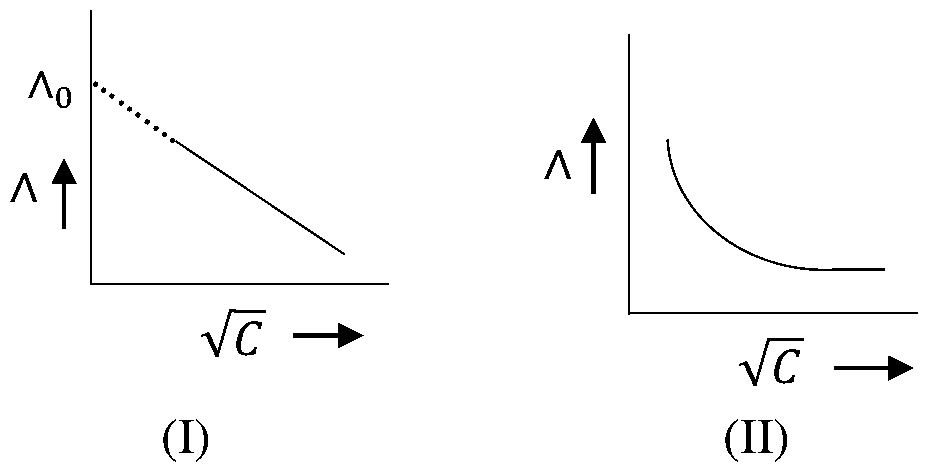
Plots of equivalent conductance (∧) vs square root of concentration (√C) of two electrolytes are given below, with ∧₀ being the equivalent conductance at infinite dilution:
Which one of the following statements is correct?
(a) Plot I is for weak electrolyte and plot II is for strong electrolyte(b) Extrapolation to ∧₀ as shown in plot I cannot be done(c) Extrapolation to ∧₀ in plot II cannot be done to get the correct ∧₀(d) Plots I and II are valid for any electrolyte for different range of concentrations
Answer and explanation with the VKC plan
Q75 Electrochemistry / conductance and dilution
Consider the following statements for an electrolyte solution which is diluted to approach infinite dilution:
Which one of the following is correct with respect to above statements?
(a) Both the statements I and II are true for strong electrolytes(b) Both the statements I and II are true for weak electrolytes(c) Statement I is true for weak electrolytes and statement II is true for strong electrolytes(d) Statement I is true for strong electrolytes and statement II is true for weak electrolytes
Answer and explanation with the VKC plan
Q76 Electrochemistry / Debye–Hückel theory
The value of log γ± in the Debye-Huckel limiting law for a 0.01m KCl solution in water at 25 °C is:
(a) – 0.1018(b) – 0.0509(c) + 0.1018(d) – 0.0254
Answer and explanation with the VKC plan
Q77 Electrochemistry / conductometric titrations
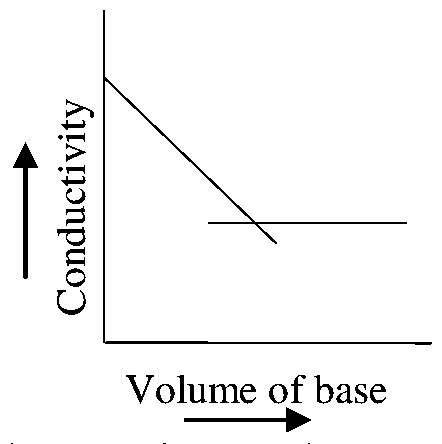
Consider the following plot:
The above plot indicates the conductometric titration between:
(a) Weak acid vs weak base(b) Strong acid vs weak base(c) Weak acid vs strong base(d) Strong acid vs strong base
Answer and explanation with the VKC plan
Q78 Electrochemistry / precipitation titration
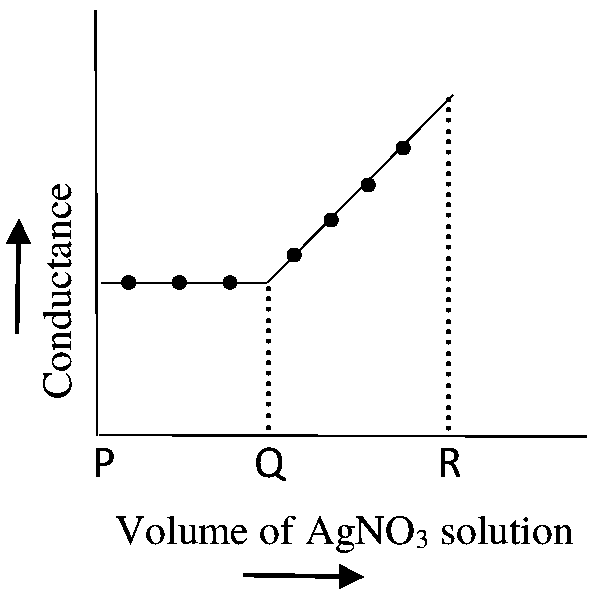
Consider the following plot for conductometric study of a reaction between KCl and AgNO₃ solutions:
Cause/s behind the constancy of conductance in the region PQ is/are due to:
(a) Precipitation of AgCl only(b) Replacement of Cl⁻ by NO₃⁻ with each species having equal conductance(c) Precipitation of AgCl and replacement of Cl⁻ by NO₃⁻(d) Inert behavior of the instrument in this region
Answer and explanation with the VKC plan
Q79 Electrochemistry / conductometric titrations
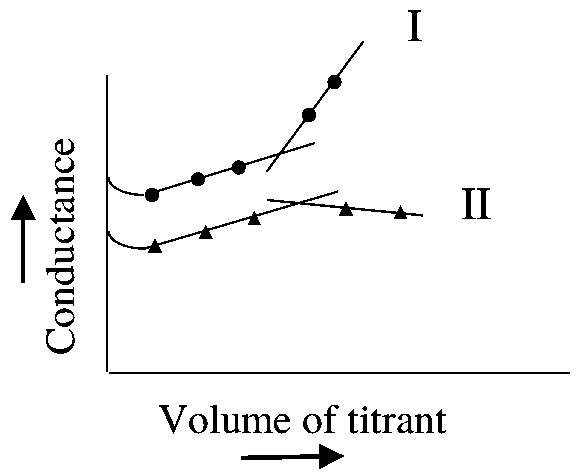
Consider the following plot for the conductometric titration:
Which one of the following is correct in respect of above plot?
(a) Plot I is for weak acid vs weak alkali; plot II is for weak acid vs strong alkali(b) Plot I is for strong acid vs strong alkali; plot II is for AgNO₃ solution vs NH₄Cl solution(c) Plot I is for AgNO₃ solution vs HCl; plot II is for AgNO₃ vs KCl(d) Plot I is for weak acid vs strong alkali; plot II is for weak acid vs weak alkali
Answer and explanation with the VKC plan
Q80 Electrochemistry / transport number
Two electrolytes AX and BX were chosen to determine transport number using moving boundary method. It is given that:
(a) The transport number of A⁺ can be determined if AX is used as principal electrolyte and BX as indicator electrolyte(b) The transport number of B⁺ can be determined if AX is used as indicator electrolyte and BX as principal electrolyte(c) The transport number of X⁻ can be determined if AX is used as indicator electrolyte and BX as principal electrolyte(d) The transport number of A⁺, B⁺ and X⁻ can be determined if AX is used as principal electrolyte and BX as indicator electrolyte
Answer and explanation with the VKC plan
Q81 Aromaticity / annulenes
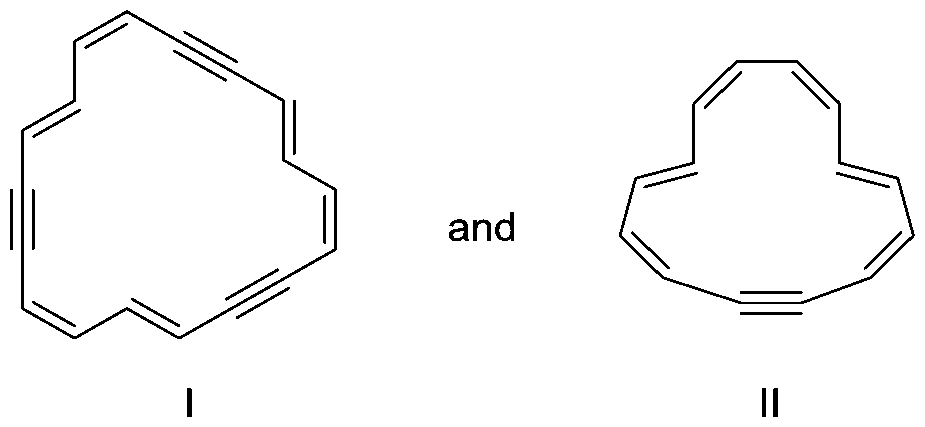
The total number of delocalized pi-electrons in compounds I and II are:
(a) 18 and 14 respectively(b) 24 and 16 respectively(c) 16 and 12 respectively(d) 22 and 14 respectively
Answer and explanation with the VKC plan
Q82 Resonance / relative stability of contributors
Rank the following structures in order of increasing contribution to the resonance hybrid:
(a) II < I < III(b) III < II < I(c) III < I < II(d) I < II < III
Answer and explanation with the VKC plan
Q83 Hybridisation / resonance
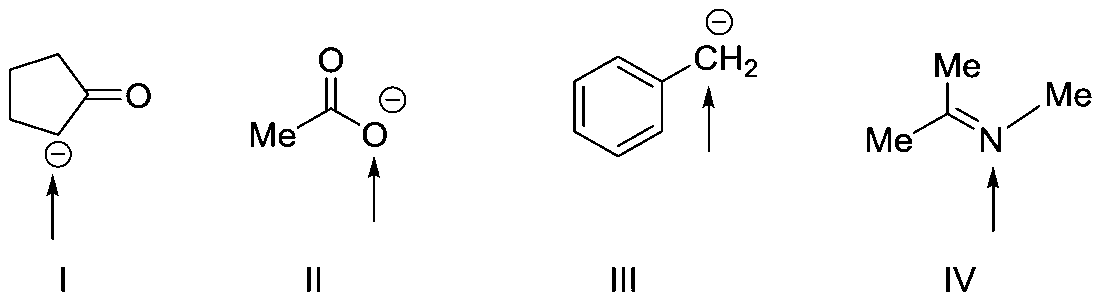
Which of the following indicated atoms in each species has sp²-hybridization?
(a) I and III only(b) I, III and IV only(c) II and IV only(d) I, II, III and IV
Answer and explanation with the VKC plan
Q84 Reactive intermediates / hyperconjugation
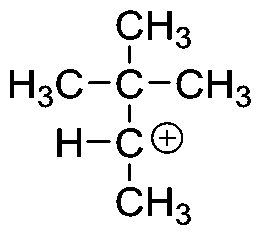
The total number of hyperconjugative structures possible for the following carbocation is:
(a) 3(b) 1(c) 4(d) 12
Answer and explanation with the VKC plan
Q85 Chemical bonding / molecular polarity
Which one of the following statements regarding polarity of bonds is NOT true?
(a) A compound with only one polar bond must be polar(b) A compound with two or more polar bonds will always be polar(c) A compound cannot be polar if it contains only nonpolar bonds(d) More electronegative atoms “pull” electron density towards them, making a dipole
Answer and explanation with the VKC plan
Q86 Heterocycles / basicity
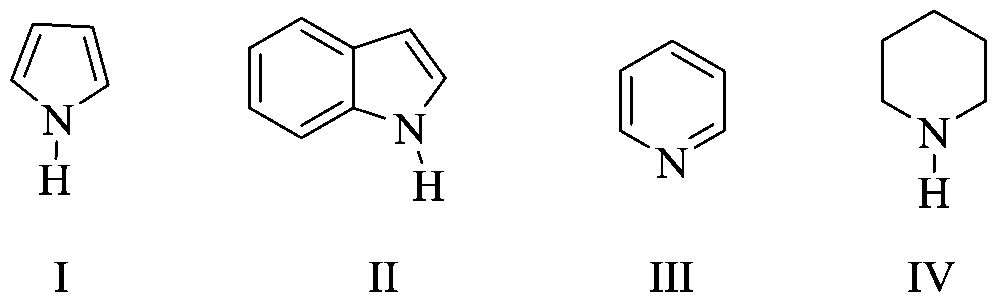
The correct order of the basicity of the following amines is:
(a) IV > III > II > I(b) III > IV > I > II(c) IV > III > I > II(d) III > IV > II > I
Answer and explanation with the VKC plan
Q87 Reactive intermediates / carbocation stability
The correct order of stability of the following carbocations is:
(a) II > IV > I > III(b) I > II > III > IV(c) II > I > IV > III(d) I > III > II > IV
Answer and explanation with the VKC plan
Q88 Dipole moment / substituted benzenes
Rank the following compounds in order of their decreasing dipole moment:
(a) III > II > IV > I(b) IV > III > I > II(c) II > IV > III > I(d) I > II > IV > III
Answer and explanation with the VKC plan
Q89 Stereochemistry / bicyclic compounds
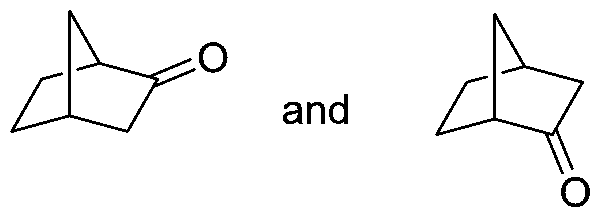
The relationship between the following pair of compounds is:
(a) Identical(b) Enantiomers(c) Diastereomers(d) Constitutional isomers
Answer and explanation with the VKC plan
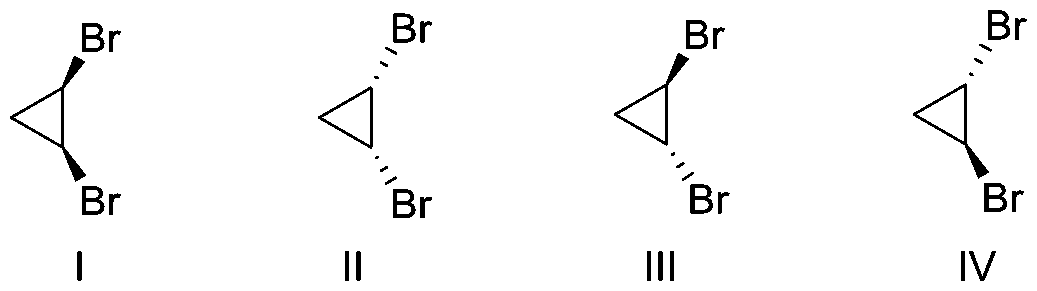
Q90 Stereochemistry / cyclopropanes
Consider the following set of compounds:
Which one of the following statements is NOT true about the above compounds (I–IV)?
(a) I and II represent same structures and are meso compounds(b) [I and III] and [I and IV] are diastereomers(c) III and IV are enantiomers(d) III and IV are diastereomers
Answer and explanation with the VKC plan
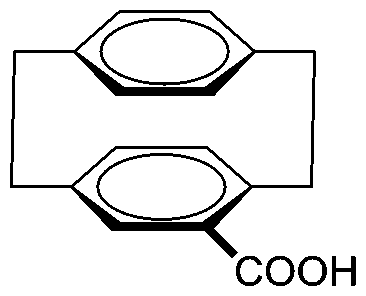
Q91 Stereochemistry / planar chirality
The correct statement about the following molecule is:
(a) Molecule is chiral and possesses a chiral plane(b) Molecule is chiral and possesses a chiral axis(c) Molecule is achiral and possesses a plane of symmetry(d) Molecule is achiral and possesses a centre of symmetry
Answer and explanation with the VKC plan
Q92 Stereochemistry / enantiomeric excess
A sample of lactic acid was found to have an enantiomeric excess (ee) of 14% with respect to R (+) isomer. What is the percentage of S (–) isomer in the sample?
(a) 86(b) 57(c) 43(d) 72
Answer and explanation with the VKC plan
Q93 Stereochemistry / optical rotation
In 2-butanol observed angle of rotation is 1.03°, concentration of sample is 1M and length of sample tube is 10 cm. Specific angle of rotation will be:
(a) 1.392°(b) 13.92°(c) 14.20°(d) 139.2°
Answer and explanation with the VKC plan
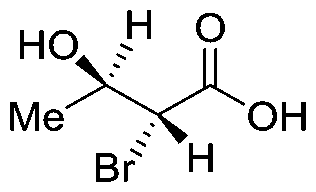
Q94 Stereochemistry / CIP R,S
The absolute configuration of C2 and C3 in the following compound is:
(a) 2R, 3S(b) 2S, 3R(c) 2S, 3S(d) 2R, 3R
Answer and explanation with the VKC plan
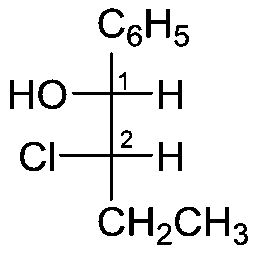
Q95 Stereochemistry / Fischer projection
The configuration of C1 and C2 carbons in the following molecule is:
(a) 1S, 2R(b) 1R, 2R(c) 1R, 2S(d) 1S, 2S
Answer and explanation with the VKC plan
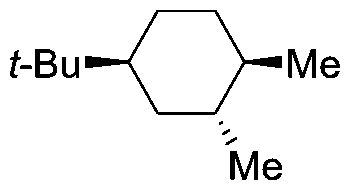
Q96 Conformational analysis / substituted cyclohexanes
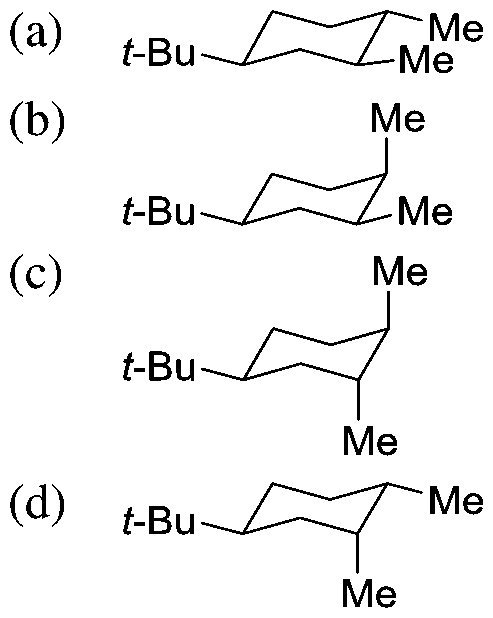
The most stable conformation of the following compound is:
(a) Chair with t-Bu equatorial and both Me equatorial(b) Chair with t-Bu equatorial, Me on the far ring carbon axial (up) and Me on the adjacent carbon equatorial(c) Chair with t-Bu equatorial and both Me axial (one up, one down)(d) Chair with t-Bu equatorial, Me on the far ring carbon equatorial and Me on the adjacent carbon axial (down)
Answer and explanation with the VKC plan
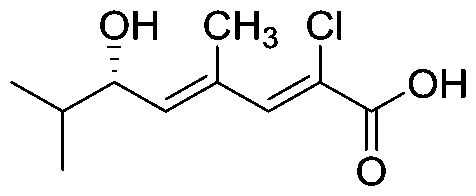
Q97 Stereochemistry / E,Z and R,S
The stereochemical notations for the following compound is:
(a) 2E, 4E, 6S(b) 2Z, 4E, 6S(c) 2Z, 4E, 6R(d) 2Z, 4Z, 6R
Answer and explanation with the VKC plan
Q98 Stereochemistry / geometrical isomerism
The total number of geometrical isomers for the following compound is:
(a) 4(b) 5(c) 6(d) 7
Answer and explanation with the VKC plan
Q99 Conformational analysis / ethane derivatives
The correct order of stability of Newman projections of 1, 2-dichloroethane is:
(a) anti > eclipsed > gauche(b) gauche > eclipsed > anti(c) gauche > anti > eclipsed(d) anti > gauche > eclipsed
Answer and explanation with the VKC plan
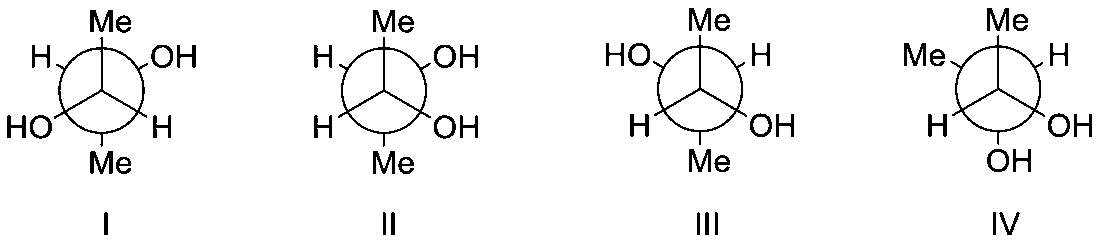
Q100 Stereochemistry / Newman projections
Among the following, the Newman projections for meso-2,3-butanediol are:
(a) I and II(b) I and III(c) III and IV(d) II and IV
Answer and explanation with the VKC plan
Q101 Alkynes / reduction
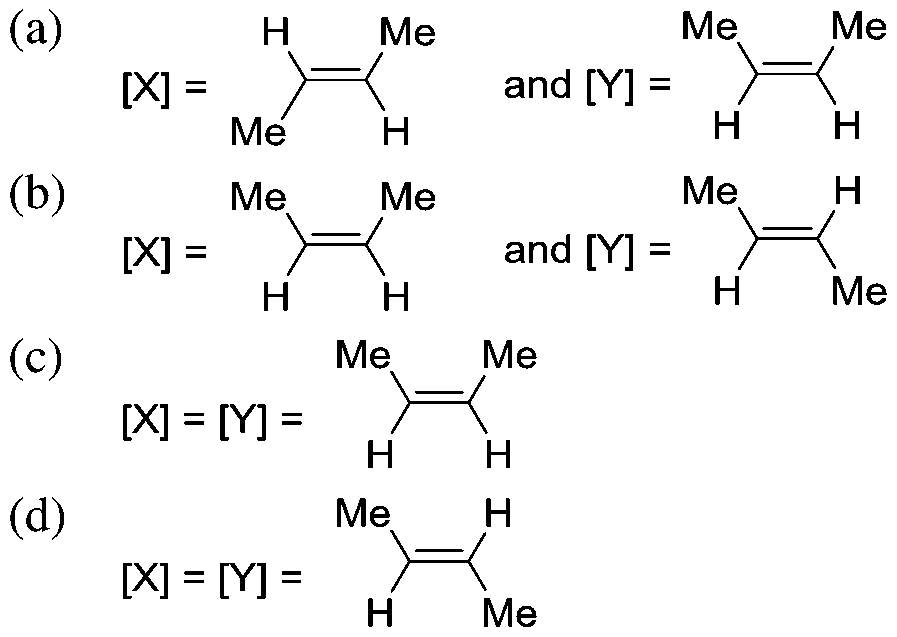
The major products [X] and [Y] formed in the following reactions are:
(a) [X] = trans-2-butene and [Y] = cis-2-butene(b) [X] = cis-2-butene and [Y] = trans-2-butene(c) [X] = [Y] = cis-2-butene(d) [X] = [Y] = trans-2-butene
Answer and explanation with the VKC plan
Q102 Nucleophilic substitution / SN2 rates
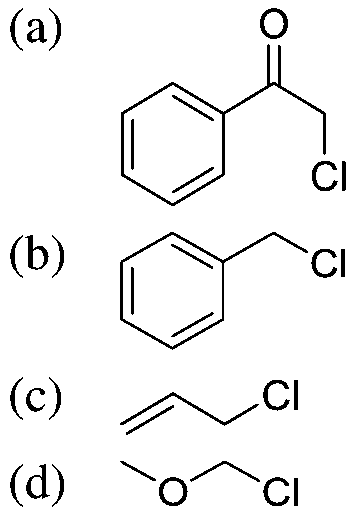
Which one of the following chlorides undergoes a fastest SN2 reaction with KI in acetone?
(a) PhCOCH₂Cl (phenacyl chloride)(b) PhCH₂Cl (benzyl chloride)(c) CH₂=CHCH₂Cl (allyl chloride)(d) CH₃OCH₂Cl (chloromethyl methyl ether)
Answer and explanation with the VKC plan
Q103 Alcohols / conversion to alkyl halides
Indicate the order of reactivity of HX in the following reaction:
(a) HI > HBr > HCl(b) HCl > HBr > HI(c) HBr > HI > HCl(d) HBr > HCl > HI
Answer and explanation with the VKC plan
Q104 Elimination / E2 stereochemistry
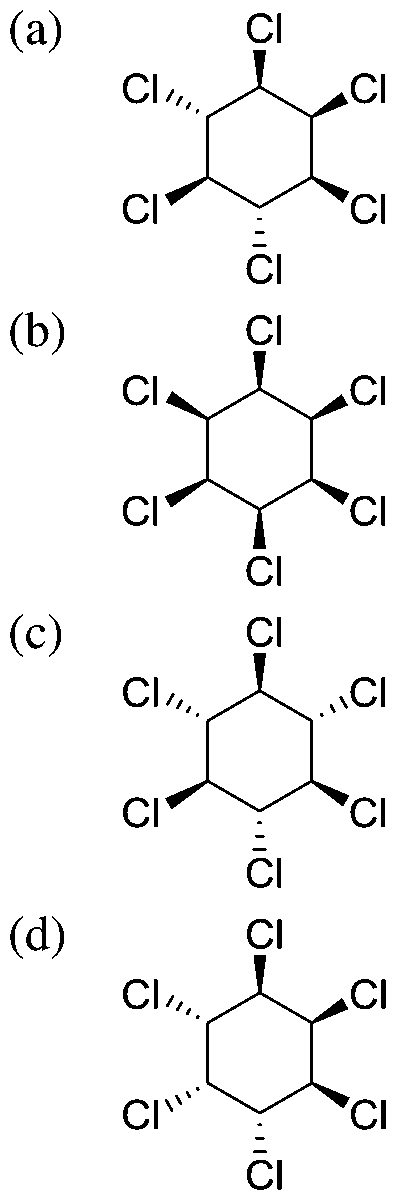
Which isomer of 1,2,3,4,5,6-hexachlorocyclohexane shown below undergoes E2 elimination (dehydrohalogenation) most slowly?
(a) Cl wedge/wedge/wedge/hash/wedge/hash around the ring(b) All six Cl on wedges (all-cis)(c) Cl alternating wedge/hash around the ring (all-trans, β-isomer)(d) Three adjacent Cl on wedges and three adjacent on hashes
Answer and explanation with the VKC plan
Q105 Elimination / E1cB mechanism
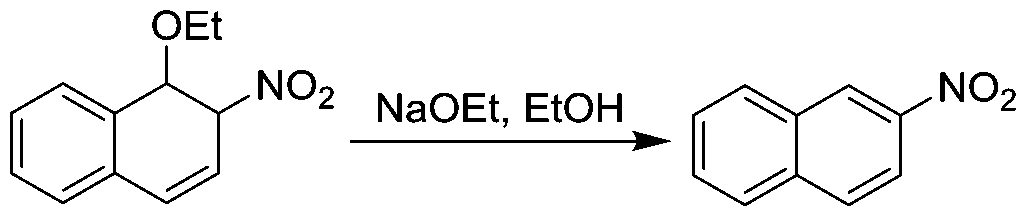
The following reaction is an example of:
(a) E2 elimination(b) E1 elimination(c) E1cb elimination(d) Syn elimination
Answer and explanation with the VKC plan
Q106 Elimination / alcohol dehydration
Which of the following statement is TRUE for the reaction mentioned below?
(a) I is major and it is called Hoffmann product(b) I is minor and it is called Zaitsev product(c) II is major and it is called Zaitsev product(d) II is minor and it is called Hoffmann product
Answer and explanation with the VKC plan
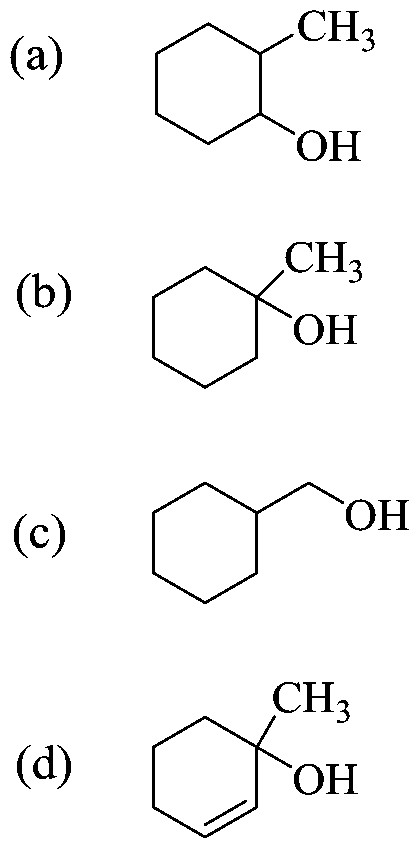
Q107 Alcohols / dehydration (E1)
Which one of the following alcohols dehydrates the fastest when heated with acid?
(a) 2-Methylcyclohexanol(b) 1-Methylcyclohexanol(c) Cyclohexylmethanol(d) 1-Methylcyclohex-2-en-1-ol
Answer and explanation with the VKC plan
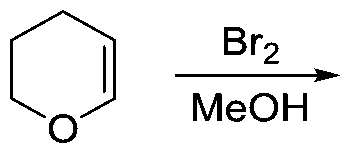
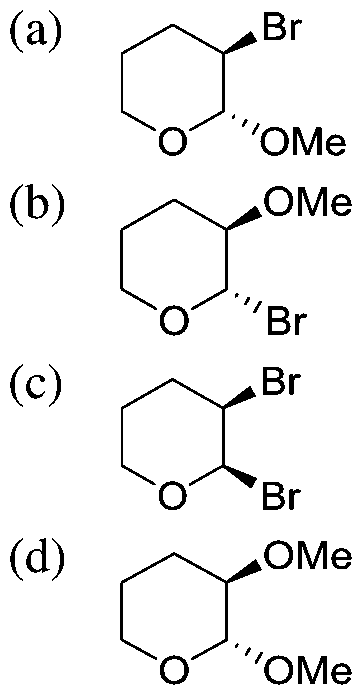
Q108 Alkenes / halohydrin-type addition
The major product formed in the following reaction is:
(a) trans-3-bromo-2-methoxytetrahydropyran (Br wedge, OMe hash)(b) trans-2-bromo-3-methoxytetrahydropyran(c) cis-2,3-dibromotetrahydropyran(d) trans-2,3-dimethoxytetrahydropyran
Answer and explanation with the VKC plan
Q109 Alkenes / electrophilic addition
Which one of the following alkenes will react most rapidly with concentrated sulphuric acid?
(a) H₂C=CH₂(b) (CH₃)₂C=CH₂(c) Cl₂C=CCl₂(d) F₃CCH=CHCH₃
Answer and explanation with the VKC plan
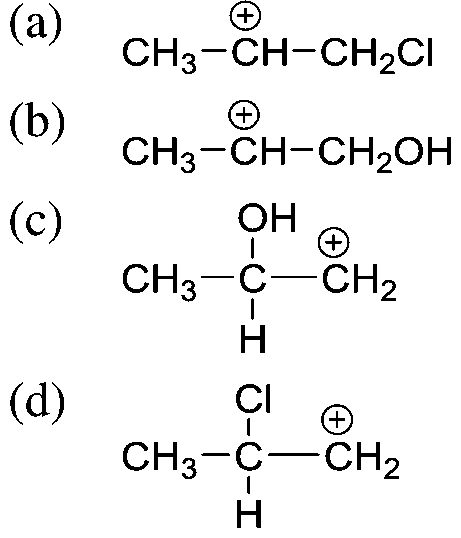
Q110 Alkenes / Markovnikov addition
The regioselective electrophilic addition of HOCl with propene proceeds through:
(a) \(CH_3-\overset{+}{C}H-CH_2Cl\) (b) \(CH_3-\overset{+}{C}H-CH_2OH\) (c) CH₃–CH(OH)–CH₂⁺(d) CH₃–CH(Cl)–CH₂⁺
Answer and explanation with the VKC plan
Q111 Aromatic compounds / reactions of anthracene
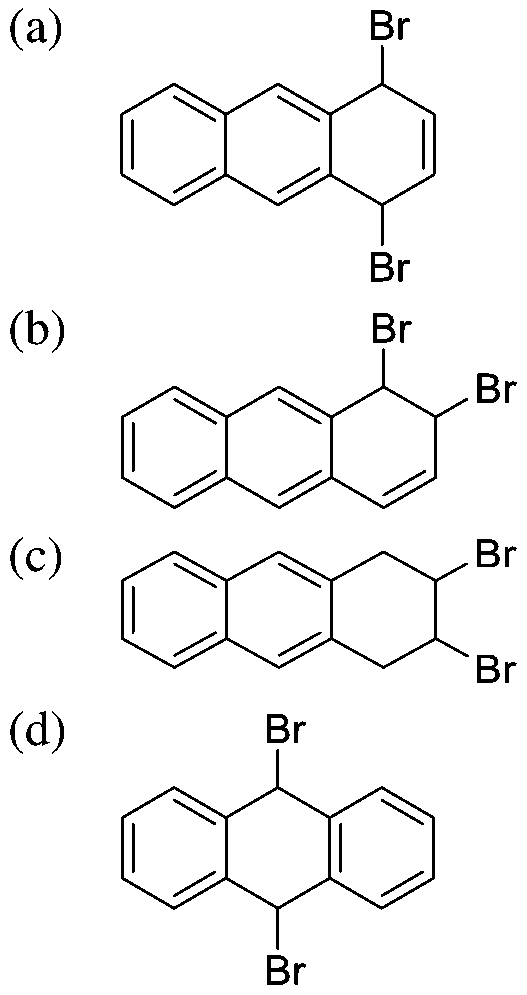
Which one of the following products is formed when bromine adds to anthracene?
(a) 1,4-Dibromo-1,4-dihydroanthracene(b) 1,2-Dibromo-1,2-dihydroanthracene(c) 2,3-Dibromo-1,2,3,4-tetrahydroanthracene(d) 9,10-Dibromo-9,10-dihydroanthracene
Answer and explanation with the VKC plan
Q112 Aromatic synthesis / directing effects
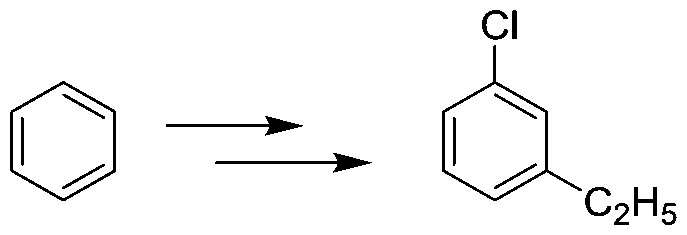
The correct sequence of reactions to accomplish the following transformation is:
(a) (i) CH₃CH₂Cl/AlCl₃, (ii) Cl₂/FeCl₃(b) (i) Cl₂/FeCl₃, (ii) CH₃CH₂Cl/AlCl₃(c) (i) CH₃COCl/AlCl₃, (ii) Cl₂/FeCl₃, (iii) Zn-Hg/HCl(d) (i) CH₃COCl/AlCl₃, (ii) Zn-Hg/HCl, (iii) Cl₂/FeCl₃
Answer and explanation with the VKC plan
Q113 Arynes / Diels–Alder reaction
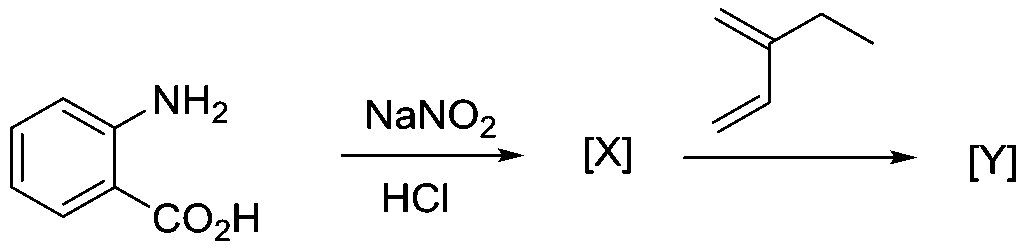
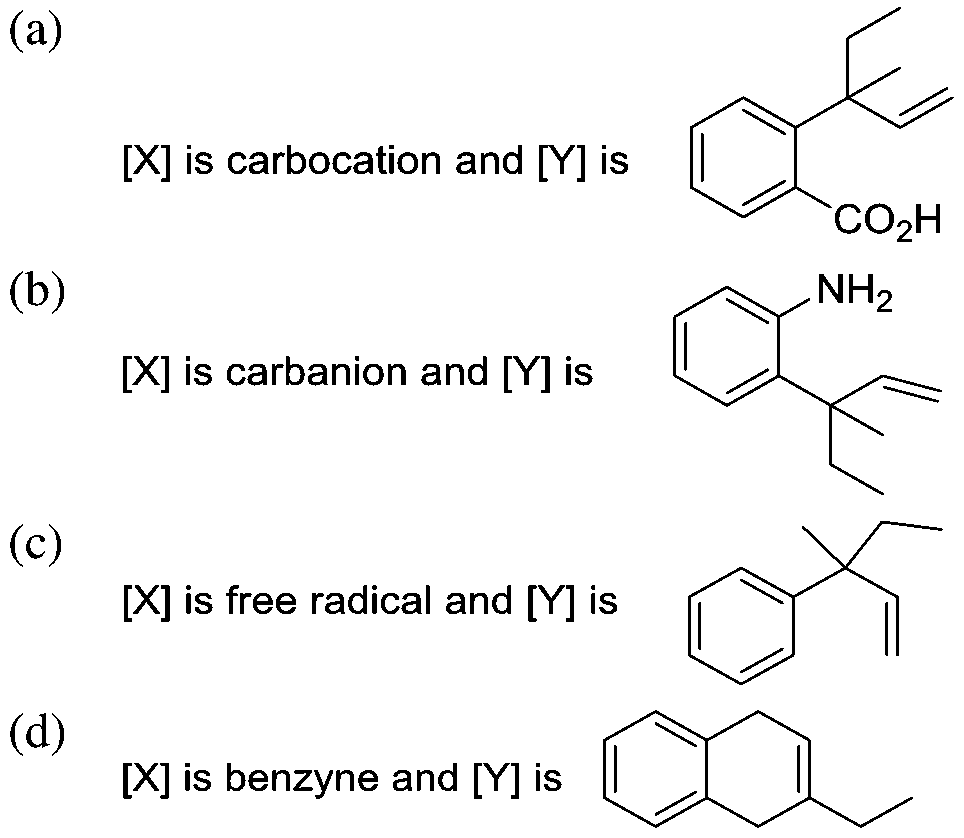
The intermediate [X] and the major product [Y] formed in the following reaction are:
(a) [X] is carbocation and [Y] is 2-(3-methylpent-1-en-3-yl)benzoic acid(b) [X] is carbanion and [Y] is 2-(3-methylpent-1-en-3-yl)aniline(c) [X] is free radical and [Y] is (3-methylpent-1-en-3-yl)benzene(d) [X] is benzyne and [Y] is 2-ethyl-1,4-dihydronaphthalene
Answer and explanation with the VKC plan
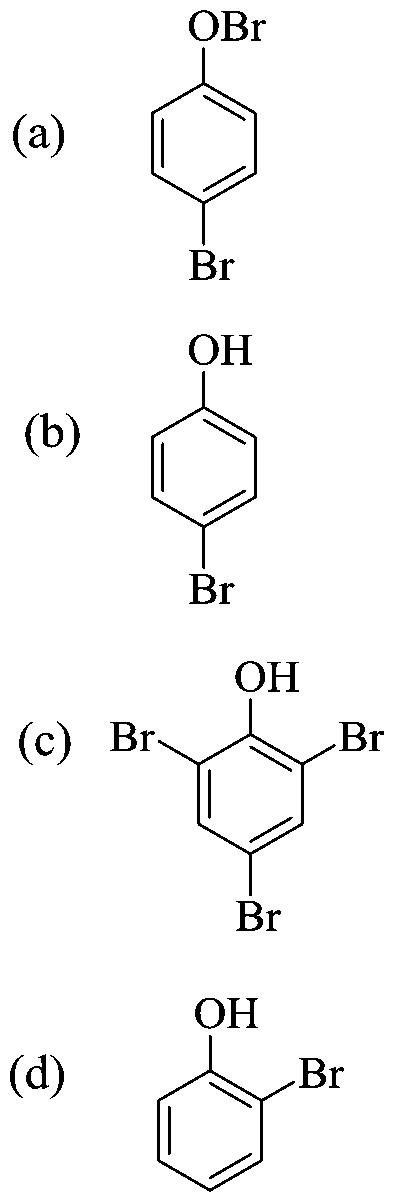
Q114 Phenols / electrophilic substitution
Which is the major product formed in the reaction of phenol with bromine in carbon disulfide at 0–5°C temperature?
(a) 4-Bromophenyl hypobromite (p-BrC₆H₄OBr)(b) 4-Bromophenol(c) 2,4,6-Tribromophenol(d) 2-Bromophenol
Answer and explanation with the VKC plan
Q115 Arynes / nucleophilic aromatic substitution
Which is the major product formed in the reaction of o-chloroanisole with NaNH₂ in liquid ammonia at low temperature?
(a) o-Anisidine(b) m-Anisidine(c) p-Anisidine(d) o-chloroaniline
Answer and explanation with the VKC plan
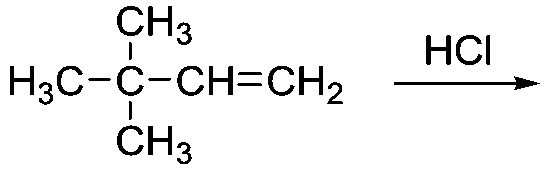
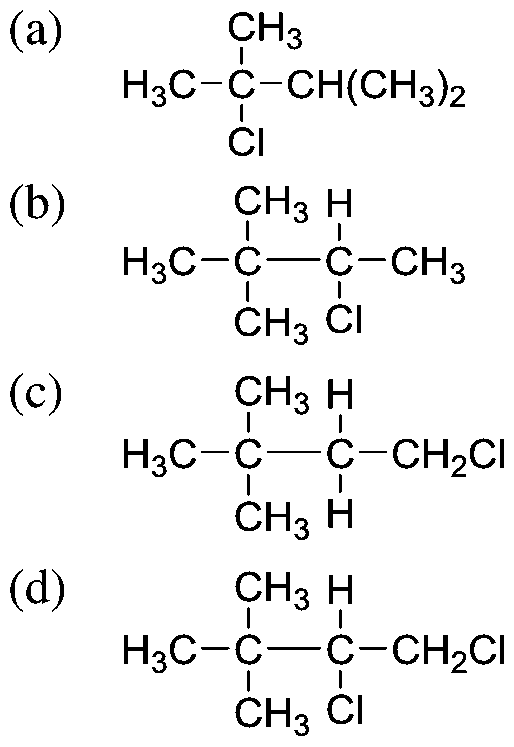
Q116 Alkenes / carbocation rearrangement
Predict the major product formed in the following reaction:
(a) (CH₃)₂C(Cl)–CH(CH₃)₂ (2-chloro-2,3-dimethylbutane)(b) (CH₃)₃C–CH(Cl)–CH₃ (3-chloro-2,2-dimethylbutane)(c) (CH₃)₃C–CH₂–CH₂Cl (1-chloro-3,3-dimethylbutane)(d) (CH₃)₃C–CH(Cl)–CH₂Cl (1,2-dichloro-3,3-dimethylbutane)
Answer and explanation with the VKC plan
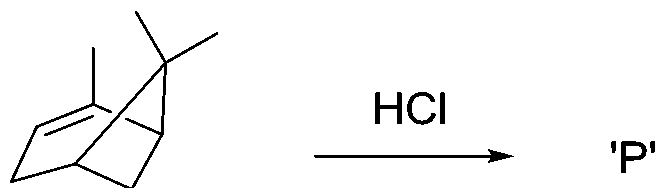
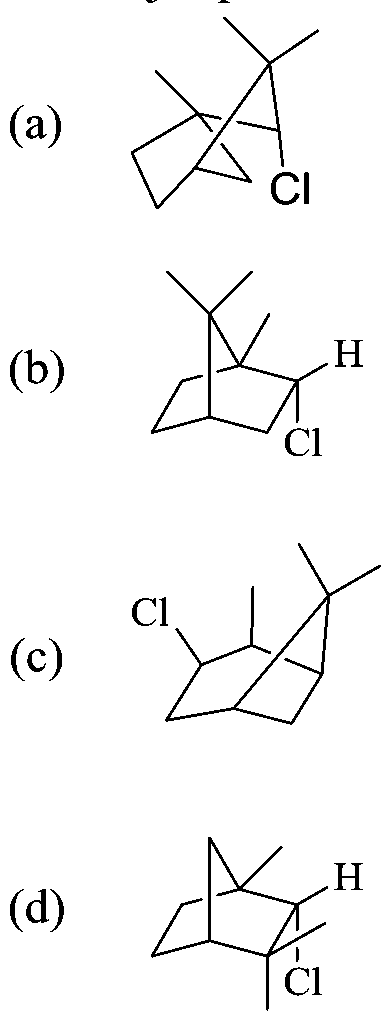
Q117 Rearrangements / Wagner–Meerwein (terpenes)
Consider the following reaction:
(a) Chloride that keeps the bridged cyclobutane (pinane-type) skeleton, Cl on the bridge carbon next to the gem-dimethyl carbon(b) Bornyl chloride (2-chloro-1,7,7-trimethylbicyclo[2.2.1]heptane)(c) Chloride that keeps the pinane skeleton, Cl on the ring carbon next to the methyl-bearing carbon(d) Bicyclo[2.2.1]heptyl chloride with a bridgehead methyl and Cl on a methyl-bearing (tertiary) ring carbon, unsubstituted C7 bridge
Answer and explanation with the VKC plan
Q118 Neighbouring group participation
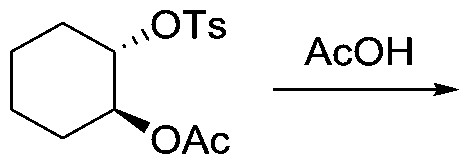
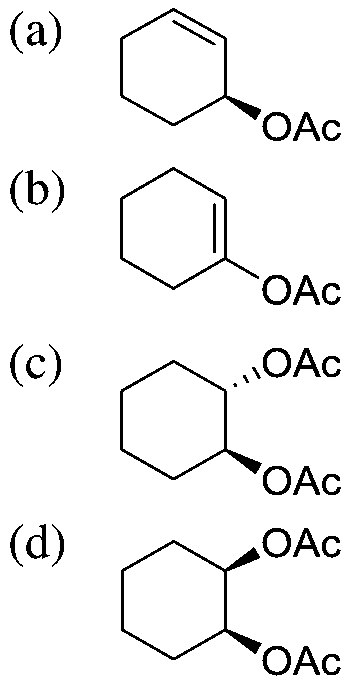
The major product formed in the following reaction is:
(a) Cyclohex-2-en-1-yl acetate(b) Cyclohex-1-en-1-yl acetate(c) trans-1,2-Diacetoxycyclohexane(d) cis-1,2-Diacetoxycyclohexane
Answer and explanation with the VKC plan
Q119 Neighbouring group participation
Which one of the following is NOT a characteristic of neighboring group participation effect?
(a) An unusual stereochemical result(b) An unexpectedly fast rate of reaction(c) Formation of a rearranged product(d) The extent of neighboring group participation increases with increasing the nucleophilicity of nucleophile in solvolysis reaction
Answer and explanation with the VKC plan
Q120 Neighbouring group participation / solvent effect
In which of the following solvents the neighboring group rate enhancement by phenyl group in the solvolysis of PhCH₂CH₂OTs is maximum?
(a) EtOH(b) HCOOH(c) CF₃COOH(d) CH₃COOH
Answer and explanation with the VKC plan