Prelims Paper II 2024 question paper Solutions UPSC Combined Geo-Scientist, Prelims · 2024 · Paper II, Chemistry
UPSC Geo-Scientist Prelims 2024 Chemistry (Paper II): answer key and solutions
All 120 questions of the 2024 Combined Geo-Scientist Prelims Paper II (chemistry), each with the answer and a short explanation in the hint-sheet style: the key fact first, numericals worked with units. Tap a number in the key to jump to the question; every question also has its own page.
Answer key 1 d 2 d 3 d 4 d 5 d 6 c 7 d 8 d 9 a 10 d 11 a 12 c 13 d 14 a 15 a 16 c 17 a 18 c 19 b 20 b 21 c 22 a 23 d 24 b 25 b 26 a 27 b 28 c 29 b 30 c 31 b 32 c 33 a 34 b 35 b 36 c 37 d 38 b 39 c 40 c 41 c 42 b 43 a 44 a 45 a 46 d 47 a 48 a 49 b 50 a 51 c 52 a 53 a 54 d 55 b 56 c 57 b 58 c 59 d 60 c 61 b 62 d 63 b 64 c 65 b 66 c 67 b 68 b 69 a 70 c 71 d 72 b 73 b 74 a 75 d 76 b 77 b 78 c 79 a 80 a 81 b 82 b 83 b 84 d 85 d 86 a 87 d 88 c 89 c 90 c 91 c 92 c 93 d 94 c 95 a 96 a 97 c 98 c 99 b 100 b 101 a 102 d 103 c 104 a 105 d 106 b 107 d 108 c 109 a 110 b 111 b 112 c 113 d 114 c 115 b 116 c 117 d 118 d 119 a 120 b Question paper: read or download the 2024 Paper II paper . Solutions are original work by VKC; question paper belongs to UPSC.
Q1 Atomic structure / quantum numbers
Which among the following principal quantum numbers has/have five degenerate d-orbitals?
(a) 2(b) 3 only(c) 4 only(d) Both 3 and 4
A d-subshell needs l = 2 , which is allowed only when n ≥ 3 (l = 0 to n − 1). n = 2 has only 2s and 2p. Both n = 3 (3d) and n = 4 (4d) have five d-orbitals (m_l = −2 to +2), degenerate in a free atom. → (d)
Read every answer and explanation of this paper with VKC Basic
VKC Basic (₹999 for 6 months) opens every solved answer, the notes, the handbook and the daily answer archive. Every Mains test series includes it.
See what is included Already a member? Sign in
Q2 Atomic structure / radial distribution
Which one of the following statements related to radial distribution plots for hydrogen atom is not correct?
(a) Most probable radius varies as 3s > 3p > 3d.(b) Most probable radius varies as 1s < 2s < 3s.(c) Most probable radius varies as 2p < 3p.(d) Most probable radius varies as 3s < 3p < 3d.
Answer and explanation with the VKC plan
Q3 Atomic structure / (n + l) rule
Which one of the following sets of quantum numbers represents the highest energy state?
(a) n = 4, l = 0, m_l = 0, m_s = +½(b) n = 3, l = 0, m_l = 0, m_s = −½(c) n = 3, l = 1, m_l = 1, m_s = +½(d) n = 3, l = 2, m_l = 1, m_s = −½
Answer and explanation with the VKC plan
Q4 Periodic table / metals and non-metals
Which one of the following groups of elements contains true metals only?
(a) Carbon, boron, silicon(b) Magnesium, aluminium, selenium(c) Boron, carbon, nitrogen(d) Sodium, thallium, bismuth
Answer and explanation with the VKC plan
Q5 f-block / lanthanides
The electronic configuration of an element A is [Xe]4f¹5d¹6s² and that of an element B is [Xe]4f³6s². The elements A and B are
(a) transition element and lanthanide, respectively(b) lanthanide and actinide, respectively(c) transition element and actinide, respectively(d) both lanthanides
Answer and explanation with the VKC plan
Q6 Periodic table / modern periodic law
The physical and chemical properties of elements are periodic functions of their
(a) atomic weight(b) atomic size(c) atomic number(d) atomic shape
Answer and explanation with the VKC plan
Q7 f-block / lanthanide contraction
Which one of the following represents the correct order of ionic radii among Y³⁺, La³⁺, Eu³⁺ and Lu³⁺?
(a) Y³⁺ < La³⁺ < Eu³⁺ < Lu³⁺(b) Lu³⁺ < Eu³⁺ < La³⁺ < Y³⁺(c) Eu³⁺ < La³⁺ < Lu³⁺ < Y³⁺(d) Lu³⁺ < Y³⁺ < Eu³⁺ < La³⁺
Answer and explanation with the VKC plan
Q8 Atomic structure / Slater's rules
Using Slater's rule, the effective nuclear charge experienced by 3d-electron in titanium (atomic number 22) is
(a) 22·0(b) 7·53(c) 5·14(d) 3·65
Answer and explanation with the VKC plan
Q9 p-block / catenation
Atomic size of nitrogen is less than carbon atom, yet carbon shows maximum catenation property while nitrogen does not. The reason for this is
(a) lone pair-lone pair repulsions in N—N single bond make the bond weaker to allow catenation(b) catenation is not dependent on atomic size(c) carbon has poor multiple bonds formation ability(d) nitrogen exists as an inert gas and therefore does not react
Answer and explanation with the VKC plan
Q10 Periodic properties / ionisation energy, electron affinity
Consider the following statements :
Sulfur has a higher ionization energy than phosphorus. Sulfur has a lower ionization energy than phosphorus. Sulfur has a lower electron affinity than chlorine. Which of the statements given above is/are correct?
(a) 1 only(b) 2 only(c) 1 and 3(d) 2 and 3
Answer and explanation with the VKC plan
Q11 Chemical bonding / bond angle (VSEPR)
Which one of the following represents the correct order of bond angle among H₂O, H₂Te, H₂Se and H₂S?
(a) H₂O > H₂S > H₂Se > H₂Te(b) H₂S > H₂Se > H₂O > H₂Te(c) H₂O > H₂Se > H₂S > H₂Te(d) H₂Te > H₂O > H₂S > H₂Se
Answer and explanation with the VKC plan
Q12 Periodic properties / metallic character, oxides
Consider the following statements :
On moving from left to right in the periodic table, the metallic character of elements decreases. On moving from left to right in the periodic table, the oxides of elements become less basic. Which of the statements given above is/are correct?
(a) 1 only(b) 2 only(c) Both 1 and 2(d) Neither 1 nor 2
Answer and explanation with the VKC plan
Q13 p-block / carbon allotropy
Carbon is able to show allotropic forms due to
(a) its smaller size(b) its higher electronegativity(c) its higher ionization enthalpy and unavailability of d-orbitals(d) catenation and pπ—pπ bond formation
Answer and explanation with the VKC plan
Q14 Atomic structure / electronic configuration
A neutral atom of an element has two K, eight L and five M electrons. What will be the total number of p-electrons in the element?
(a) 9(b) 8(c) 7(d) 6
Answer and explanation with the VKC plan
Q15 Ionic equilibrium / buffers, salt hydrolysis
Consider the following statements :
Statement–1 : An aqueous solution of NaH₂PO₄ is acidic and that of Na₂HPO₄ is basic in nature. Statement–2 : An equimolar mixture of NaH₂PO₄ and Na₂HPO₄ acts as a buffer. Which one of the following is correct with respect to the above statements?
(a) Both Statement–1 and Statement–2 are true and Statement–1 is not the correct explanation of Statement–2(b) Both Statement–1 and Statement–2 are true and Statement–1 is the correct explanation of Statement–2(c) Statement–1 is true but Statement–2 is false(d) Statement–1 is false but Statement–2 is true
Answer and explanation with the VKC plan
Q16 Chemical bonding / resonance, delocalisation
In SO₃, one p-orbital and two d-orbitals are used in S=O π-bond formation. However, all S=O bond lengths are identical. This is due to
(a) involvement of equivalent hybrid orbitals in π-bonding(b) considerable polarity in bonds(c) delocalization of π-bonds in the molecule(d) ionic covalent resonance in the molecule
Answer and explanation with the VKC plan
Q17 Chemical bonding / VSEPR, Lewis basicity
Consider the following statements regarding NF₃ :
NF₃ has bond angle value much lower than tetrahedral bond angle. NF₃ is a good Lewis base. Which of the statements given above is/are correct?
(a) 1 only(b) 2 only(c) Both 1 and 2(d) Neither 1 nor 2
Answer and explanation with the VKC plan
Q18 p-block / boron hydrides
Which one of the following reactions is not possible between diborane and ammonia?
(a) B₂H₆ + NH₃ (Excess) —(Low T)→ B₂H₆·2NH₃(b) B₂H₆ + NH₃ (Excess) —(High T)→ (BN)ₓ(c) B₂H₆ + 2NH₃ —(RT, Aqueous medium)→ B₄H₁₀ + N₂ + 4H₂(d) B₂H₆ + 2NH₃ —(High T)→ B₃N₃H₆
Answer and explanation with the VKC plan
Q19 Solid state / radius ratio, covalency
For ZnS, a radius ratio (r_{Zn²⁺}/r_{S²⁻}) of 0·52 suggests a coordination number, of 6 for both cation and anion. However, in reality, ZnS adopts a coordination number of 4 : 4. This is because
(a) ZnS is a true covalent compound(b) ZnS is an ionic compound with considerable covalency(c) Zn²⁺ is too small to occupy octahedral holes(d) S²⁻ ions are too large to provide higher coordination number to Zn²⁺
Answer and explanation with the VKC plan
Q20 Ionic solids / Born–Haber cycle
Theoretically calculated lattice energy (using Born-Landé equation) of hypothetical molecule NaCl₂ is –2180 kJ/mol while that of NaCl is –755 kJ/mol. (Both the molecules are assumed to be formed from elements in their standard states.) Yet NaCl is a stable molecule while NaCl₂ does not exist. The reason for this is
(a) dissociation energy of Cl₂ molecule is too high(b) second ionization energy of Na metal is too high(c) electron affinity of Cl atom is too low(d) Born-Landé equation cannot predict the correct lattice energy of these molecules
Answer and explanation with the VKC plan
Q21 Ionic solids / solubility
The solubility of an ionic compound in a solvent depends on
(a) lattice enthalpy only(b) solvation enthalpy only(c) lattice enthalpy and solvation enthalpy both(d) ionization enthalpy of metal
Answer and explanation with the VKC plan
Q22 Solid state / point defects
Consider the following statements regarding Frenkel defect in solids :
Statement–1 : Compounds having Frenkel defects have some covalent character. Statement–2 : Compounds having Frenkel defects have small positive ions and large negative ions, where small positive ions are highly polarizing and large negative ions are readily polarized. Which one of the following is correct with respect to the above statements?
(a) Both Statement–1 and Statement–2 are true and Statement–2 is the correct explanation of Statement–1(b) Both Statement–1 and Statement–2 are true and Statement–2 is not the correct explanation of Statement–1(c) Statement–1 is true but Statement–2 is false(d) Statement–1 is false but Statement–2 is true
Answer and explanation with the VKC plan
Q23 Main-group stereochemistry / Berry pseudorotation
Two types of F atoms in (CH₃)PF₄ are indistinguishable while in (CH₃)₂PF₃, equatorially placed F atom is distinguishable from apical F atom with the help of ¹⁹F NMR spectroscopy. The reason for the same is
(a) (CH₃)PF₄ has a square pyramidal geometry while (CH₃)₂PF₃ has a trigonal bipyramidal geometry(b) (CH₃)PF₄ has all equivalent hybrid orbitals but (CH₃)₂PF₃ has non-equivalent hybrid orbitals(c) inductive effect of methyl groups is higher in (CH₃)₂PF₃ than in (CH₃)PF₄(d) two methyl groups pose higher rigidity in the molecule to allow pseudorotation in (CH₃)₂PF₃
Answer and explanation with the VKC plan
Q24 Chemical bonding / Coulson's hybridisation
The bond angle in H₂O molecule is 104·5°. The p-character in non-bonding set of orbitals will be [where cos (104·5°) = −0·25]
(a) 20%(b) 70%(c) 75%(d) 80%
Answer and explanation with the VKC plan
Q25 Chemical bonding / valence bond theory
The wave function\(\Psi = \Psi_{cov} + \lambda\Psi_{H^+H^-} + \lambda\Psi_{H^-H^+}\)
(a) vibration(b) resonance(c) conjugation(d) orbital
Answer and explanation with the VKC plan
Q26 Coordination chemistry / Werner's theory
Werner confirmed the presence of primary and secondary valencies in the coordination compounds CoCl₃·6NH₃, CoCl₃·5NH₃ and CoCl₃·4NH₃ by
(a) treating cold aqueous solutions of cobalt complexes with excess of silver nitrate solution(b) treating cold aqueous solutions of cobalt complexes with excess of barium nitrate solution(c) treating cold aqueous solutions of cobalt complexes with excess of barium chloride solution(d) treating cold aqueous solutions of cobalt complexes with excess of sodium nitrate solution
Answer and explanation with the VKC plan
Q27 Coordination chemistry / chelate effect
Which one among the following chelate rings will be more stable?
(a) Four-membered chelate ring(b) Five-membered chelate ring(c) Six-membered chelate ring(d) Seven-membered chelate ring
Answer and explanation with the VKC plan
Q28 Coordination chemistry / IUPAC nomenclature
Which one of the following is the correct IUPAC name of Li[AlH₄]?
(a) Lithium aluminium hydride(b) Lithium aluminium tetrahydride(c) Lithium tetrahydridoaluminate(III)(d) Lithium tetrahydroaluminate(III)
Answer and explanation with the VKC plan
Q29 Coordination chemistry / geometrical isomerism
Consider the following reaction :
How many isomers of the product complex are possible for the above reaction?
(a) 1(b) 2(c) 3(d) 5
Answer and explanation with the VKC plan
Q30 Coordination chemistry / EAN rule
The effective atomic number of K₄[Fe(CN)₆] complex is
(a) 34(b) 35(c) 36(d) 38
Answer and explanation with the VKC plan
Q31 Coordination chemistry / formula from name
The formula for the coordination compound amminediaquachlorido-platinum(IV) tetrachloridoplatinate(II) is
(a) [PtCl(NH₃)(H₂O)₂][PtCl₄](b) [PtCl(NH₃)(H₂O)₂]₂[PtCl₄]₃(c) [PtCl(NH₃)(H₂O)₂]₃[PtCl₄]₂(d) [PtCl(NH₃)(H₂O)₂]₂[PtCl₄]
Answer and explanation with the VKC plan
Q32 Stoichiometry / titration
How many millilitres of 0·25 M solution of H₂SO₄ will react with 10 mL of 0·25 M solution of NaOH?
(a) 1 mL(b) 2·5 mL(c) 5 mL(d) 10 mL
Answer and explanation with the VKC plan
Q33 p-block / acidic oxides
Which one of the following represents the correct order of acidity among CO₂, SO₂ and SO₃?
(a) SO₃ > SO₂ > CO₂(b) SO₂ > SO₃ > CO₂(c) SO₂ > CO₂ > SO₃(d) CO₂ > SO₂ > SO₃
Answer and explanation with the VKC plan
Q34 Ionic equilibrium / Ostwald's dilution law
Which of the following statements regarding Ostwald's dilution law is/are not correct? (Where α = degree of dissociation, k = equilibrium constant for dissociation, c = concentration of solution)
Activity coefficients are taken as unity. Ostwald's law is valid for strong electrolytes. One may conclude \(\alpha = \sqrt{\frac{k}{c}}\) . Select the correct answer using the code given below.
(a) 1 only(b) 2 only(c) 1 and 3(d) 2 and 3
Answer and explanation with the VKC plan
Q35 Ionic equilibrium / ionic product of water
Which one of the following statements is correct?
(a) Water is strong electrolyte.(b) The value of ionic product of water varies with temperature.(c) The concentrations of H⁺ and OH⁻ in 10⁻⁵ M HCl solution are same.(d) The ionization constant and ionic product of water are same.
Answer and explanation with the VKC plan
Q36 Ionic equilibrium / Henderson equation
The pH of a buffer solution containing 6·0 mL of CH₃COOH (0·2 M) and 4·0 mL of CH₃COONa (0·2 M) solutions will be approximately [where pK_a (CH₃COOH) = 4·76; log 2 = 0·30, log 3 = 0·48]
(a) 6·0(b) 5·13(c) 4·58(d) 2·46
Answer and explanation with the VKC plan
Q37 Ionic equilibrium / salt hydrolysis
Which one of the following does not represent a correct expression for hydrolysis constant for the equilibrium reaction A⁻ + H₂O ⇌ OH⁻ + HA ?
(a) K_h = [OH⁻][HA]/[A⁻](b) pK_h = pK_w − pK_a(c) K_h = K_w/K_a(d) K_h = [OH⁻][HA]
Answer and explanation with the VKC plan
Q38 Analytical chemistry / primary standards
Which one among the following compounds does not form primary standard solution?
(a) Na₂CO₃(b) NaOH(c) ZnO(d) Potassium hydrogen phthalate
Answer and explanation with the VKC plan
Q39 Analytical chemistry / redox titration
While performing the titration of KMnO₄ with clear Mohr's salt solution, a student obtained brown precipitate in the conical flask instead of a colourless solution, much before the end point was reached. What could be the possible source of error?
(a) Reaction mixture was not heated to 60 °C(b) Fe²⁺ in the Mohr's salt solution hydrolyzed to precipitate brown hydroxide(c) Reaction medium was not made acidic(d) Too large quantity of KMnO₄ had been added to the Mohr's salt solution
Answer and explanation with the VKC plan
Q40 Analytical chemistry / complexometry
In which one of the following titrations are metal-ion indicators used?
(a) Acid-base titration(b) Precipitation titration(c) Complexometric titration(d) Redox titration
Answer and explanation with the VKC plan
Q41 Gaseous state / kinetic theory
The total kinetic energy of 2 moles of an ideal gas at 300 K is approximately (where R = 8·3 JK⁻¹ mol⁻¹)
(a) 1·25 × 10⁻²⁰ J(b) 6·3 × 10⁻²¹ J(c) 7·5 × 10³ J(d) 1·9 × 10³ J
Answer and explanation with the VKC plan
Q42 Gaseous state / kinetic theory
The root mean square velocity of one mole of a monatomic gas having molar mass M is u_rms. The relation between u_rms and the average kinetic energy E of the gas is
(a) \(u_{rms} = \sqrt{\frac{E}{3M}}\) (b) \(u_{rms} = \sqrt{\frac{2E}{M}}\) (c) \(u_{rms} = \sqrt{\frac{E}{2M}}\) (d) \(u_{rms} = \sqrt{\frac{3E}{2M}}\)
Answer and explanation with the VKC plan
Q43 Gaseous state / kinetic theory
Consider the following statements regarding kinetic energy of a gas :
Statement–1 : At 25 °C, the average kinetic energy of hydrogen gas molecules is the same as that of helium gas atoms. Statement–2 : The kinetic energy of a gas depends on the temperature and does not depend on the nature of the gas. Which one of the following is correct with respect to the above statements?
(a) Both Statement–1 and Statement–2 are true and Statement–2 is the correct explanation of Statement–1(b) Both Statement–1 and Statement–2 are true and Statement–2 is not the correct explanation of Statement–1(c) Statement–1 is true but Statement–2 is false(d) Statement–1 is false but Statement–2 is true
Answer and explanation with the VKC plan
Q44 Gaseous state / van der Waals constants
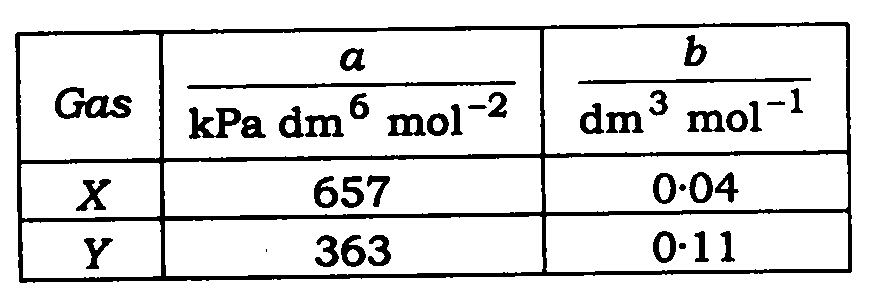
Consider the following van der Waals' constant values of two gases X and Y :
Which one of the following is correct with respect to the van der Waals' constant values of X and Y in the table given above?
(a) X is more easily liquefied than Y(b) Y is more easily liquefied than X(c) Ease of liquefaction does not depend upon the van der Waals' constant a(d) Ease of liquefaction does not depend upon the van der Waals' constant b
Answer and explanation with the VKC plan
Q45 Gaseous state / Maxwell distribution
Consider the following statements regarding speed distribution of molecules :
The total area under the plots of \(\left(\frac{1}{N}\right)\left(\frac{dN_u}{du}\right)\) versus u is a measure of the total number of molecules in the collection. The curve at any temperature is parabolic near the origin. The majority of molecules have speeds which cluster around the average value ū in the distribution curve. Which of the statements given above is/are correct?
(a) 1 and 2(b) 1 and 3(c) 2 and 3(d) 3 only
Answer and explanation with the VKC plan
Q46 Gaseous state / mean free path
At constant volume, the mean free path of a gas is
(a) directly proportional to temperature only(b) inversely proportional to pressure(c) directly proportional to both temperature and pressure(d) independent of temperature and pressure
Answer and explanation with the VKC plan
Q47 Gaseous state / Graham's law
Hydrogen molecule (H₂) with molar mass 2 g mol⁻¹ effuses through a small hole at a temperature of 300 K and pressure of 5 torr. Under the same conditions, methane (CH₄) with molar mass 16 g mol⁻¹ is also allowed to effuse. The ratio of the rate of effusion of hydrogen (r_{H₂}) and methane (r_{CH₄}) is
(a) 2·828 : 1(b) 1 : 2·828(c) 1 : 8(d) 8 : 1
Answer and explanation with the VKC plan
Q48 Thermodynamics / adiabatic work
The work involved in a reversible adiabatic expansion of an ideal gas from p_i and V_i to p_f and V_f is given by
\(w = \frac{p_f V_f - p_i V_i}{\gamma - 1}\) \(w = -nC_{v,m}T_i\left[1-\left(\frac{p_f}{p_i}\right)^{\frac{R}{C_{p,m}}}\right]\) \(w = \frac{p_f V_f - p_i V_i}{1-\gamma}\) \(w = nC_{p,m}T_i\left[1-\left(\frac{p_f}{p_i}\right)^{\frac{R}{C_{p,m}}}\right]\) Select the correct answer using the code given below.
(a) 1 and 2 only(b) 1, 2 and 3 only(c) 3 and 4 only(d) 1, 2, 3 and 4
Answer and explanation with the VKC plan
Q49 Thermodynamics / intensive and extensive properties
Consider the following variables :
Dielectric constant Surface tension Energy Enthalpy Which one of the following regarding classification of variables is correct?
(a) 1 and 3 are intensive variables; 2 and 4 are extensive variables(b) 1 and 2 are intensive variables; 3 and 4 are extensive variables(c) 1 and 4 are intensive variables; 2 and 3 are extensive variables(d) 2 and 3 are intensive variables; 1 and 4 are extensive variables
Answer and explanation with the VKC plan
Q50 Thermodynamics / state functions
Consider the following statements regarding compressibility factor (Z) :
Statement–1 : If a system at state A is converted to state B by two methods (reversible compression and irreversible compression), then the change in internal energy of the system is the same in both the processes. Statement–2 : Change in internal energy is a state function. Which one of the following is correct with respect to the above statements?
(a) Both Statement–1 and Statement–2 are true and Statement–2 is the correct explanation of Statement–1(b) Both Statement–1 and Statement–2 are true and Statement–2 is not the correct explanation of Statement–1(c) Statement–1 is true but Statement–2 is false(d) Statement–1 is false but Statement–2 is true
Answer and explanation with the VKC plan
Q51 Thermodynamics / internal energy
A 0·04 mole sample of a monatomic gas at 1·00 atm pressure and 298 K expands isothermally and reversibly from an initial volume of 1·0 L to 10·0 L. It is then heated to 500 K, followed by isothermal compression to 1·00 L and finally cooled to 25 °C. The ΔU for the overall process is
(a) 228 J(b) −228 J(c) zero(d) 456 J
Answer and explanation with the VKC plan
Q52 Thermodynamics / Joule–Thomson effect
Consider the following statements :
Statement–1 : The temperature of a perfect gas is unchanged by Joule-Thomson expansion. Statement–2 : For a perfect gas, Joule-Thomson coefficient (μ) is zero. Which one of the following is correct with respect to the above statements?
(a) Both Statement–1 and Statement–2 are true and Statement–2 is the correct explanation of Statement–1(b) Both Statement–1 and Statement–2 are true and Statement–2 is not the correct explanation of Statement–1(c) Statement–1 is true but Statement–2 is false(d) Statement–1 is false but Statement–2 is true
Answer and explanation with the VKC plan
Q53 Thermodynamics / free expansion
In a free expansion process
(a) the work done is zero and the heat transfer is zero(b) the work done is zero but the heat flows into the system(c) work is done by the system but the heat transfer is zero(d) work is done on the system and the heat flows out of the system
Answer and explanation with the VKC plan
Q54 Thermochemistry / Hess's law
Consider the following hypothetical reactions :
(a) (a + b) kJ mol⁻¹(b) a kJ mol⁻¹(c) b kJ mol⁻¹(d) (a − b) kJ mol⁻¹
Answer and explanation with the VKC plan
Q55 Thermodynamics / Carnot efficiency
The maximum efficiency of an engine operating between 127 °C and 27 °C is
(a) 78·7%(b) 25%(c) 21·25%(d) 75%
Answer and explanation with the VKC plan
Q56 Thermodynamics / Gibbs energy
Consider the following reaction :
(a) 0·2 kJ(b) −532 kJ(c) −226 kJ(d) −49 kJ
Answer and explanation with the VKC plan
Q57 Thermodynamics / spontaneity
Consider the following statements regarding change of enthalpy (ΔH) and change of entropy (ΔS) for a chemical reaction at any temperature T :
If ΔH is negative and ΔS is positive, the reaction will be spontaneous at all temperatures. If ΔH is positive and ΔS is negative, the reaction will be spontaneous at low temperatures. When both ΔH and ΔS are positive, the reaction will proceed spontaneously at high temperatures. Which of the statements given above is/are correct?
(a) 1 and 2(b) 1 and 3(c) 2 and 3(d) 2 only
Answer and explanation with the VKC plan
Q58 Thermodynamics / spontaneity
Consider the following reactions :
H₂ (g) + ½O₂ (g) → H₂O (l); Δ_rH = −285·8 kJ mol⁻¹ ½N₂ (g) + O₂ (g) → NO₂ (g); Δ_rH = +33·2 kJ mol⁻¹ Which one of the following is correct with respect to the above reactions?
(a) Reaction 1 is endothermic and non-spontaneous at all temperatures(b) Reaction 2 is exothermic and spontaneous at all temperatures(c) Reaction 2 is endothermic and non-spontaneous at all temperatures(d) Reaction 1 is exothermic and spontaneous at all temperatures
Answer and explanation with the VKC plan
Q59 Solutions / abnormal colligative properties
The experimental results of colligative properties of solutions are often found to differ from the calculated values due to
association of the concerned solute dissociation of the concerned solute the solutions being often non-ideal Select the correct answer using the code given below.
(a) 1 and 2 only(b) 2 and 3 only(c) 1 and 3 only(d) 1, 2 and 3
Answer and explanation with the VKC plan
Q60 Solutions / relative lowering of vapour pressure
The vapour pressure of pure water decreases from 24 torr to 23 torr on adding x amount of a solute (molar mass 480 g mol⁻¹) in 150 g of water. The value of x is
(a) 114 g(b) 128 g(c) 167 g(d) 1124 g
Answer and explanation with the VKC plan
Q61 Solutions / osmotic pressure
Consider a solution of 50 g of an enzyme dissolved in water to give 2 dm³ of solution at 27 °C. The osmotic pressure of the given solution is (where molar mass of enzyme = 90000 g mol⁻¹ and R = 0·083 dm³ bar K⁻¹ mol⁻¹)
(a) 0·49 kPa(b) 0·69 kPa(c) 0·89 kPa(d) 1·09 kPa
Answer and explanation with the VKC plan
Q62 Solutions / elevation of boiling point
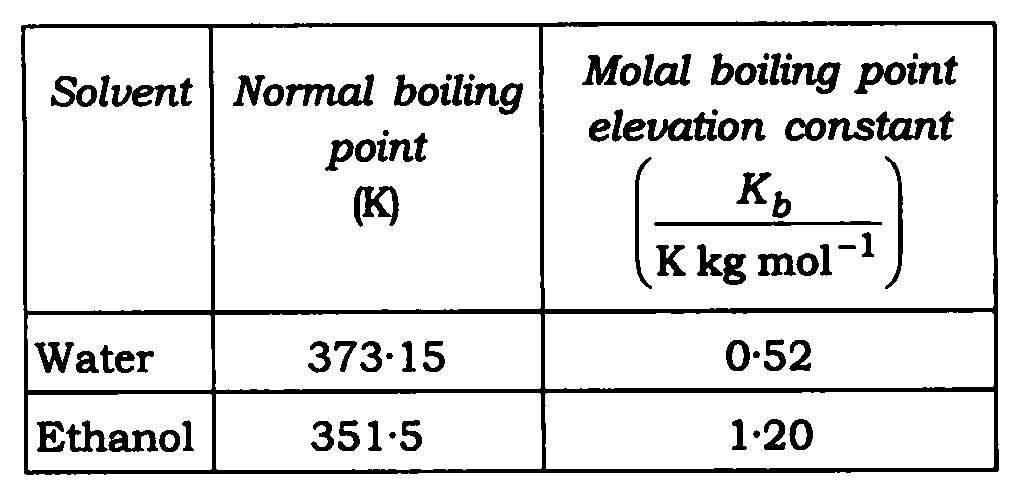
Consider the following values of normal boiling point and molal boiling point elevation constant for some solvents :
Which one of the following solutions would result in the greatest boiling point elevation?
(a) 0·05 M lithium chloride in water(b) 0·05 M lithium chloride in ethanol(c) 0·05 M magnesium chloride in water(d) 0·05 M magnesium chloride in ethanol
Answer and explanation with the VKC plan
Q63 Solutions / depression of freezing point
When a non-volatile solute is dissolved in a volatile solvent, the depression in the freezing point is
(a) inversely proportional to the molality of the solution(b) directly proportional to the molality of the solution(c) independent of the amount of solute present in the solution(d) directly proportional to the mole fraction of the solvent present
Answer and explanation with the VKC plan
Q64 Solutions / Henry's law
Consider the following statements regarding Henry's law :
The Henry's law constant depends on the nature of the gas. CO₂ is more soluble than O₂. The Henry's law constant does not depend on the nature of the solvent. The Henry's law constant depends on the temperature. (The Henry's law constant values of CO₂ and O₂ in water at 298 K are 3·01 × 10³ kPa kg mol⁻¹ and 7·92 × 10⁴ kPa kg mol⁻¹, respectively)
(a) 1 and 2 only(b) 1, 2 and 3(c) 1, 2 and 4(d) 3 and 4
Answer and explanation with the VKC plan
Q65 Solutions / Henry's law
The value of the Henry's law constant of O₂ in water at 298 K is 8·0 × 10⁴ kPa kg mol⁻¹. When its partial pressure is 20 kPa, the molar concentration of O₂ in water at 25 °C is
(a) 25 mmol dm⁻³(b) 0·25 mmol dm⁻³(c) 0·4 × 10⁻³ kg mol⁻¹(d) 4 × 10⁻³ mol kg⁻¹
Answer and explanation with the VKC plan
Q66 Electrochemistry / molar conductivity
A conductivity cell was calibrated using 0·1 M KCl solution and the measured resistance was 100 Ω. The resistance of the same cell when filled with 0·02 M KCl solution is 500 Ω. The molar conductivity of 0·02 M KCl solution will be (the conductivity of 0·1 M KCl solution is 1·3 S m⁻¹)
(a) 13·0 S cm² mol⁻¹(b) 130·0 × 10⁻⁴ S cm² mol⁻¹(c) 130·0 S cm² mol⁻¹(d) 260·0 S cm² mol⁻¹
Answer and explanation with the VKC plan
Q67 Electrochemistry / Kohlrausch's law
The molar conductivities at infinite dilution Λ°_m for HNO₃, CH₃COOH and NaNO₃ are 421·2 S cm² mol⁻¹, 391·0 S cm² mol⁻¹ and 121·5 S cm² mol⁻¹, respectively. The Λ°_m for CH₃COONa will be
(a) 51·5 S cm² mol⁻¹(b) 91·3 S cm² mol⁻¹(c) 151·5 S cm² mol⁻¹(d) 201·0 S cm² mol⁻¹
Answer and explanation with the VKC plan
Q68 Electrochemistry / ionic mobility
The correct order of molar conductance at infinite dilution of LiCl, NaCl and KCl is
(a) LiCl > NaCl > KCl(b) KCl > NaCl > LiCl(c) NaCl > KCl > LiCl(d) KCl > LiCl > NaCl
Answer and explanation with the VKC plan
Q69 Electrochemistry / variation of conductivity with dilution
Consider the following statements regarding ionic molar conductivities :
Statement–1 : With increasing dilution, the conductivity keeps on increasing. Statement–2 : With increasing dilution, the degree of ionization of weak electrolytes increases, and the mobility of ions also increases. Which one of the following is correct with respect to the above statements?
(a) Both Statement–1 and Statement–2 are true and Statement–2 is the correct explanation of Statement–1(b) Both Statement–1 and Statement–2 are true and Statement–2 is not the correct explanation of Statement–1(c) Statement–1 is true but Statement–2 is false(d) Statement–1 is false but Statement–2 is true
Answer and explanation with the VKC plan
Q70 Electrochemistry / Walden's rule
Consider the following statements regarding ionic molar conductivities :
Statement–1 : The Walden's rule holds good for tetramethylammonium ion and picrate ion. Statement–2 : The effective radii of tetramethylammonium ion and picrate ion in the solvent are larger and very different from the crystallographic radii of the ions. Which one of the following is correct with respect to the above statements?
(a) Both Statement–1 and Statement–2 are true and Statement–2 is the correct explanation of Statement–1(b) Both Statement–1 and Statement–2 are true and Statement–2 is not the correct explanation of Statement–1(c) Statement–1 is true but Statement–2 is false(d) Statement–1 is false but Statement–2 is true
Answer and explanation with the VKC plan
Q71 Electrochemistry / ionic mobility, transport number
Consider the following statements regarding movement of ions :
Ionic mobility is inversely proportional to the potential gradient. Ionic mobility is directly proportional to the ionic speed. Transport number of the ions is inversely proportional to the ionic speed. Sum of the transport numbers of ions in a solution is equal to one. Which of the statements given above are correct?
(a) 1 and 2 only(b) 1, 2 and 3(c) 3 and 4(d) 1, 2 and 4
Answer and explanation with the VKC plan
Q72 Electrochemistry / Λ_m vs √c
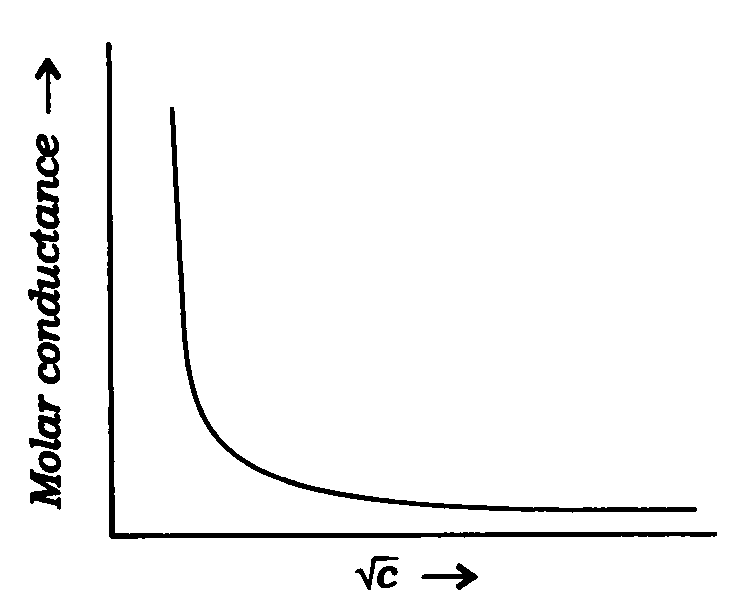
The following graph shows the variation of molar conductance with the concentration of a/an
(a) strong acid(b) weak acid(c) buffer(d) ethanol
Answer and explanation with the VKC plan
Q73 Electrochemistry / Kohlrausch extrapolation
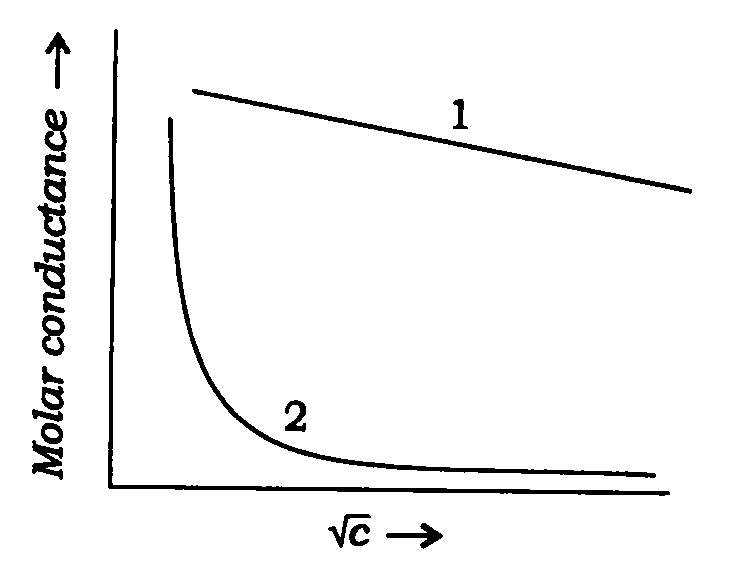
Consider the following graph showing the variation of molar conductance with concentration :
Which one of the following statements is correct with respect to the above graph?
(a) Plot 1 can be extrapolated to obtain the molar conductance at infinite dilution of weak electrolytes.(b) Plot 1 can be extrapolated to obtain the molar conductance at infinite dilution of strong electrolytes.(c) Plot 2 can be extrapolated to obtain the molar conductance at infinite dilution of strong electrolytes.(d) Both plots 1 and 2 can be extrapolated to obtain the molar conductance at infinite dilution of strong and weak electrolytes, respectively.
Answer and explanation with the VKC plan
Q74 Electrochemistry / Debye–Hückel–Onsager equation
The term A√c in the Onsager equation Λ = Λ^∞ − (A + BΛ^∞)√c represents the
(a) decrease in molar conductivity due to the electrophoretic effect(b) decrease in molar conductivity due to the asymmetry effect(c) increase in molar conductivity due to the electrophoretic effect(d) increase in molar conductivity due to the asymmetry effect
Answer and explanation with the VKC plan
Q75 Electrochemistry / Kohlrausch's law, Ostwald dilution
The conductivity of 0·001 M dichloroacetic acid solution is 3·88 × 10⁻⁵ S cm⁻¹. The molar conductivities at infinite dilution for HCl, NaCl and CHCl₂COONa (sodium dichloroacetate) are 426 S cm² mol⁻¹, 126 S cm² mol⁻¹ and 88 S cm² mol⁻¹, respectively. The degree of dissociation and dissociation constant of dichloroacetic acid will be respectively
(a) 0·2 and 1·1 × 10⁻⁶(b) 0·1 and 1·1 × 10⁻⁶(c) 0·2 and 1·1 × 10⁻⁴(d) 0·1 and 1·1 × 10⁻⁵
Answer and explanation with the VKC plan
Q76 Electrochemistry / solubility from conductance
The conductivity and molar conductance of CaF₂ at 18 °C are 4 × 10⁻⁵ S cm⁻¹ and 200 S cm² mol⁻¹, respectively. The K_sp for CaF₂ will be
(a) 4·0 × 10⁻⁸(b) 3·2 × 10⁻¹¹(c) 8·0 × 10⁻¹²(d) 2·0 × 10⁻¹²
Answer and explanation with the VKC plan
Q77 Electrochemistry / conductometric titration
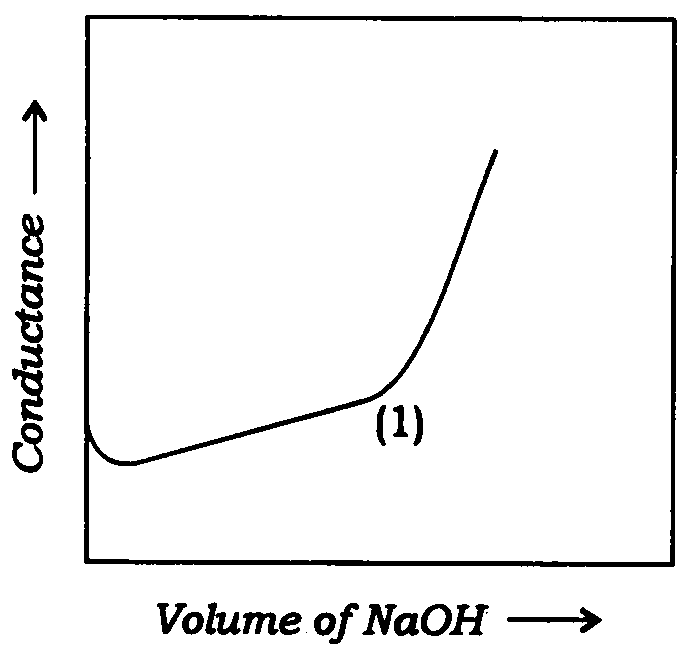
In the given plot of conductometric titration of CH₃COOH vs. NaOH, the area around point (1) is curved due to
(a) neutralization of weak acid with weak base(b) hydrolysis of the salt CH₃COONa(c) suppression of dissociation of CH₃COOH(d) poor conductance of CH₃COOH
Answer and explanation with the VKC plan
Q78 Electrochemistry / anomalous transport numbers, complex ions
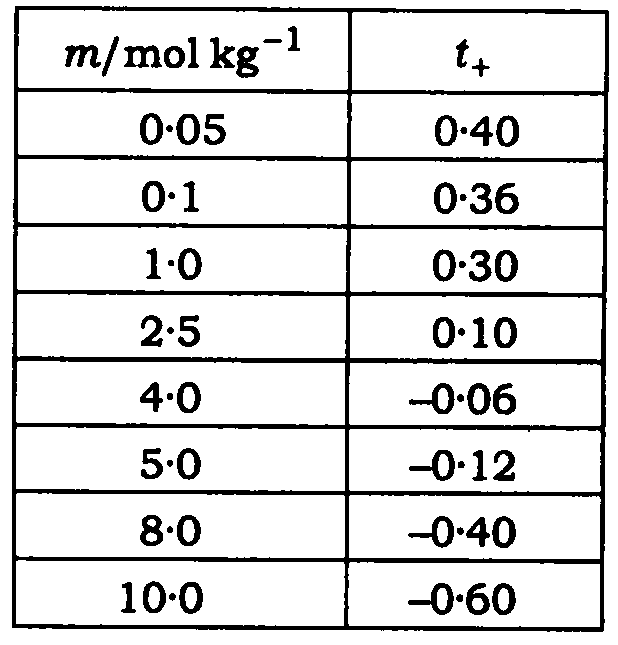
Consider the following table showing the apparent transport numbers of Cd²⁺ ion in CdI₂ solutions of different molalities :
Which one of the following interpretations is correct with respect to the table given above?
(a) In dilute solutions, Cd²⁺ ion migrates towards the anode and I⁻ migrates towards the cathode and vice versa in concentrated solutions.(b) In dilute solutions, Cd²⁺ ion migrates towards the cathode and I⁻ migrates towards the anode and vice versa in concentrated solutions.(c) In dilute solutions, Cd²⁺ ion migrates towards the cathode and I⁻ migrates towards the anode and in concentrated solutions, Cd²⁺ ion migrates towards the cathode and CdI₄²⁻ migrates towards the anode.(d) In dilute solutions, Cd²⁺ ion migrates towards the anode and I⁻ migrates towards the cathode and in concentrated solutions, Cd²⁺ ion migrates towards the anode and CdI₄²⁻ migrates towards the cathode.
Answer and explanation with the VKC plan
Q79 Electrochemistry / moving boundary method
The transport number of ions in a 1·0 M solution of AgNO₃ was determined using a 0·3 M solution of Cd(NO₃)₂ in the moving boundary method. When a current of 15 mA was passed for 30 min, the boundary swept through a volume of 0·1 cm³. The transport number of Ag⁺ is (Faraday's constant = 96500 C mol⁻¹)
(a) 0·36(b) 0·64(c) 0·71(d) 0·83
Answer and explanation with the VKC plan
Q80 Electrochemistry / moving boundary method
Which of the following electrolytes should be given to a chemist to be used as an indicator electrolyte in the determination of the transport number of Ag⁺ in AgNO₃ solution using the moving boundary method?
(a) Cd(NO₃)₂(b) LiNO₃ only(c) CdCl₂ only(d) Both LiNO₃ and CdCl₂
Answer and explanation with the VKC plan
Q81 Aromaticity / bond fixation in polycyclic arenes
Consider the following statements regarding structures of naphthalene and biphenylene :
The C1-C2 bond order is more than C2-C3 bond in naphthalene. The C2-C3 bond order is more than C1-C2 bond in naphthalene. The C1-C2 bond order is more than C2-C3 bond in biphenylene. The C2-C3 bond order is more than C1-C2 bond in biphenylene. Which of the statements given above are correct?
(a) 1 and 3(b) 1 and 4(c) 2 and 3(d) 2 and 4
Answer and explanation with the VKC plan
Q82 Organic / acidity of substituted benzoic acids
The correct order of increasing acid strength of the given carboxylic acids is
(a) 4-acetylbenzoic acid < 4-cyanobenzoic acid < 4-hydroxybenzoic acid < benzene-1,4-dicarboxylic acid(b) 4-hydroxybenzoic acid < 4-acetylbenzoic acid < 4-cyanobenzoic acid < benzene-1,4-dicarboxylic acid(c) 4-hydroxybenzoic acid < benzene-1,4-dicarboxylic acid < 4-acetylbenzoic acid < 4-cyanobenzoic acid(d) 4-cyanobenzoic acid < 4-acetylbenzoic acid < benzene-1,4-dicarboxylic acid < 4-hydroxybenzoic acid
Answer and explanation with the VKC plan
Q83 Heterocycles / basicity of azoles and azaindoles
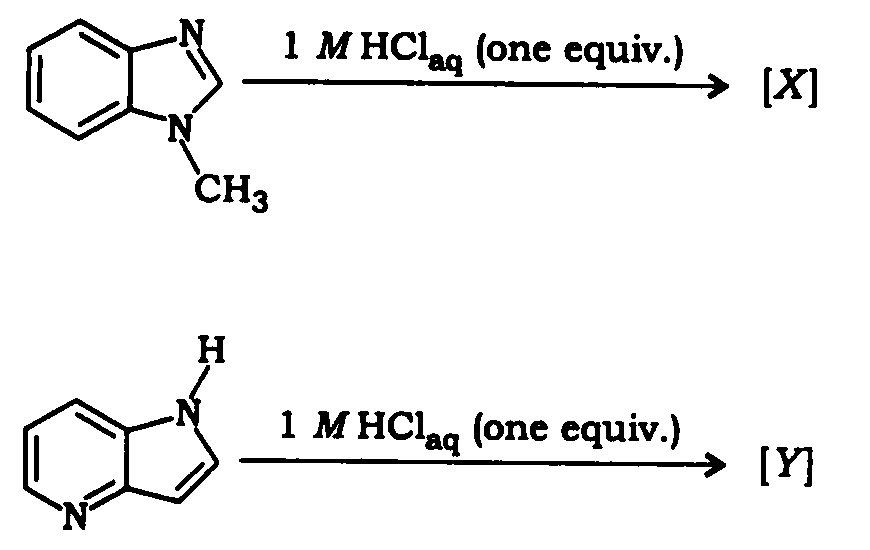
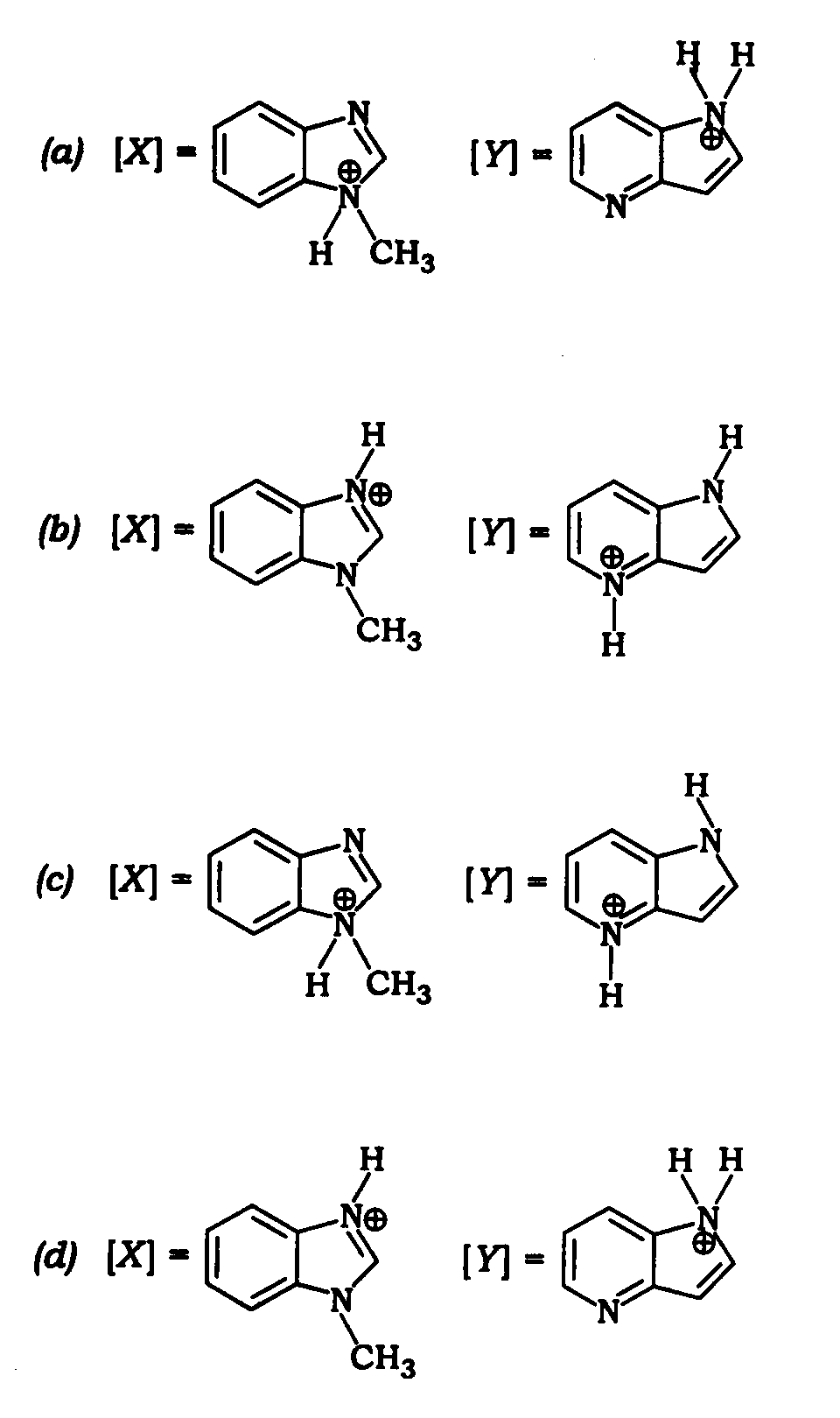
The major products [X] and [Y] formed in the following reactions are
(a) [X] = 1-methylbenzimidazolium protonated at N-1 (N bearing CH₃); [Y] = pyrrolo-pyridine protonated at the pyrrole N (NH₂⁺)(b) [X] = 1-methylbenzimidazolium protonated at N-3; [Y] = pyrrolo-pyridine protonated at the pyridine N (pyrrole NH intact)(c) [X] = 1-methylbenzimidazolium protonated at N-1 (N bearing CH₃); [Y] = pyrrolo-pyridine protonated at the pyridine N(d) [X] = 1-methylbenzimidazolium protonated at N-3; [Y] = pyrrolo-pyridine protonated at the pyrrole N (NH₂⁺)
Answer and explanation with the VKC plan
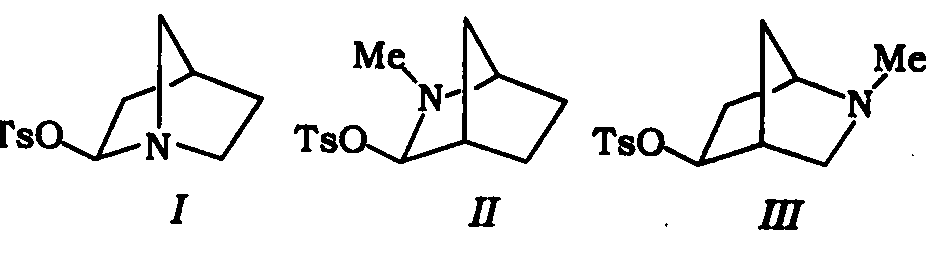
Q84 Neighbouring group participation / α-amino effect, Bredt's rule
The correct decreasing order of reactivity towards ionization under acidic conditions of the following compounds is
(a) I > III > II(b) I > II > III(c) III > II > I(d) II > III > I
Answer and explanation with the VKC plan
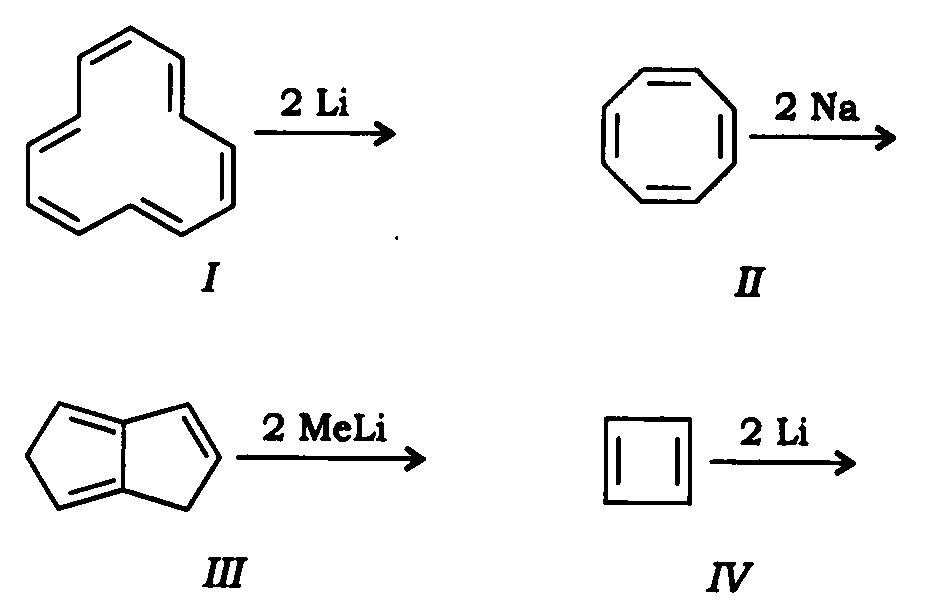
Q85 Aromaticity / annulene dianions (Hückel rule)
The products of which of the following reactions are aromatic in nature?
(a) I, II and IV only(b) II and III only(c) III and IV only(d) I, II, III and IV
Answer and explanation with the VKC plan
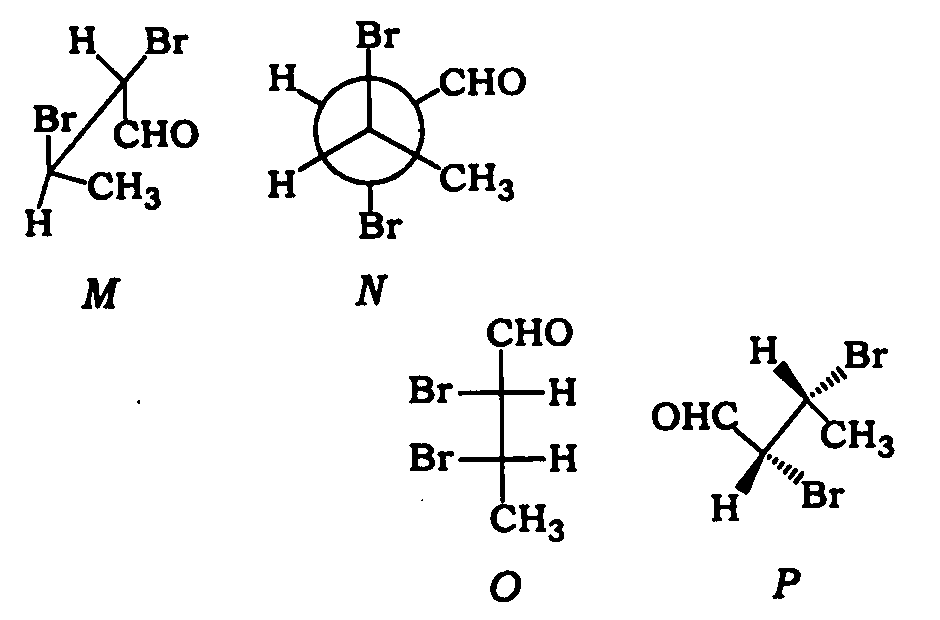
Q86 Stereochemistry / R,S and relationships
Match the pair of compounds from Column–I with their stereochemical relationship with each other from Column–II and select the correct answer using the code given below the Columns :
Column–I Column–II (A) M and N 1. Identical (B) M and O 2. Diastereomers (C) M and P 3. Enantiomers (D) N and P
(a) A-2, B-3, C-2, D-1(b) A-3, B-3, C-1, D-2(c) A-1, B-3, C-1, D-2(d) A-3, B-1, C-2, D-1
Answer and explanation with the VKC plan
Q87 Stereochemistry / meso compounds
Which one of the following has an achiral stereoisomer?
(a) 2,3-Dibromo-2,3-dimethylbutane(b) 2-Bromo-4-methylpentan-3-ol(c) 2,3-Dibromopentane(d) 1,2-Dibromocyclobutane
Answer and explanation with the VKC plan
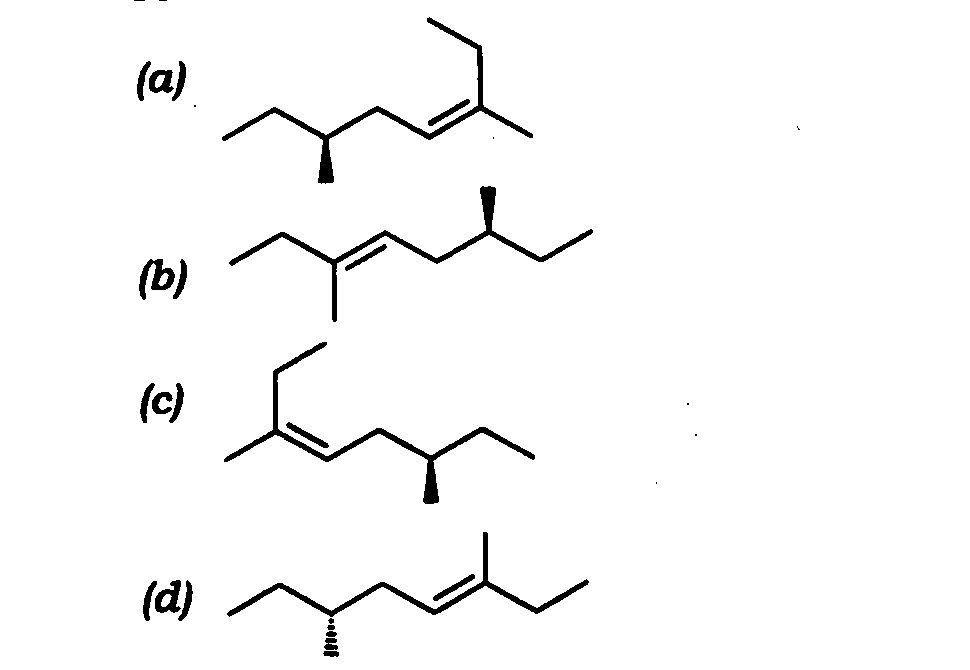
Q88 Stereochemistry / E,Z and R,S nomenclature
The structure which is consistent with (R, Z)-3,6-dimethyloct-3-ene as its IUPAC name is
(a) skeletal structure (a): Z-alkene, C6 methyl on wedge(b) skeletal structure (b): E-alkene, C6 methyl on wedge(c) skeletal structure (c): Z-alkene, C6 methyl on wedge(d) skeletal structure (d): E-alkene, C6 methyl on hashed bond
Answer and explanation with the VKC plan
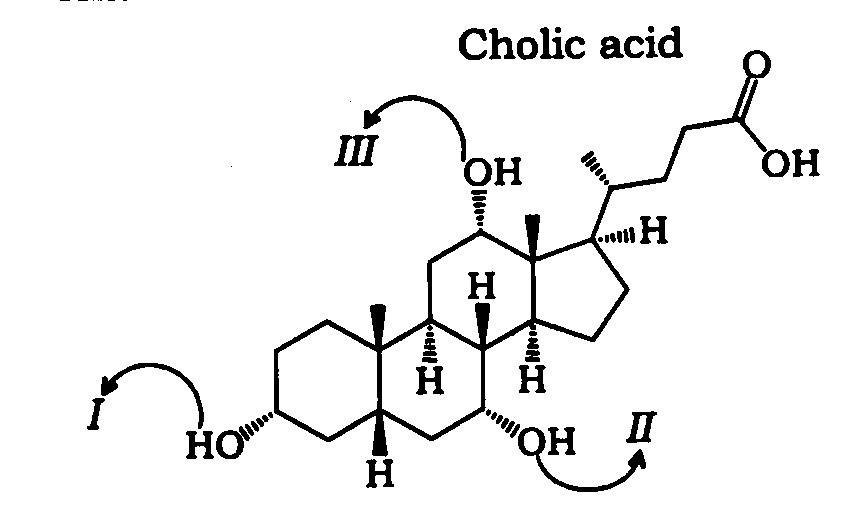
Q89 Conformational analysis / steroids
Cholic acid, a major constituent of bile, has the structure as shown below. What are the positions of labeled I, II and III hydroxyl groups, respectively, in their chair conformations?
(a) Equatorial, equatorial and axial(b) Equatorial, equatorial and equatorial(c) Equatorial, axial and axial(d) Axial, axial and axial
Answer and explanation with the VKC plan
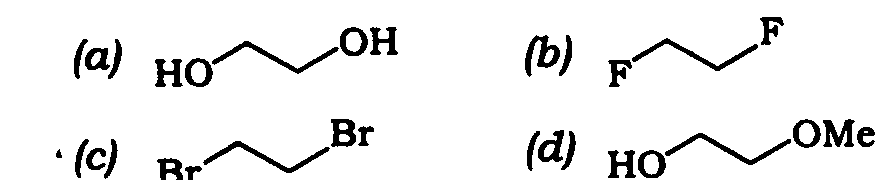
Q90 Conformational analysis / gauche effect
In which one of the following compounds, the anti-conformer is more stable than gauche conformer?
(a) HOCH₂CH₂OH(b) FCH₂CH₂F(c) BrCH₂CH₂Br(d) HOCH₂CH₂OMe
Answer and explanation with the VKC plan
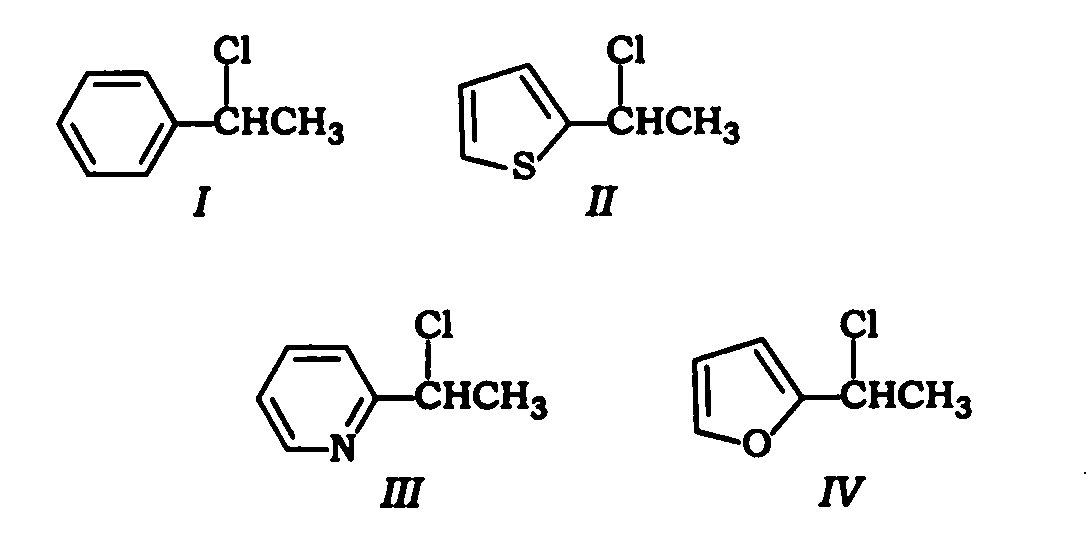
Q91 Reaction mechanism / SN1 and carbocation stability
The increasing order of SN1 solvolysis reactivity in ethanol of the following substrates is
(a) I < II < IV < III(b) III < I < IV < II(c) III < I < II < IV(d) II < III < IV < I
Answer and explanation with the VKC plan
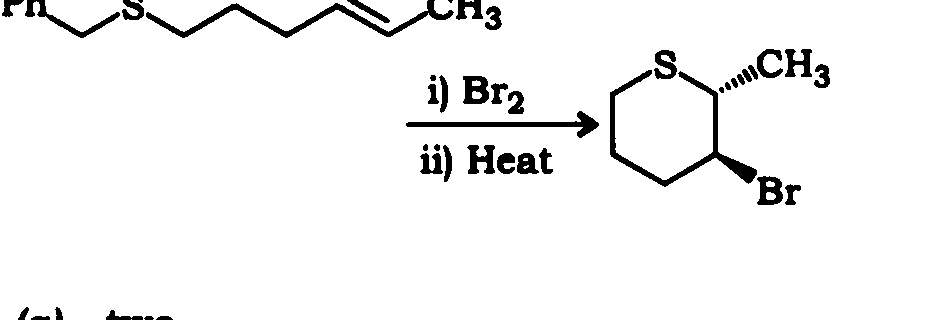
Q92 Neighbouring group participation / sulfur, ring expansion
The number of SN2 processes involved in the mechanism of the following reaction is
(a) two(b) three(c) four(d) five
Answer and explanation with the VKC plan
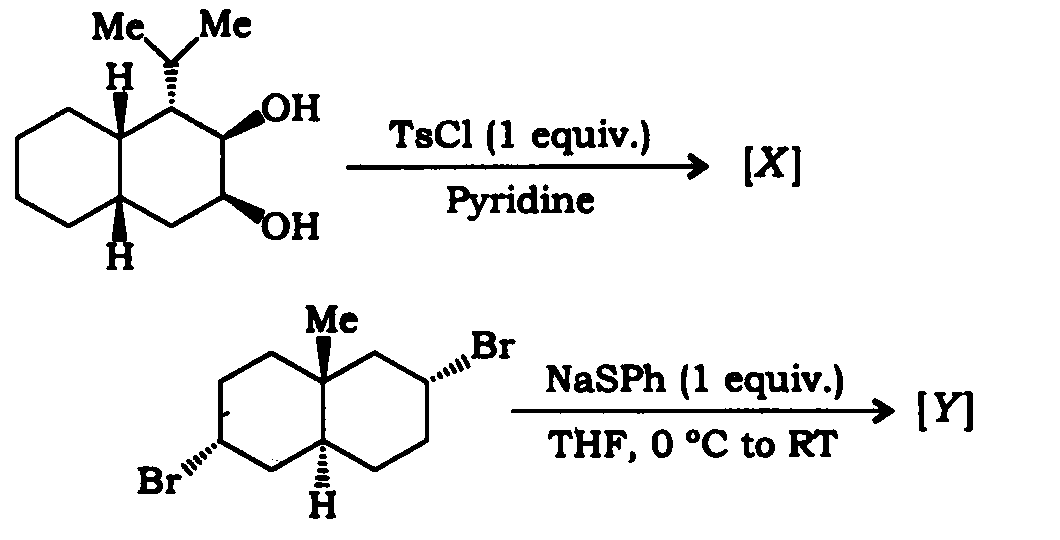
Q93 Conformational analysis / selective tosylation, SN2 in decalins
The major products [X] and [Y] formed in the following reactions are
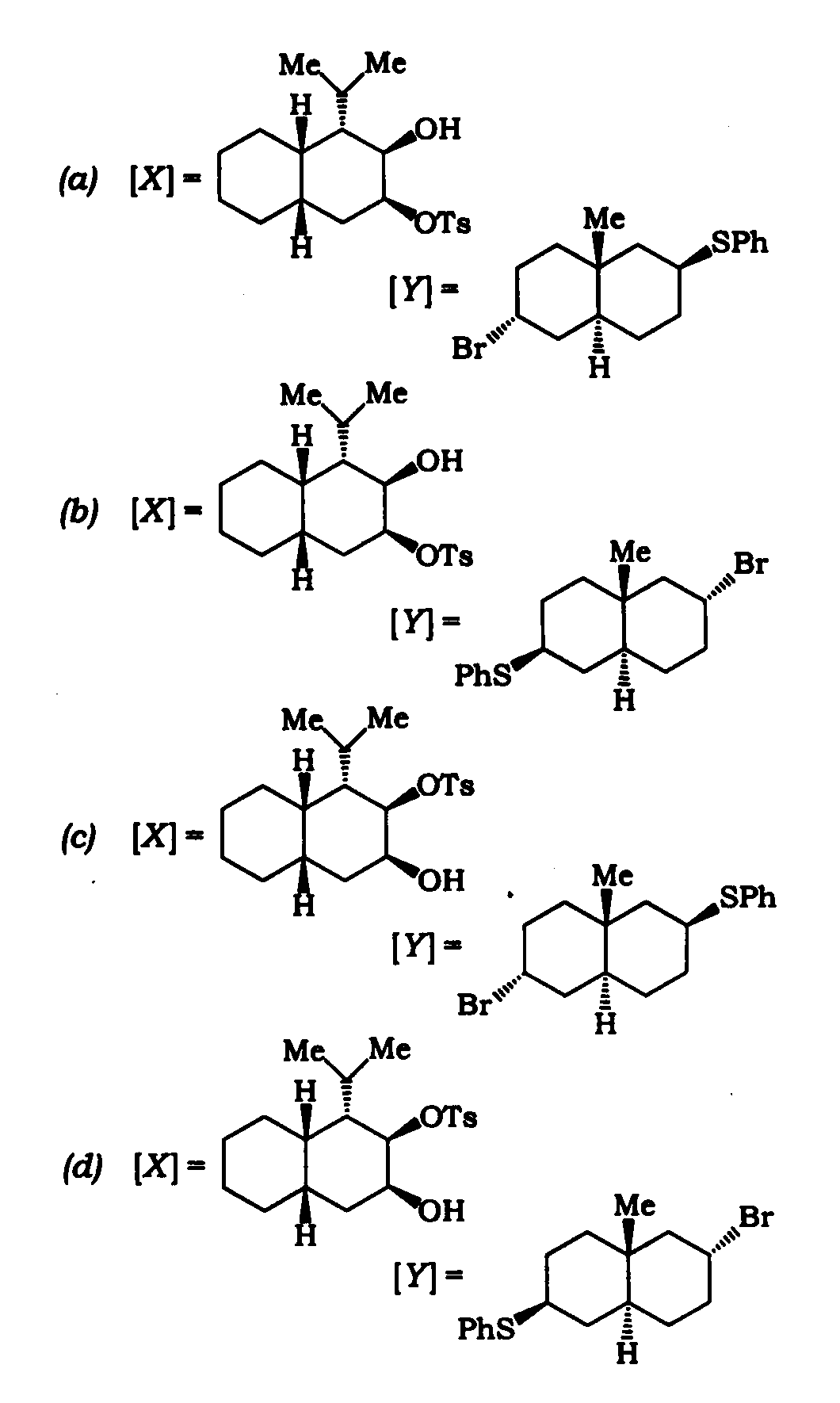
(a) [X] = OTs on C-3 (less hindered OH), OH on C-2; [Y] = SPh (wedge) replaces the right-ring Br, left-ring Br retained(b) [X] = OTs on C-3 (less hindered OH), OH on C-2; [Y] = SPh (wedge) replaces the left-ring Br, right-ring Br retained(c) [X] = OTs on C-2 (next to the isopropyl carbon), OH on C-3; [Y] = SPh (wedge) replaces the right-ring Br, left-ring Br retained(d) [X] = OTs on C-2 (next to the isopropyl carbon), OH on C-3; [Y] = SPh (wedge) replaces the left-ring Br, right-ring Br retained
Answer and explanation with the VKC plan
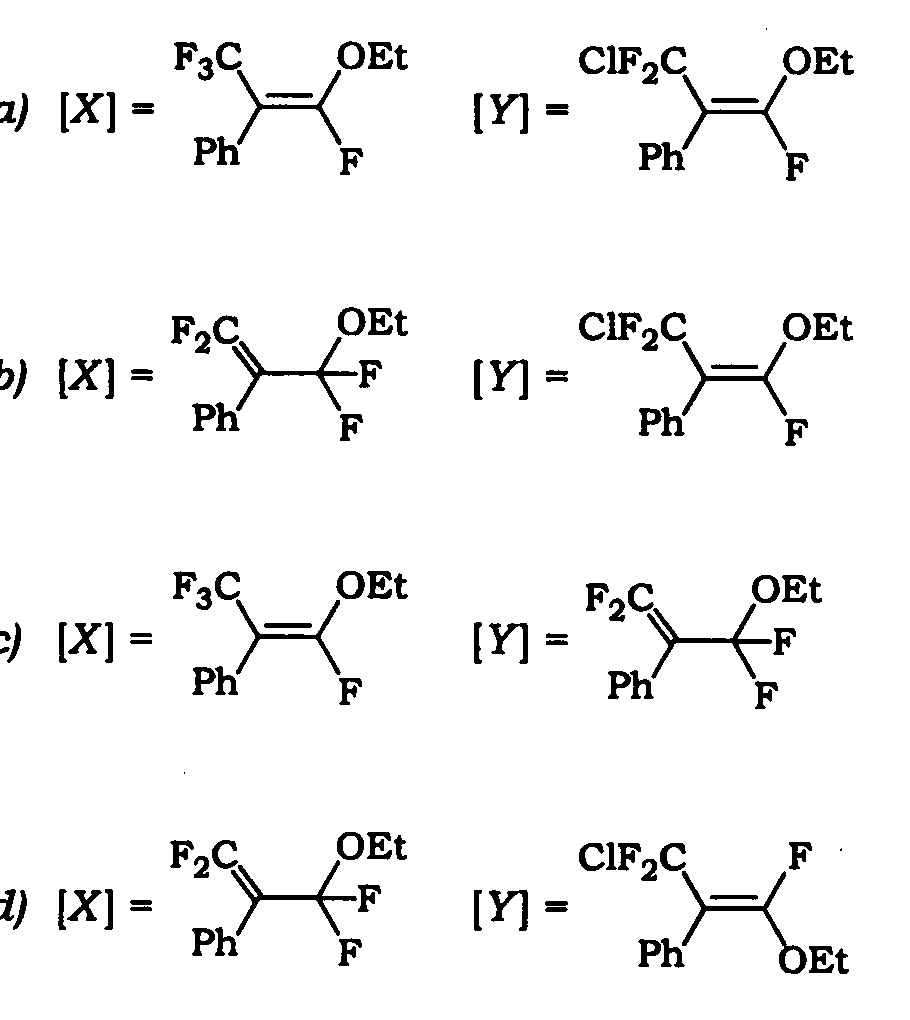
Q94 Organofluorine / nucleophilic vinylic substitution, SN2′
The major products [X] and [Y] formed in the following reactions are
(a) [X] = F₃C(Ph)C=CF(OEt); [Y] = ClF₂C(Ph)C=CF(OEt)(b) [X] = F₂C=C(Ph)CF₂OEt; [Y] = ClF₂C(Ph)C=CF(OEt)(c) [X] = F₃C(Ph)C=CF(OEt); [Y] = F₂C=C(Ph)CF₂OEt(d) [X] = F₂C=C(Ph)CF₂OEt; [Y] = ClF₂C(Ph)C=C(F)OEt (OEt cis to Ph)
Answer and explanation with the VKC plan
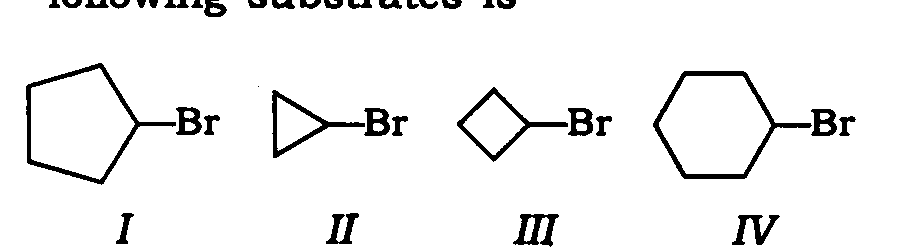
Q95 SN2 / ring size effects
The relative SN2 reactivity order of the following substrates is
(a) II < III < IV < I(b) II < III < I < IV(c) I < III < II < IV(d) IV < I < III < II
Answer and explanation with the VKC plan
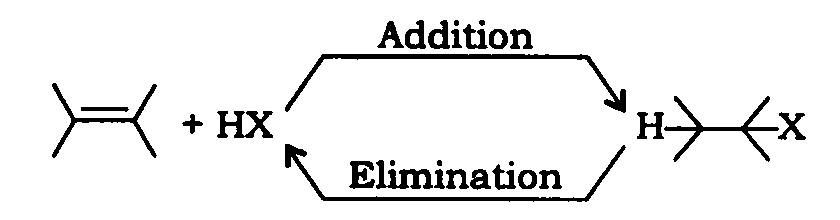
Q96 Thermodynamics of organic reactions / addition vs elimination
Which of the following statements are correct about the following reactions?
Addition is favoured at low temperature whereas elimination is favoured at high temperature. Addition is favoured at high temperature whereas elimination is favoured at low temperature. At high temperature, ΔG is positive for addition reaction whereas ΔG is negative for elimination reaction. At high temperature, ΔG is negative for addition reaction whereas ΔG is positive for elimination reaction. Select the correct answer using the code given below.
(a) 1 and 3(b) 1 and 4(c) 2 and 3(d) 2 and 4
Answer and explanation with the VKC plan
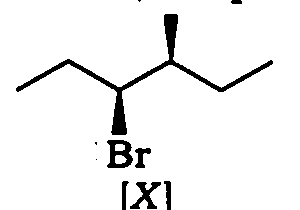
Q97 Stereochemistry / E2 and SN2 stereospecificity
The major products formed in E2 and SN2 reactions of the substrate [X] with sodium methoxide, respectively, are
(a) (Z)-3-methylhex-3-ene and (3R, 4R)-3-methoxy-4-methylhexane(b) (Z)-3-methylhex-3-ene and (3R, 4S)-3-methoxy-4-methylhexane(c) (E)-3-methylhex-3-ene and (3R, 4S)-3-methoxy-4-methylhexane(d) (E)-3-methylhex-3-ene and (3R, 4R)-3-methoxy-4-methylhexane
Answer and explanation with the VKC plan
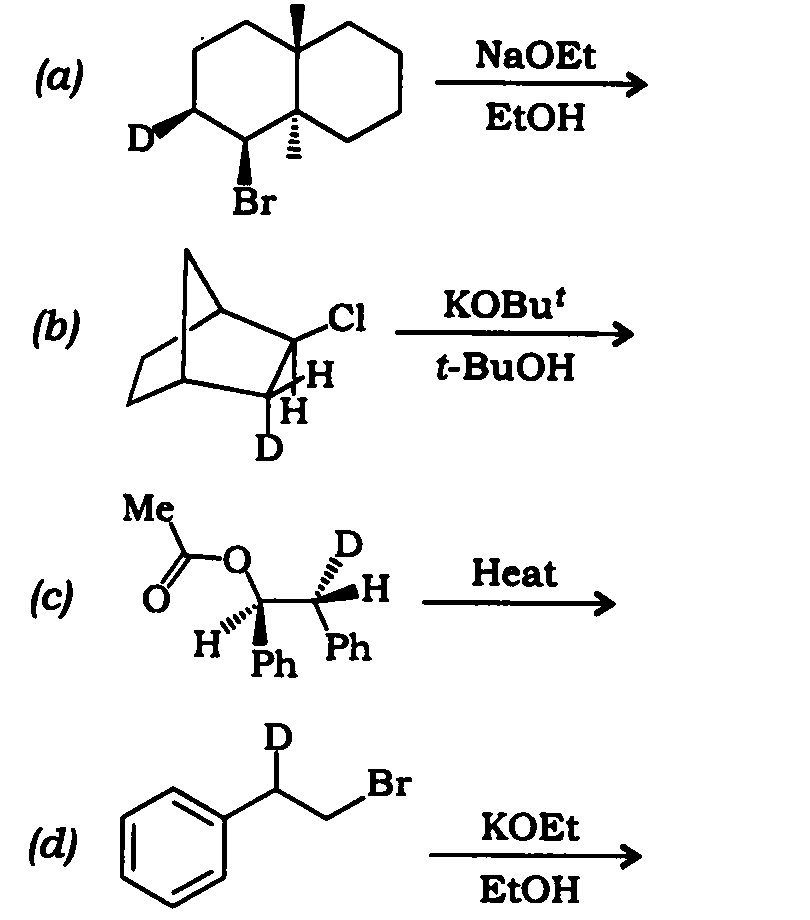
Q98 Elimination / stereochemistry of E2 and Ei
In which one of the following elimination reactions, deuterium is not retained in the alkene formed as the major product?
(a) trans-decalyl bromide with adjacent D (cis to Br), NaOEt/EtOH(b) exo-2-norbornyl chloride with D at C-3, KOBuᵗ/t-BuOH(c) PhCH(OAc)–CHDPh acetate, heat(d) PhCHD–CH₂Br, KOEt/EtOH
Answer and explanation with the VKC plan
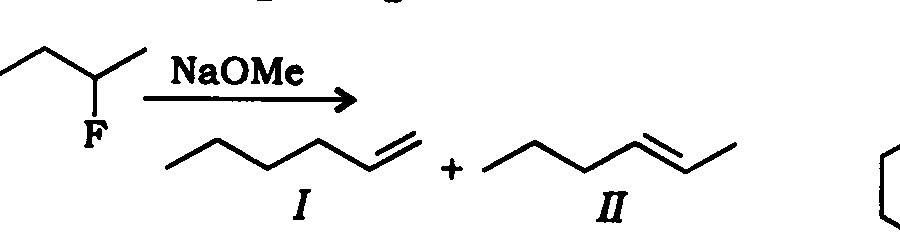
Q99 Elimination / Hofmann vs Zaitsev
Which one of the following statements is correct regarding the given reaction?
(a) The major product formed is I and is called Zaitsev product.(b) The major product formed is I and is called Hofmann product.(c) The major product formed is II and is called Zaitsev product.(d) The major product formed is II and is called Hofmann product.
Answer and explanation with the VKC plan
Q100 Amines / Hofmann exhaustive methylation
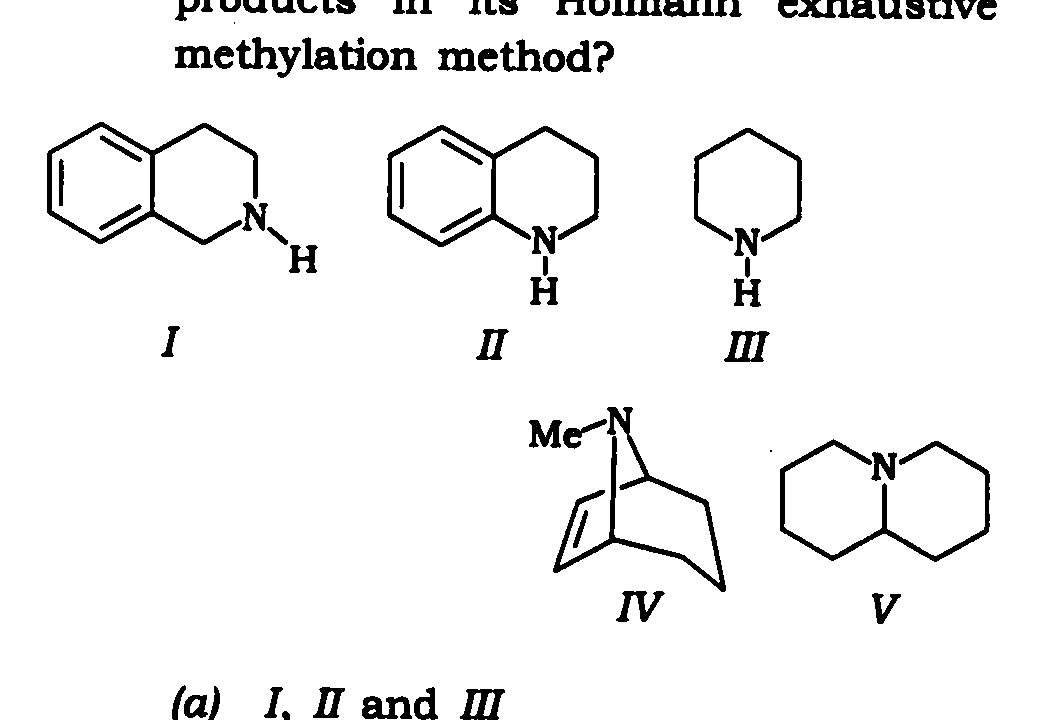
Which of the following substrates do not form trimethylamine as one of the products in its Hofmann exhaustive methylation method?
(a) I, II and III(b) I and II only(c) III, IV and V(d) IV and V only
Answer and explanation with the VKC plan
Q101 Conformational analysis / E2 in trans-decalins
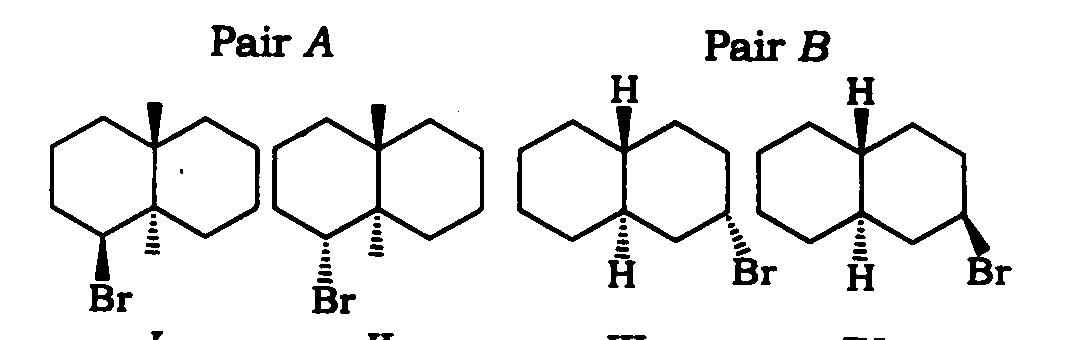
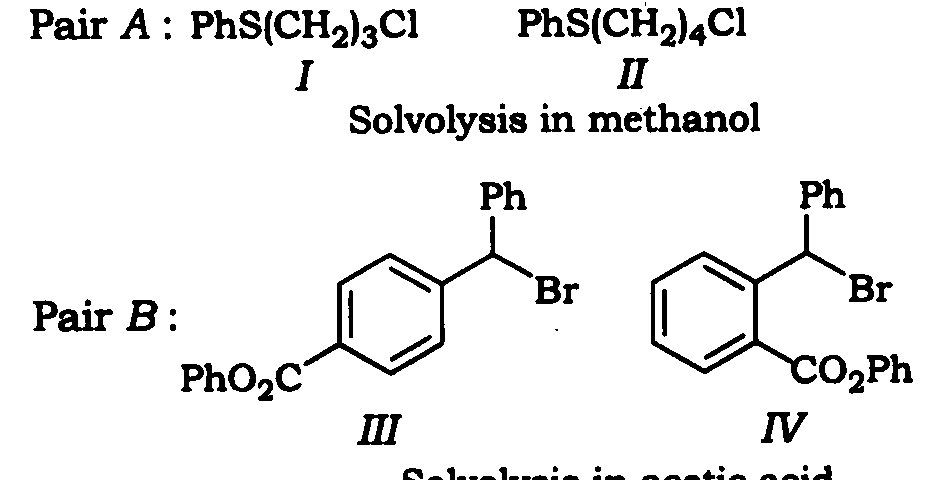
Which of the compounds in Pair A and Pair B are more reactive towards elimination reaction using NaOEt/EtOH?
(a) Pair A : I is more reactive than II(b) Pair A : I is more reactive than II(c) Pair A : II is more reactive than I(d) Pair A : II is more reactive than I
Answer and explanation with the VKC plan
Q102 Elimination / stereospecific E2, E1cB
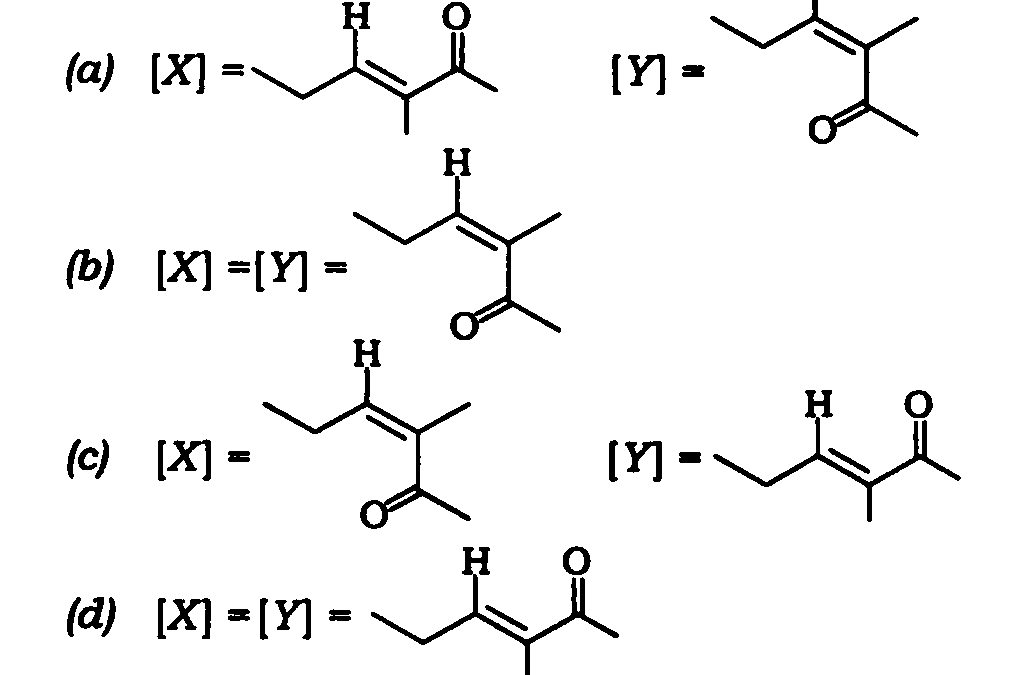
The major products [X] and [Y] formed in the following reactions are
(a) [X] = (E)-3-methylhex-3-en-2-one; [Y] = (Z)-3-methylhex-3-en-2-one(b) [X] = [Y] = (Z)-3-methylhex-3-en-2-one(c) [X] = (Z)-3-methylhex-3-en-2-one; [Y] = (E)-3-methylhex-3-en-2-one(d) [X] = [Y] = (E)-3-methylhex-3-en-2-one
Answer and explanation with the VKC plan
Q103 Alkenes / hydration methods
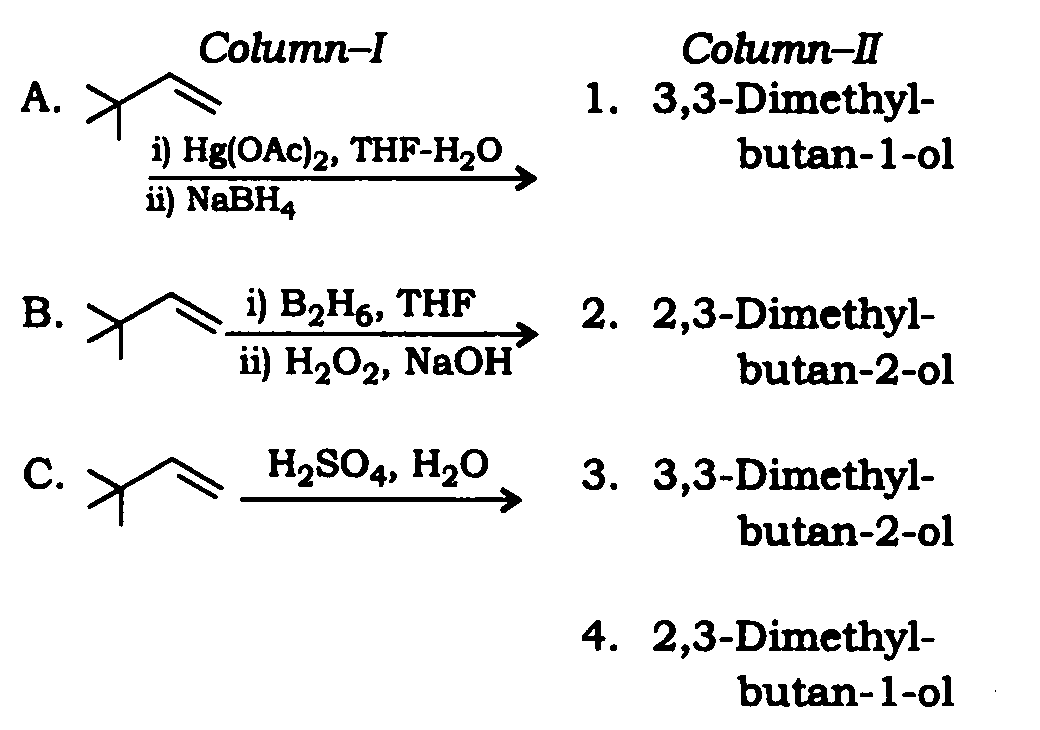
Match the reactions from Column–I with the major products formed from Column–II and select the correct answer using the code given below the Columns :
Column–I Column–II A. 3,3-dimethylbut-1-ene, i) Hg(OAc)₂, THF-H₂O; ii) NaBH₄ 1. 3,3-Dimethylbutan-1-ol B. 3,3-dimethylbut-1-ene, i) B₂H₆, THF; ii) H₂O₂, NaOH 2. 2,3-Dimethylbutan-2-ol C. 3,3-dimethylbut-1-ene, H₂SO₄, H₂O 3. 3,3-Dimethylbutan-2-ol 4. 2,3-Dimethylbutan-1-ol
(a) A-2, B-4, C-1(b) A-4, B-3, C-2(c) A-3, B-1, C-2(d) A-3, B-4, C-1
Answer and explanation with the VKC plan
Q104 Free-radical addition / peroxide (Kharasch) effect
Consider the following statements :
Statement–1 : The peroxide effect is observed for the addition of HBr to alkene but not for the addition of HCl or HI. Statement–2 : Either of the two propagation steps for the addition of HCl or HI to alkene is endothermic in nature. Which one of the following is correct with respect to the above statements?
(a) Both Statement–1 and Statement–2 are correct and Statement–2 is the correct explanation of Statement–1(b) Both Statement–1 and Statement–2 are correct and Statement–2 is not the correct explanation of Statement–1(c) Statement–1 is correct but Statement–2 is incorrect(d) Statement–1 is incorrect but Statement–2 is correct
Answer and explanation with the VKC plan
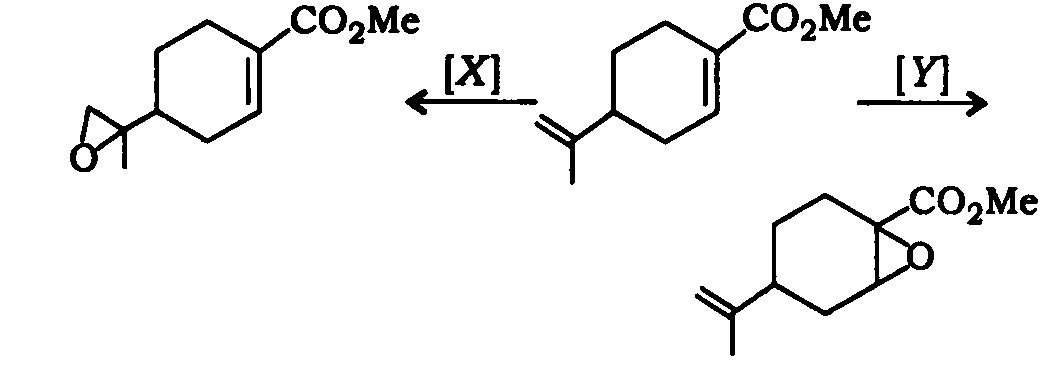
Q105 Oxidation / chemoselective epoxidation
The reagents [X] and [Y] required to carry out the following transformations are
(a) [X] = m-CPBA and [Y] = CH₃CO₃H(b) [X] = CH₃CO₃H and [Y] = m-CPBA(c) [X] = H₂O₂/NaOH and [Y] = CH₃CO₃H(d) [X] = CH₃CO₃H and [Y] = H₂O₂/NaOH
Answer and explanation with the VKC plan
Q106 Carbonyl chemistry / double Michael addition
Which one of the following statements is not correct regarding the following reaction?
(a) The product is formed by two successive Michael additions.(b) The product is formed by Michael addition followed by intra-aldol condensation.(c) Monocyclic product does not give the test of unsaturation with bromine.(d) The double bond equivalence of monocyclic product is twelve.
Answer and explanation with the VKC plan
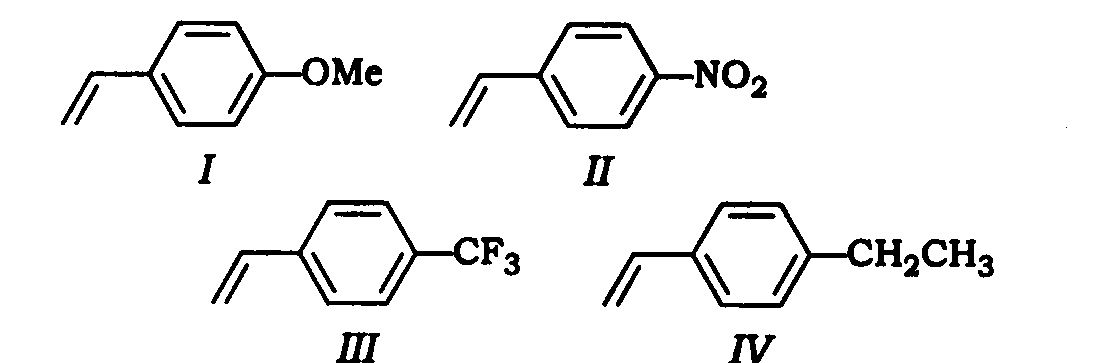
Q107 Polymers / ionic chain polymerisation
Classify the following substituted styrenes with respect to their preferred mode of addition polymerization and select the correct answer accordingly :
(a) I and IV undergo anionic polymerization while II and III undergo cationic polymerization(b) III and IV undergo cationic polymerization while I and II undergo anionic polymerization(c) I, III and IV undergo cationic polymerization while II undergoes anionic polymerization(d) I and IV undergo cationic polymerization while II and III undergo anionic polymerization
Answer and explanation with the VKC plan
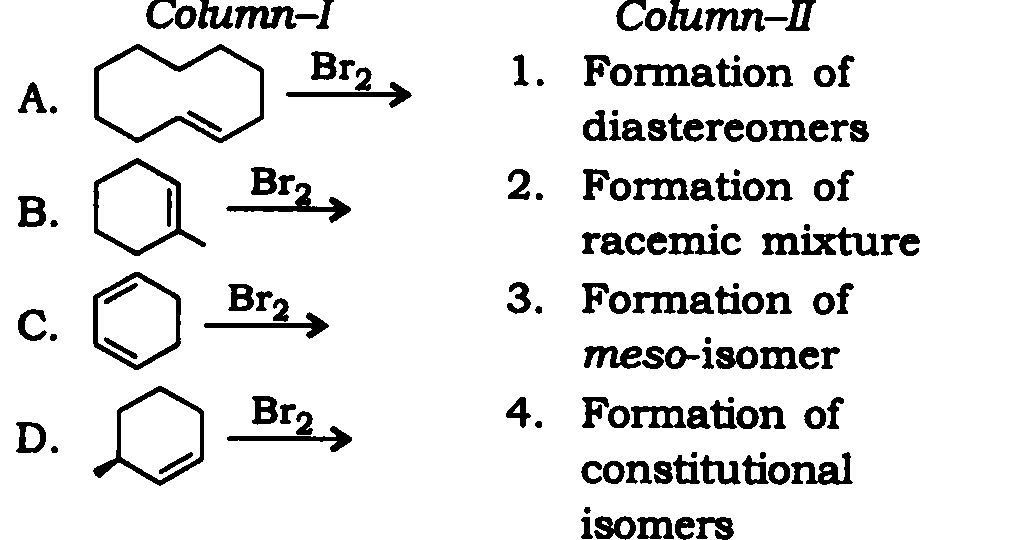
Q108 Stereochemistry / anti addition of bromine
Match the reactions from Column–I with the stereochemical outcome of the products described in Column–II and select the correct answer using the code given below the Columns :
Column–I Column–II A. (E)-cyclodecene + Br₂ 1. Formation of diastereomers B. 1-methylcyclohexene + Br₂ 2. Formation of racemic mixture C. cyclohexa-1,3-diene + Br₂ 3. Formation of meso-isomer D. 3-methylcyclohexene (single enantiomer) + Br₂ 4. Formation of constitutional isomers
(a) A-2, B-1, C-4, D-3(b) A-2, B-4, C-1, D-3(c) A-3, B-2, C-4, D-1(d) A-4, B-2, C-1, D-2
Answer and explanation with the VKC plan
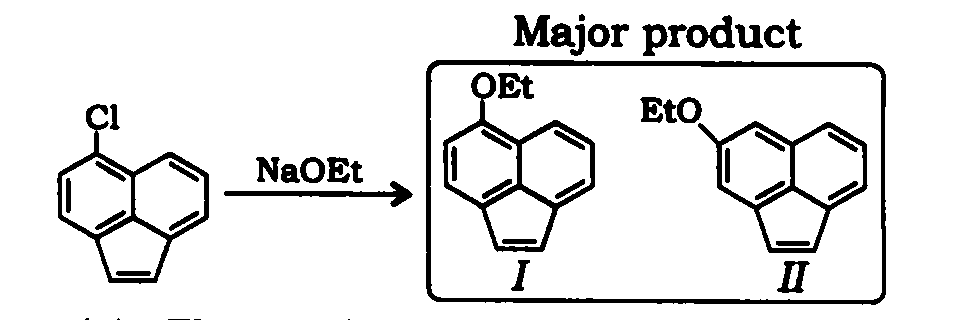
Q109 Aromatic substitution / aryne mechanism
Which one of the following statements is correct for the indicated reaction?
(a) The major product formed is I and the reaction proceeds through addition-elimination pathway.(b) The major product formed is II and the reaction proceeds through addition-elimination pathway.(c) The major product formed is I and the reaction proceeds through elimination-addition pathway.(d) The major product formed is II and the reaction proceeds through elimination-addition pathway.
Answer and explanation with the VKC plan
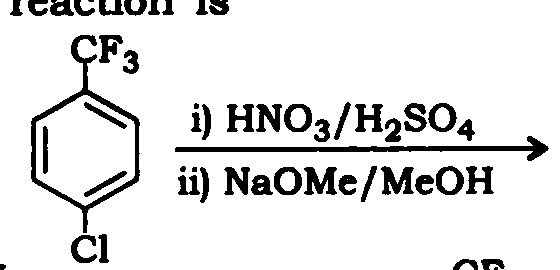
Q110 Aromatic substitution / nitration then SNAr
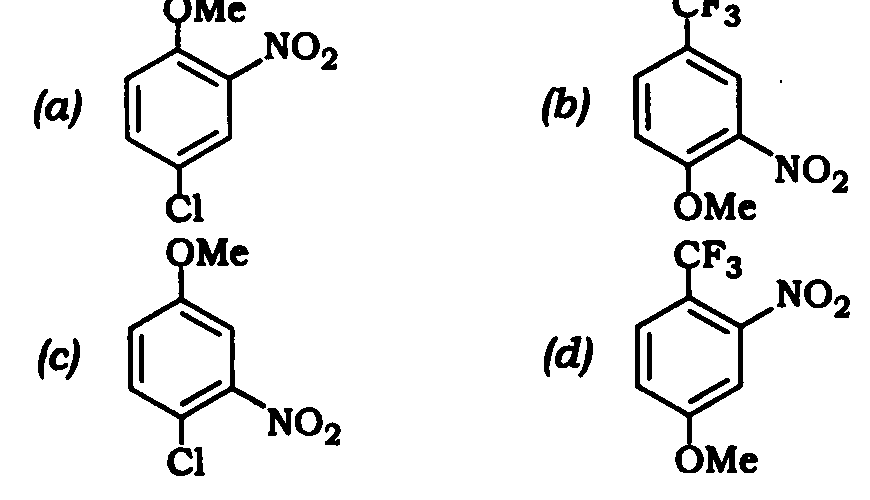
The major product formed in the following reaction is
(a) 4-chloro-2-nitroanisole (OMe and NO₂ ortho; Cl para to OMe)(b) 4-methoxy-3-nitrobenzotrifluoride (CF₃; NO₂ meta to CF₃; OMe para to CF₃)(c) 4-chloro-3-nitroanisole (OMe para to Cl; NO₂ ortho to Cl)(d) 4-methoxy-2-nitrobenzotrifluoride (NO₂ ortho to CF₃; OMe para to CF₃)
Answer and explanation with the VKC plan
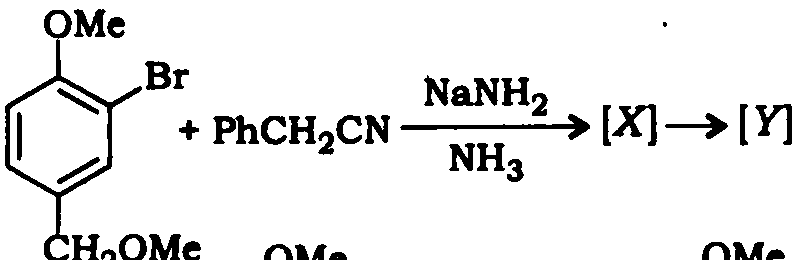
Q111 Aromatic substitution / aryne, tandem addition–cyclisation
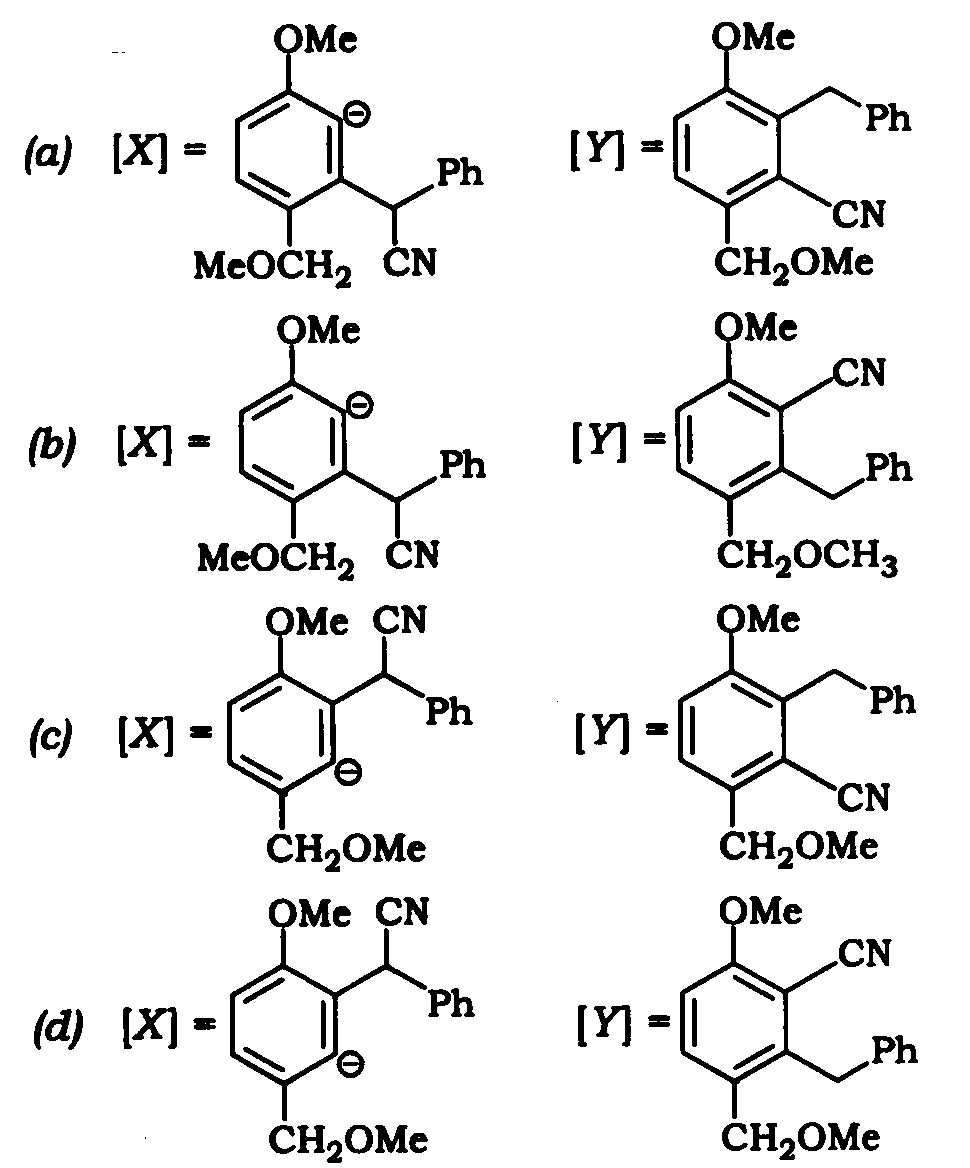
The intermediate [X] and the major product [Y] formed in the following reaction are
(a) [X] = aryl anion ortho to OMe, CH(Ph)CN meta to OMe; [Y] = 2-benzyl-3-cyano pattern (CH₂Ph ortho to OMe, CN next to CH₂OMe)(b) [X] = aryl anion ortho to OMe, CH(Ph)CN meta to OMe; [Y] = CN ortho to OMe, CH₂Ph next to CH₂OCH₃(c) [X] = CH(Ph)CN ortho to OMe, aryl anion meta to OMe; [Y] = CH₂Ph ortho to OMe, CN next to CH₂OMe(d) [X] = CH(Ph)CN ortho to OMe, aryl anion meta to OMe; [Y] = CN ortho to OMe, CH₂Ph next to CH₂OMe
Answer and explanation with the VKC plan
Q112 Heterocycles / intramolecular Chichibabin amination
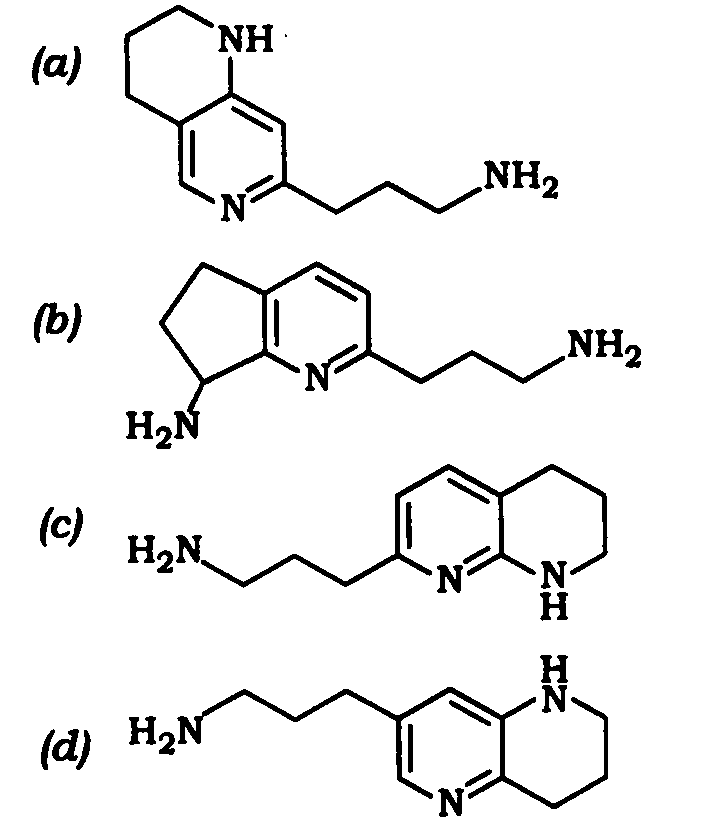
The major product formed in the following reaction is
(a) tetrahydro-1,6-naphthyridine: NH ring fused at C-4/C-5 positions, aminopropyl at C-2(b) cyclopenta[b]pyridine bearing NH₂ on the five-membered ring, aminopropyl at C-2(c) 5,6,7,8-tetrahydro-1,8-naphthyridine (NH next to ring N), 3-aminopropyl at C-2(d) tetrahydro-1,5-naphthyridine (NH at β-position), 3-aminopropyl on the pyridine ring
Answer and explanation with the VKC plan
Q113 Synthesis / Friedel–Crafts with blocking group
The correct sequence of reactions to accomplish the multi-step synthesis of 1-isobutyl-2-methylbenzene from benzene is
(a) [1] (CH₃)₂CHCOCl / AlCl₃; [2] HCl, Zn(Hg)/heat; [3] dilute H₂SO₄; [4] CH₃Cl, AlCl₃; [5] fuming H₂SO₄(b) [1] CH₃Cl, AlCl₃; [2] dilute H₂SO₄; [3] (CH₃)₂CHCOCl / AlCl₃; [4] HCl, Zn(Hg)/heat; [5] fuming H₂SO₄(c) [1] (CH₃)₂CHCl / AlCl₃; [2] fuming H₂SO₄; [3] CH₃Cl, AlCl₃; [4] dilute H₂SO₄(d) [1] (CH₃)₂CHCOCl / AlCl₃; [2] HCl, Zn(Hg)/heat; [3] fuming H₂SO₄; [4] CH₃Cl, AlCl₃; [5] dilute H₂SO₄
Answer and explanation with the VKC plan
Q114 Aromatic substitution / directing effects
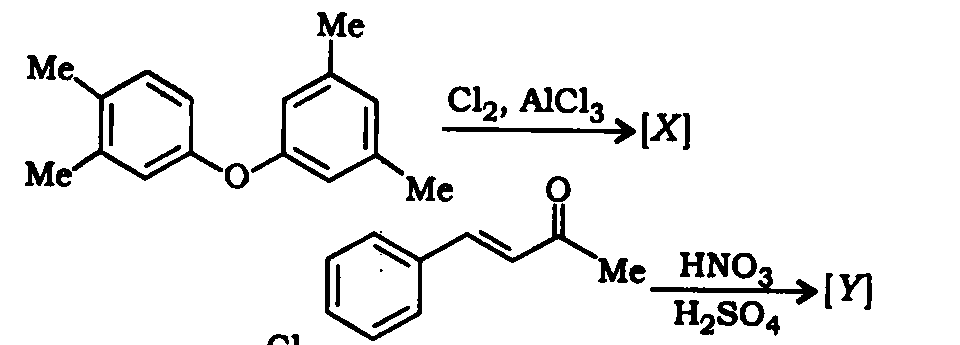
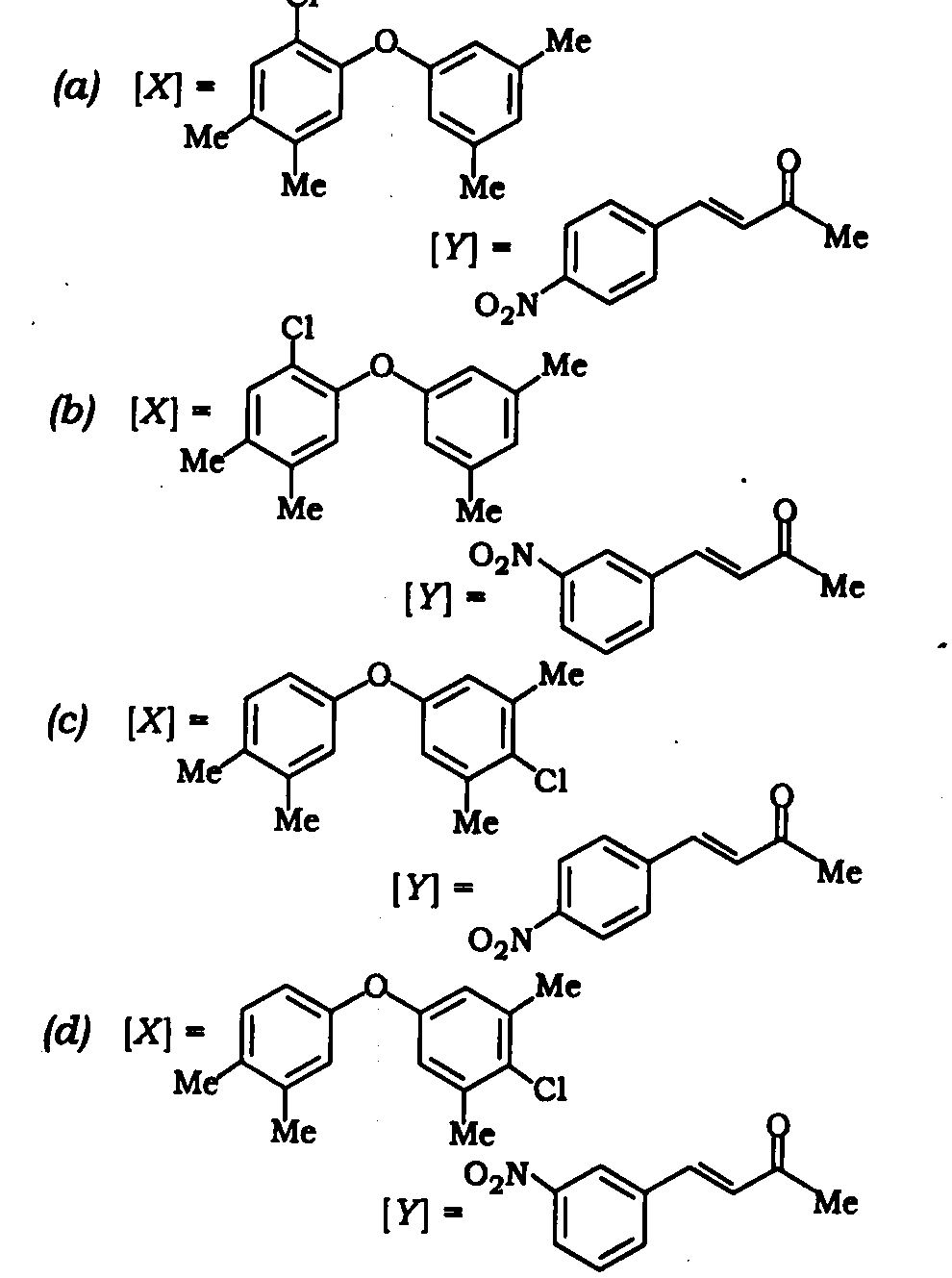
The major products [X] and [Y] formed in the following reactions are
(a) [X] = Cl ortho to O on the 3,4-dimethylphenyl ring; [Y] = para-nitro benzalacetone(b) [X] = Cl ortho to O on the 3,4-dimethylphenyl ring; [Y] = meta-nitro benzalacetone(c) [X] = Cl para to O (between the two Me) on the 3,5-dimethylphenyl ring; [Y] = para-nitro benzalacetone(d) [X] = Cl para to O (between the two Me) on the 3,5-dimethylphenyl ring; [Y] = meta-nitro benzalacetone
Answer and explanation with the VKC plan
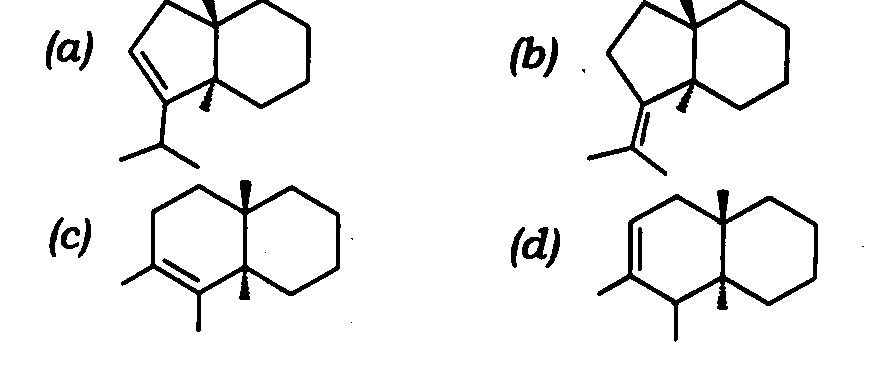
Q115 Carbocation rearrangements / ring contraction
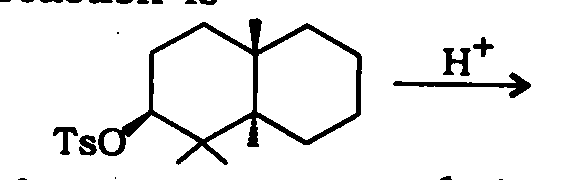
The major product formed in the following reaction is
(a) hydrindane with 1-isopropylcyclopentene unit (ring-contracted, endocyclic C=C)(b) hydrindane with exocyclic isopropylidene on the five-membered ring (ring-contracted)(c) octalin with tetrasubstituted ring C=C bearing two methyls (methyl shift)(d) octalin with trisubstituted ring C=C and gem-methyl migrated (methyl shift)
Answer and explanation with the VKC plan
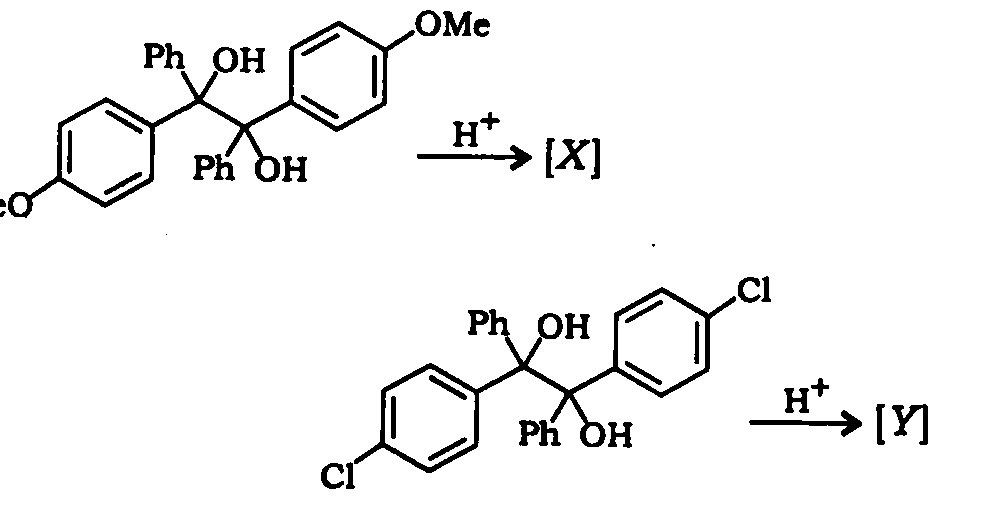
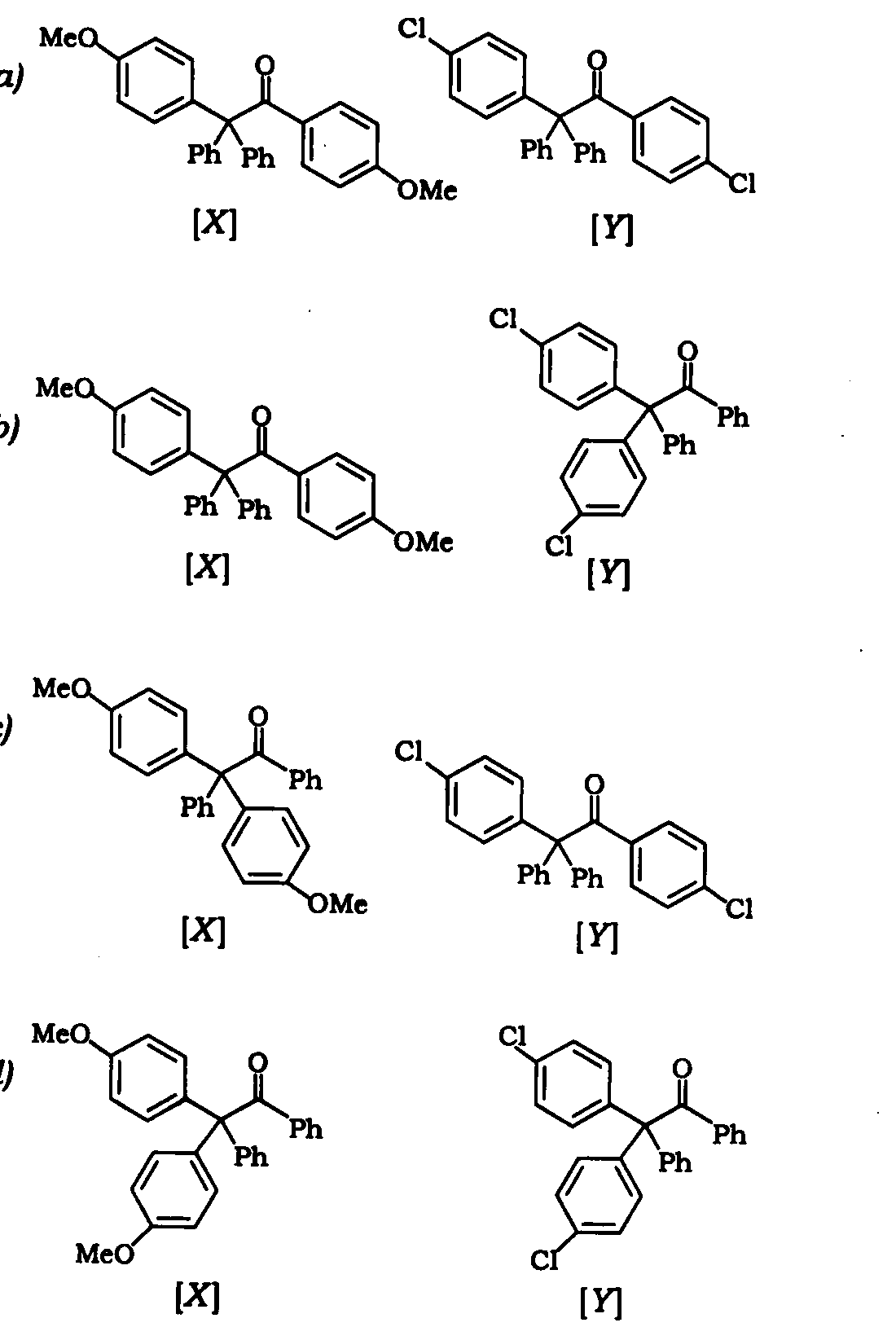
Q116 Rearrangements / pinacol, migratory aptitude
The major products [X] and [Y] formed in the following reactions are
(a) [X] = (4-MeOC₆H₄)Ph₂C–CO–C₆H₄OMe-4; [Y] = (4-ClC₆H₄)Ph₂C–CO–C₆H₄Cl-4(b) [X] = (4-MeOC₆H₄)Ph₂C–CO–C₆H₄OMe-4; [Y] = (4-ClC₆H₄)₂PhC–COPh(c) [X] = (4-MeOC₆H₄)₂PhC–COPh; [Y] = (4-ClC₆H₄)Ph₂C–CO–C₆H₄Cl-4(d) [X] = (4-MeOC₆H₄)₂PhC–COPh; [Y] = (4-ClC₆H₄)₂PhC–COPh
Answer and explanation with the VKC plan
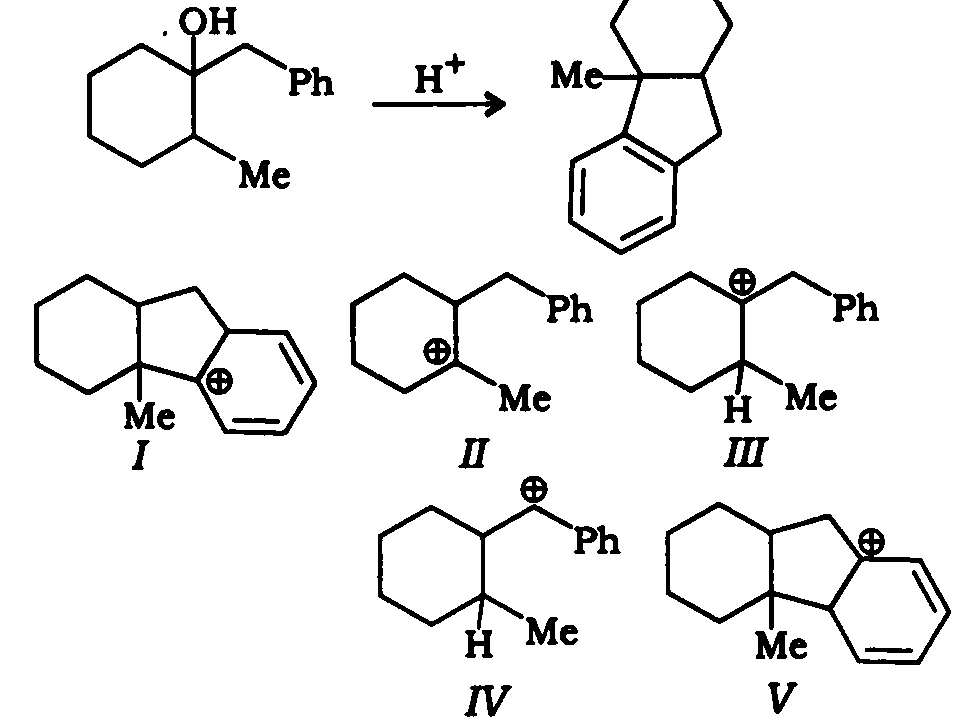
Q117 Carbocations / hydride shift and Friedel–Crafts cyclisation
The reasonable carbocation intermediates which are likely to form in the reaction mechanism of the following transformation are
(a) I, III and IV(b) III, IV and V(c) I, II and IV(d) II, III and V
Answer and explanation with the VKC plan
Q118 Neighbouring group participation / ring size
Which substrate in each pair is expected to be faster in the indicated reaction?
(a) I is more reactive than II whereas III is more reactive than IV(b) I is more reactive than II whereas IV is more reactive than III(c) II is more reactive than I whereas III is more reactive than IV(d) II is more reactive than I whereas IV is more reactive than III
Answer and explanation with the VKC plan
Q119 SN1 / carbocation stabilisation
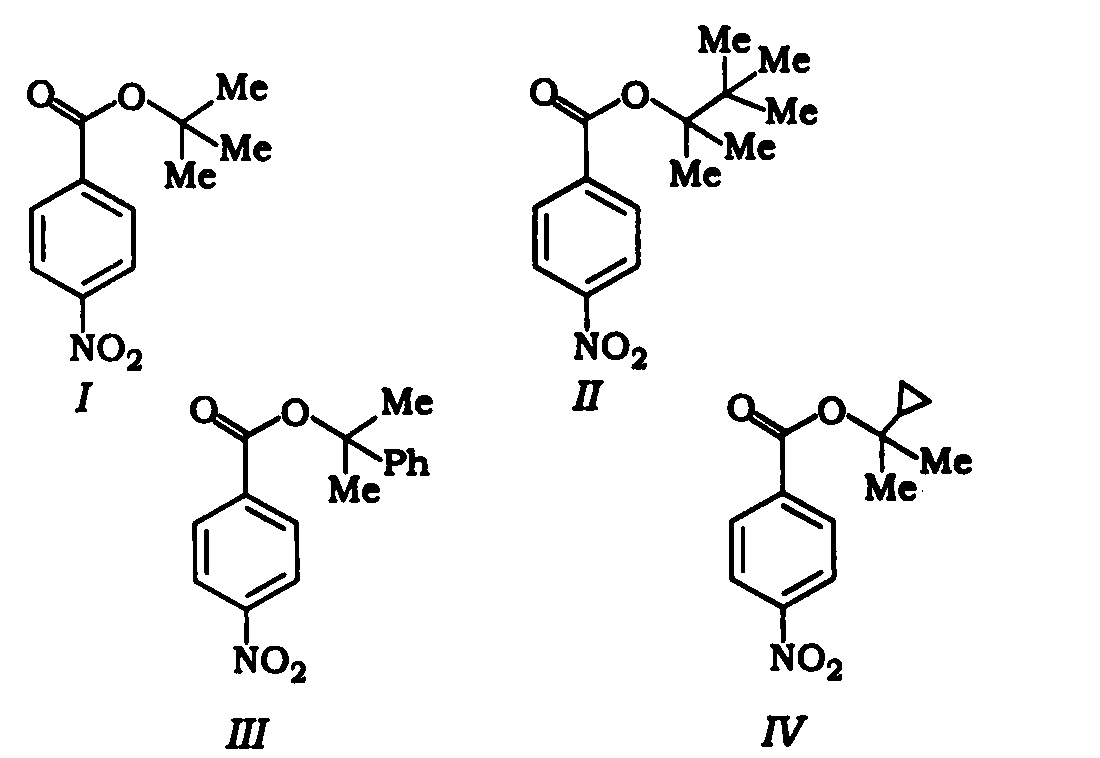
The relative rate of solvolysis in aqueous acetone of the following tertiary p-nitrobenzoate esters is
(a) I < II < III < IV(b) I < IV < II < III(c) IV < I < III < II(d) II < I < IV < III
Answer and explanation with the VKC plan
Q120 Medicinal chemistry / nitrogen mustards, aziridinium ions
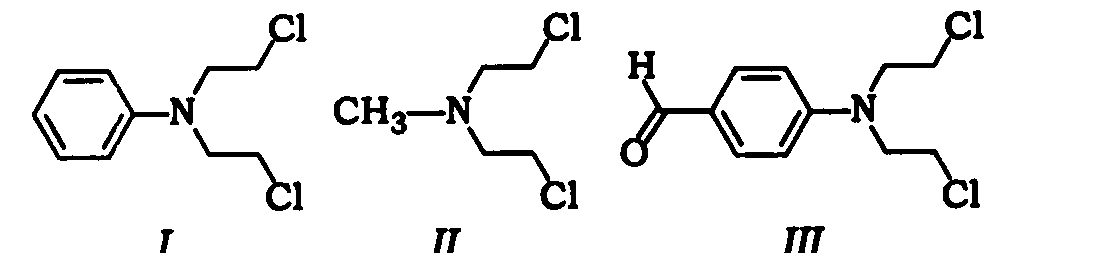
Arrange the following three nitrogen mustards in decreasing order of reactivity towards their possible use as alkylating agents for clinical purpose :
(a) I > III > II(b) II > I > III(c) III > I > II(d) II > III > I
Answer and explanation with the VKC plan