Prelims Paper II 2023 question paper Solutions UPSC Combined Geo-Scientist, Prelims · 2023 · Paper II, Chemistry
UPSC Geo-Scientist Prelims 2023 Chemistry (Paper II): answer key and solutions
All 120 questions of the 2023 Combined Geo-Scientist Prelims Paper II (chemistry), each with the answer and a short explanation in the hint-sheet style: the key fact first, numericals worked with units. Tap a number in the key to jump to the question; every question also has its own page.
Answer key 1 a 2 b 3 b 4 a 5 c 6 a 7 c 8 b 9 d 10 a 11 a 12 a 13 a 14 d 15 c 16 a 17 a 18 a 19 d 20 b 21 b 22 a 23 a 24 c 25 c 26 c 27 d 28 c 29 b 30 b 31 c 32 c 33 d 34 b 35 a 36 a 37 a 38 c 39 d 40 c 41 c 42 a 43 c 44 b 45 b 46 b 47 b 48 c 49 a 50 a 51 c 52 b 53 a 54 b 55 d 56 c 57 b 58 d 59 d 60 d 61 d 62 b 63 c 64 b 65 b 66 d 67 d 68 d 69 b 70 a 71 a 72 c 73 d 74 c 75 c 76 a 77 d 78 c 79 c 80 a 81 a 82 a 83 b 84 b 85 c 86 b 87 d 88 b 89 c 90 c 91 b 92 b 93 d 94 b 95 a 96 b 97 a 98 a 99 a 100 b 101 c 102 b 103 b 104 b 105 b 106 d 107 d 108 c 109 a 110 c 111 c 112 b 113 b 114 b 115 d 116 c 117 b 118 c 119 d 120 d Question paper: read or download the 2023 Paper II paper . Solutions are original work by VKC; question paper belongs to UPSC.
Q1 Atomic structure / penetration and shielding
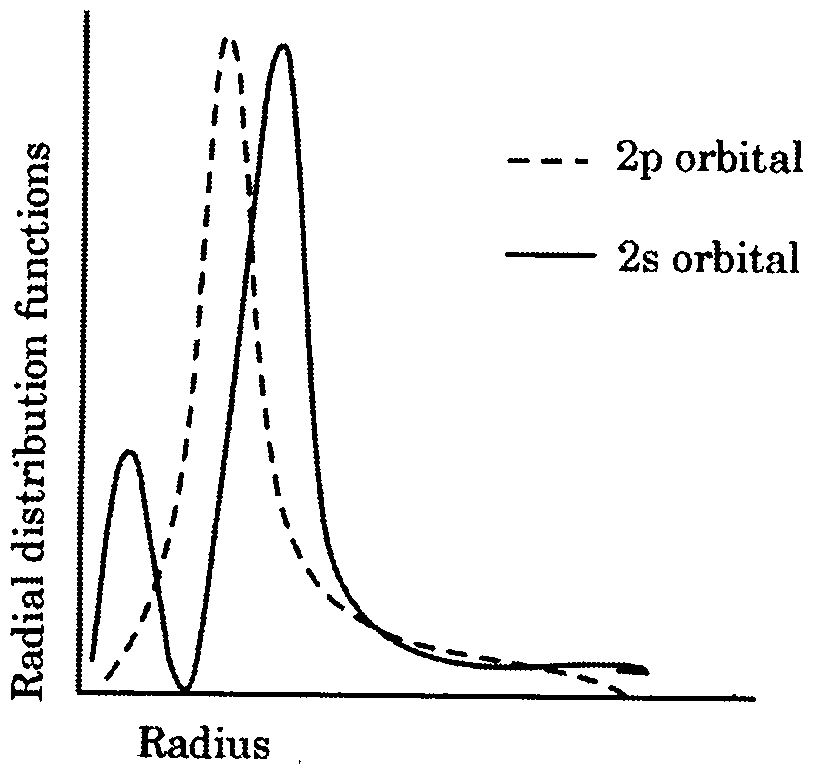
Consider the following diagram regarding the radial distribution function for 2s and 2p orbitals :
Which one of the following statements is a correct conclusion drawn from the diagram given above ?
(a) 2s electrons are less shielded than 2p electrons.(b) 2p electrons are less shielded than 2s electrons.(c) 2s and 2p orbitals have equal probability of closer approach to nucleus.(d) 2s orbital electron density is at a greater distance from nucleus than that of 2p orbital.
The 2s curve has a small inner maximum very close to the nucleus, inside the main 2p maximum. So a 2s electron penetrates the inner core more and feels a larger Z_eff. Greater penetration means less shielding : 2s electrons are less shielded than 2p electrons → (a). Remember: penetration order s > p > d > f, hence energy order ns < np < nd < nf in many-electron atoms.
Read every answer and explanation of this paper with VKC Basic
VKC Basic (₹999 for 6 months) opens every solved answer, the notes, the handbook and the daily answer archive. Every Mains test series includes it.
See what is included Already a member? Sign in
Q2 Atomic structure / wave functions
Which one of the following statements regarding wave functions is not correct ?
(a) The square of the wave function gives the probability of finding the electron in the space.(b) The angular wave function of a given type of orbital is dependent on the principal quantum number.(c) The radial function of 2s orbital is both positive and negative.(d) The probability of finding the electron density is zero at a node in the wave function.
Answer and explanation with the VKC plan
Q3 f-block / electronic configuration
The electronic configuration of an ion M³⁺ generated from an element with atomic number 58 is :
(a) [Xe]4f¹ 5d¹ 6s²(b) [Xe]4f¹(c) [Rn]5f³ 6d¹ 7s²(d) [Rn]5f²
Answer and explanation with the VKC plan
Q4 Atomic structure / filling rules
Which one of the following rules for filling of atomic orbitals is violated in the electronic configuration 1s² 2s² 2pₓ² 2p_y¹ ?
(a) Hund’s rule of maximum multiplicity(b) Pauli’s exclusion principle(c) Aufbau principle(d) Slater’s rule
Answer and explanation with the VKC plan
Q5 d-block / lanthanide contraction
Which one of the following pair of elements will have similar atomic radii in d-block of the periodic table ?
(a) Sc, Ti(b) La, Hf(c) Zr, Hf(d) Fe, Ru
Answer and explanation with the VKC plan
Q6 f-block / lanthanide ions
The number of unpaired electrons in the ground state of Lu³⁺ ion (atomic number 71) is :
(a) Zero(b) One(c) Two(d) Three
Answer and explanation with the VKC plan
Q7 Periodic table / noble gases
The electronic configuration of the outermost shell of all noble gases are ns² np⁶ EXCEPT :
(a) Xe(b) Ar(c) He(d) Ne
Answer and explanation with the VKC plan
Q8 s-block / alkali metals in liquid NH₃
Solutions of alkali metals in liquid ammonia are deep blue irrespective of the type of alkali metal dissolved. The deep blue colour is due to :
(a) Formation of ammoniates of alkali metals(b) Generation of ammoniated electrons in solution(c) Formation of alkali metal amides(d) Formation of alkali metal hydroxides
Answer and explanation with the VKC plan
Q9 Periodic properties / isoelectronic ions
Which one of the following represents the correct order of ionic radii among O²⁻, F⁻, Na⁺, Mg²⁺ and Al³⁺ ?
(a) Al³⁺ > Mg²⁺ > Na⁺ > F⁻ > O²⁻(b) Na⁺ > Mg²⁺ > Al³⁺ > O²⁻ > F⁻(c) Na⁺ > F⁻ > Mg²⁺ > O²⁻ > Al³⁺(d) O²⁻ > F⁻ > Na⁺ > Mg²⁺ > Al³⁺
Answer and explanation with the VKC plan
Q10 Atomic structure / Slater's rules
The effective nuclear charge (Z_eff) at the periphery of O²⁻ ion is :
(a) 3·85(b) 3·50(c) 3·80(d) 3·45
Answer and explanation with the VKC plan
Q11 Periodic properties / electron affinity
Consider the following statements regarding electron affinity :
Electron affinity of fluorine is lower than that of chlorine. Electron affinity of nitrogen is higher than that of phosphorus. Which of the statements given above is/are correct ?
(a) 1 only(b) 2 only(c) Both 1 and 2(d) Neither 1 nor 2
Answer and explanation with the VKC plan
Q12 Periodic properties / ionisation energy
A main group element has the following four successive ionization energies in MJ mol⁻¹ : 0·8995, 1·7571, 14·8487 and 21·0065. The element belongs to which group in the periodic table ?
(a) Group II(b) Group XIII(c) Group XIV(d) Group XVI
Answer and explanation with the VKC plan
Q13 p-block / Group 14 allotropy
Which allotropic form of tin has more metallic character ?
(a) White tin (β-tin)(b) Grey tin (α-tin)(c) Yellow tin (γ-tin)(d) Red tin (δ-tin)
Answer and explanation with the VKC plan
Q14 p-block / catenation
Which one of the following statements regarding catenation is not correct ?
(a) Multiple bond formation leads to decreased catenation property.(b) Catenation is higher if the overlapping atomic orbitals are of small size.(c) Catenation results in formation of long chain compounds by an element.(d) Catenation is observed for electropositive elements.
Answer and explanation with the VKC plan
Q15 s-block / alkali metals in liquid NH₃
Liquid ammonia as a solvent dissolves all alkali metals by solvating metal ions and electrons. However NH₃ itself is not reduced by the solvated electrons present in the solution. This is because :
(a) Solvated electrons lose their reducing power(b) Ammonia binds to solvated metal ions and therefore cannot accept electrons(c) Nitrogen atom in ammonia is already in lowest possible oxidation state(d) Ammonia has electron donor properties
Answer and explanation with the VKC plan
Q16 p-block / oxoacids of phosphorus
The basicity of pyrophosphoric acid, orthophosphorus acid and hypophosphorus acid are respectively :
(a) 4, 2, 1(b) 4, 3, 2(c) 3, 3, 3(d) 3, 2, 1
Answer and explanation with the VKC plan
Q17 p-block / Group 16
Consider the following statements for Group XVI of periodic table :
Oxoacids of sulphur are more numerous than other elements of Group XVI. Sulphur forms most stable dπ-pπ bonds with oxygen. Inert pair effect becomes dominant for heavier members of the group. Which of the statements given above are correct ?
(a) 1, 2 and 3(b) 2 and 3 only(c) 1 and 3 only(d) 1 and 2 only
Answer and explanation with the VKC plan
Q18 p-block / SF₆
SF₆ is inert towards hydrolysis. Which one of the following is not a reason for this ?
(a) SF₆ is oxidizing in nature(b) S-F bond strength is very high(c) Sulphur does not possess vacant d orbitals in this molecule(d) SF₆ is a coordinately saturated molecule
Answer and explanation with the VKC plan
Q19 p-block / oxides of nitrogen
Which one of the following statements regarding oxides of Nitrogen (NO and NO₂) is not correct ?
(a) NO can bind with metal ions to form complexes but NO₂ cannot.(b) NO is a colourless gas but NO₂ is a brown gas.(c) Both NO and NO₂ are oxidizing agents.(d) NO₂ is reluctant to dimerisation while NO dimerises readily.
Answer and explanation with the VKC plan
Q20 Solid state / radius ratio rule
Which of the following statements regarding radius ratio rule is/are correct ?
Radius ratio quite often fails when its value is close to one of the limiting values. Radius ratios are not affected by the polarizability of the electron clouds of ions. Radius ratio rule strictly works if the ions are treated as hard spheres. Radius ratio rule will not work if an ionic compound shows polymorphism. Select the correct answer using the code given below :
(a) 2 only(b) 1, 3 and 4(c) 3 and 4 only(d) 1 and 3 only
Answer and explanation with the VKC plan
Q21 Solid state / packing
The coordination numbers for the elements in ccp, bcc and hcp packing are :
(a) 6, 8 and 12 respectively(b) 12, 8 and 12 respectively(c) 12, 8 and 6 respectively(d) 8, 12 and 6 respectively
Answer and explanation with the VKC plan
Q22 Chemical bonding / Fajans’ rules
Which one of the following represents the correct order of polarizing power among Al³⁺, Na⁺, and Mg²⁺ ?
(a) Na⁺ < Mg²⁺ < Al³⁺(b) Al³⁺ < Mg²⁺ < Na⁺(c) Na⁺ < Al³⁺ < Mg²⁺(d) Al³⁺ < Na⁺ < Mg²⁺
Answer and explanation with the VKC plan
Q23 Solid state / point defects
Schottky defect is observed in a crystal lattice when :
(a) A pair of oppositely charged ions are missing from their lattice positions in a crystal(b) An ion leaves the lattice position and occupies the interstitial position(c) The lattice position of an anion is occupied by an electron(d) Some of the similar charged ions of other elements are present in interstices
Answer and explanation with the VKC plan
Q24 Chemical bonding / VSEPR
Which one of the following is the basis of VSEPR theory ?
(a) Number of bonded pairs of electrons around central atom(b) Number of lone pairs of electrons around central atom(c) Number of bonded and lone pairs of electrons around central atom(d) Number of hybrid orbital atoms of central atom
Answer and explanation with the VKC plan
Q25 Chemical bonding / fluxional molecules
In which one of the following geometries is Berry pseudorotation observed ?
(a) Triangular planar(b) Square planar(c) Trigonal bipyramidal(d) Octahedral
Answer and explanation with the VKC plan
Q26 Chemical bonding / resonance
Consider the following statements regarding the resonating structures contributing to the resonance hybrid of a molecule :
Contributing structures should have same number of unpaired electrons. Contributing structures should have negative charge residing on more electronegative atom. Contributing structures should not have large energy difference between them. Which of the statements given above is/are correct ?
(a) 1 only(b) 1 and 2 only(c) 1, 2 and 3(d) 2 and 3 only
Answer and explanation with the VKC plan
Q27 Coordination chemistry / Werner’s theory
Cobalt (III) chloride forms several octahedral complexes with ammonia. Which one of the following will not give test of chloride ions with AgNO₃ at 25°C ?
(a) CoCl₃.6NH₃(b) CoCl₃.5NH₃(c) CoCl₃.4NH₃(d) CoCl₃.3NH₃
Answer and explanation with the VKC plan
Q28 Coordination chemistry / ligands
Which one of the following group of species contains all ambidentate ligands ?
(a) C₂O₄²⁻, CO₃²⁻, NO₃⁻(b) SCN⁻, NO₂⁻, NO₃⁻(c) CN⁻, NO₂⁻, SCN⁻(d) CN⁻, CO, PPh₃
Answer and explanation with the VKC plan
Q29 Coordination chemistry / nomenclature
Which one of the following is the correct IUPAC name of Na₂[Fe(CN)₅NO] ?
(a) Sodium pentacyanonitrosylferrate(0)(b) Sodium pentacyanonitrosylferrate(II)(c) Sodium pentacyanonitrosylferrate(I)(d) Sodium pentacyanonitrosylferrate(III)
Answer and explanation with the VKC plan
Q30 Coordination chemistry / isomerism
The number of geometrical isomers possible for tetrahedral coordination compounds [MA₄], [MA₂B₂] and [MABCD] are : (where, M is the metal and A, B, C and D are ligands)
(a) 0, 2, 2 respectively(b) 0, 0, 0 respectively(c) 0, 2, 3 respectively(d) 0, 3, 3 respectively
Answer and explanation with the VKC plan
Q31 Coordination chemistry / optical isomerism
Which one of the following complexes shows optical isomerism ?
(a) [ZnCl₄]²⁻(b) [Co(CN)₆]³⁻(c) [Cr(C₂O₄)₃]³⁻(d) [Cu(NH₃)₄]²⁺
Answer and explanation with the VKC plan
Q32 Chemical equilibrium / Le Chatelier
Consider the following equilibrium reaction : N₂(g) + O₂(g) ⇌ 2NO(g) ΔH = 180 kJ mol⁻¹
The volume change at constant pressure does not affect the equilibrium The formation of NO is increased at higher temperature The formation of NO is decreased at higher temperature The pressure change at constant volume does not affect the equilibrium Which of the following are true for the equilibrium reaction given above ? Select the correct answer using the code given below :
(a) 1 and 2 only(b) 3 and 4 only(c) 1, 2 and 4(d) 1, 3 and 4
Answer and explanation with the VKC plan
Q33 Ionic equilibrium / Brønsted acids and bases
Which one of the following is the conjugate base of H₂PO₄⁻ ?
(a) PO₄³⁻(b) P₂O₅(c) H₃PO₄(d) HPO₄²⁻
Answer and explanation with the VKC plan
Q34 Ionic equilibrium / water
The process of self-ionization of water to give H₃O⁺ and OH⁻ is called :
(a) Neutralization(b) Autoprotolysis(c) Dissociation(d) Hydrolysis
Answer and explanation with the VKC plan
Q35 Ionic equilibrium / pH
What will be the approximate concentration of H⁺ in a solution having pH 5·5 ?
(a) 3·2 × 10⁻⁶ M(b) 2·4 × 10⁻⁶ M(c) 1·6 × 10⁻⁶ M(d) 1·2 × 10⁻⁶ M
Answer and explanation with the VKC plan
Q36 Ionic equilibrium / salt hydrolysis
100 mL of 0·1 M ethanoic acid solution is neutralized with 0·1 M sodium hydroxide solution. The pH of the solution at the equivalence point will be : (where, pKₐ of CH₃COOH is 4·76 and log 0·05 = − 1·30)
(a) 8·73(b) 8·37(c) 9·38(d) 9·83
Answer and explanation with the VKC plan
Q37 Solutions / concentration terms
Specific gravity of a solution is defined as :
(a) Ratio of mass of a solution to the mass of an equal volume of water(b) Ratio of molarities of two solutions(c) Ratio of normalities of two solutions(d) Ratio of volumes of two solutions
Answer and explanation with the VKC plan
Q38 Analytical chemistry / primary standards
Which one of the following statements regarding Ammonium Ferrous Sulphate is not correct ?
(a) It’s composition is constant.(b) It’s aqueous solutions tend to undergo hydrolysis.(c) It contains considerable amount of Fe³⁺ owing to aerial oxidation.(d) It’s standard solution can be prepared by direct weighing.
Answer and explanation with the VKC plan
Q39 Analytical chemistry / permanganometry
A solution of oxalic acid needs to be heated up to 60°C before titrating with potassium permanganate solution. Which one of the following is not a reason for this ?
(a) It helps in removal of dissolved carbon dioxide from the solution(b) It helps in increasing the rate of reaction(c) High temperature decomposes [Mn(C₂O₄)₃]³⁻ complex if formed during the titration(d) Oxalic acid precipitates at room temperature
Answer and explanation with the VKC plan
Q40 Analytical chemistry / iodometry
During iodometric titration of CuSO₄ solution with Na₂S₂O₃ solution, a student used starch solution as the indicator. However the blue black colour obtained with the indicator did not disappear even after adding the required amount of Na₂S₂O₃ from the burette (end point). What possibly could be the mistake done in this titration ?
(a) Starch solution is not a suitable indicator for iodometric titration(b) Freshly prepared starch solution was not used(c) Starch solution was added in the beginning of the titration(d) The reaction medium was acidic
Answer and explanation with the VKC plan
Q41 Gaseous state / real gases
Consider the following statements regarding a gas described by Van der Waals equation :
It behaves similar to an ideal gas at high temperatures. It behaves similar to an ideal gas at high pressures. It is characterized by Van der Waals constants that are dependent on the nature of the gas. It has a pressure that is lower than the pressure exerted by the same gas behaving ideally. Which of the statements given above are correct ?
(a) 1 and 2 only(b) 2, 3 and 4 only(c) 1, 3 and 4 only(d) 1, 2, 3 and 4
Answer and explanation with the VKC plan
Q42 Gaseous state / Maxwell distribution
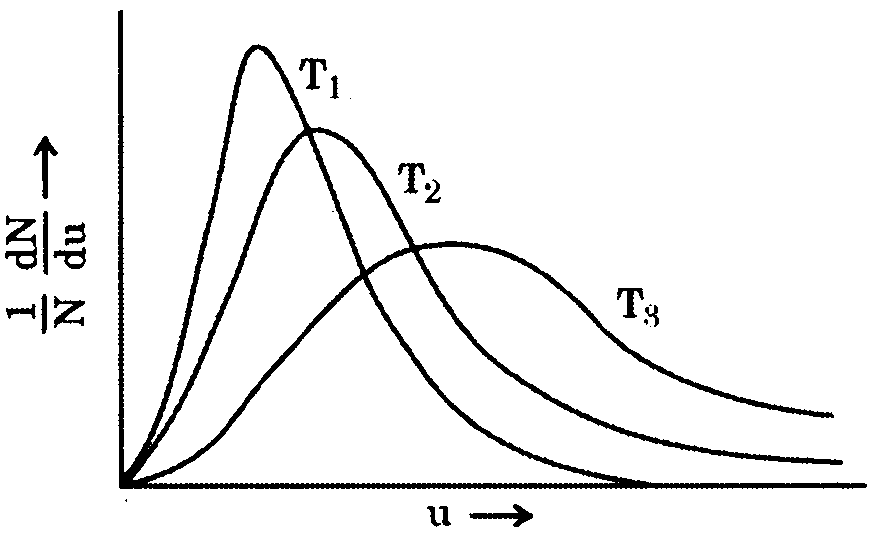
Consider the following graph for Maxwell-Boltzmann distribution of speeds :
Which one of the following represents the correct order of temperatures in the graph given above ?
(a) T₁ < T₂ < T₃(b) T₃ < T₂ < T₁(c) T₁ < T₃ < T₂(d) T₂ < T₁ < T₃
Answer and explanation with the VKC plan
Q43 Gaseous state / Boyle temperature
What will be the Boyle temperature of H₂ gas, if its Van der Waals constants a and b are 22·0 kPa dm⁶ mol⁻² and 0·024 dm³ mol⁻¹ respectively ? (where, R = 8·3 kPa dm³ K⁻¹ mol⁻¹)
(a) 56°C(b) 110°C(c) − 163°C(d) − 249°C
Answer and explanation with the VKC plan
Q44 Gaseous state / molecular speeds
At 150 K, the root mean square speed of a gas A (molar mass = 30 g mol⁻¹) is equal to the most probable speed of the gas B at 300 K. The molar mass of gas B is :
(a) 30 g mol⁻¹(b) 40 g mol⁻¹(c) 50 g mol⁻¹(d) 60 g mol⁻¹
Answer and explanation with the VKC plan
Q45 Gaseous state / compressibility factor
Consider the following statements regarding the compressibility factor (Z) : Statement-1 : Z is greater than unity at all pressures for H₂ gas. Statement-2 : For N₂ gas, Z is less than unity in the lower pressure range and is greater than unity at very high pressures.
Which one of the following is correct in respect of the above statements ?
(a) Both Statement-1 and Statement-2 are true and Statement-2 is the correct explanation of Statement-1.(b) Both Statement-1 and Statement-2 are true, but Statement-2 is not the correct explanation of Statement-1.(c) Statement-1 is true, but Statement-2 is false.(d) Statement-1 is false, but Statement-2 is true.
Answer and explanation with the VKC plan
Q46 Gaseous state / Graham’s law
Equal volumes of two gases X and Y diffused through a porous pot in 20 s and 10 s respectively. The molar mass of gas X is 200 g mol⁻¹. The molar mass of Y will be :
(a) 20 g mol⁻¹(b) 50 g mol⁻¹(c) 80 g mol⁻¹(d) 100 g mol⁻¹
Answer and explanation with the VKC plan
Q47 Gaseous state / collision frequency
Consider the following statements regarding the number of collisions made by a single molecule (Z₁) in unit time :
It is directly proportional to pressure. It is inversely proportional to temperature. It is inversely proportional to square root of temperature. It is independent of the effect of temperature and pressure. Which of the statements given above is/are correct ?
(a) 1 and 2(b) 1 and 3(c) 3 only(d) 4 only
Answer and explanation with the VKC plan
Q48 Thermodynamics / work in expansion
Consider the following statements regarding Isothermal and Adiabatic processes :
Work done in a reversible isothermal process is the maximum work done. Adiabatic work of expansion is greater than the isothermal work of expansion of an ideal gas. Reversible and isothermal work of expansion for an ideal gas is less than that for a Van der Waals gas. In an adiabatic expansion of a gas, cooling is produced. Which of the statements given above are correct ?
(a) 1 and 2 only(b) 3 and 4 only(c) 1 and 4 only(d) 1, 3 and 4
Answer and explanation with the VKC plan
Q49 Thermodynamics / isothermal process
Consider 2·0 mol of an ideal gas being compressed reversibly from 1·0 bar to 100·0 bar at 27°C. The values of ΔU, ΔH and w are respectively : (where, R = 8·3 J K⁻¹ mol⁻¹, ln 10 = 2·3)
(a) 0, 0, 23 kJ(b) 0, 23 0 kJ(c) 0, 10, 0 kJ(d) 0, 0, 10 kJ
Answer and explanation with the VKC plan
Q50 Thermodynamics / partial derivatives
Considering U as a function of variables T and V, which one of the following expressions is correct for \(\left(\frac{\partial U}{\partial p}\right)_T\) ?
(a) \(\left(\frac{\partial U}{\partial p}\right)_T = \left(\frac{\partial U}{\partial V}\right)_T \left(\frac{\partial V}{\partial p}\right)_T\) (b) \(\left(\frac{\partial U}{\partial p}\right)_T = -\left(\frac{\partial U}{\partial V}\right)_p \left(\frac{\partial V}{\partial p}\right)_T\) (c) \(\left(\frac{\partial U}{\partial p}\right)_T = \left(\frac{\partial U}{\partial T}\right)_p \left(\frac{\partial V}{\partial U}\right)_p\) (d) \(\left(\frac{\partial U}{\partial p}\right)_T = -\left(\frac{\partial U}{\partial V}\right)_T \left(\frac{\partial V}{\partial p}\right)_T\)
Answer and explanation with the VKC plan
Q51 Thermodynamics / cyclic rule
For a cyclic process of one mole of an ideal gas, the value of \(\left(\frac{\partial p}{\partial T}\right)_V \left(\frac{\partial T}{\partial V}\right)_p \left(\frac{\partial V}{\partial p}\right)_T\) is :
(a) \(\frac{-R^2}{p^2}\) (b) + 1(c) − 1(d) \(\frac{R^2}{p^2}\)
Answer and explanation with the VKC plan
Q52 Thermochemistry / Hess’s law
In the refining of sulphide ores, the ore is roasted with oxygen to form metal oxide and SO₂ (g). The Δ_rH°₂₉₈ for the roasting of sphalerite (ZnS) will be : (where, Δ_fH°₂₉₈ (ZnS) = − 206 kJ mol⁻¹, Δ_fH°₂₉₈ (ZnO) = − 348 kJ mol⁻¹ and Δ_fH°₂₉₈ (SO₂) = − 296 kJ mol⁻¹)
(a) − 238 kJ(b) − 438 kJ(c) − 583 kJ(d) − 590 kJ
Answer and explanation with the VKC plan
Q53 Thermodynamics / Joule–Thomson effect
The final temperature of one mole of a gas when it undergoes expansion from an initial pressure of 200 bar to a final pressure of 1 bar under isenthalpic conditions at 27°C is : (where, μ_JT = 0·10 K bar⁻¹)
(a) 7°C(b) 17°C(c) 27°C(d) 37°C
Answer and explanation with the VKC plan
Q54 Thermochemistry / Kirchhoff’s equation
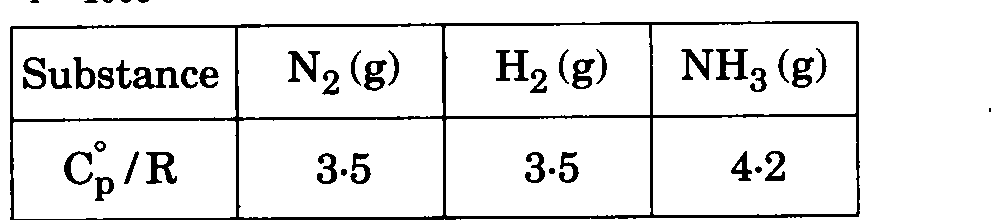
Consider the following data table for the reaction N₂ (g) + 3H₂ (g) ⟶ 2NH₃ (g) Δ_rH°₁₀₀₀ = − 124 kJ mol⁻¹ at 1000 K : (where, R = 8·3 J K⁻¹ mol⁻¹)
What will be the approximate heat of formation of NH₃ at 300 K ?
(a) − 35·0 kJ mol⁻¹(b) − 45·7 kJ mol⁻¹(c) − 55·4 kJ mol⁻¹(d) − 65·8 kJ mol⁻¹
Answer and explanation with the VKC plan
Q55 Thermodynamics / Carnot efficiency
A steam engine operates between 300 K and 200 K under high pressures. The minimum amount of heat that must be drawn from the hot reservoir to obtain 1000 J of work is :
(a) 600 J(b) 800 J(c) 2000 J(d) 3000 J
Answer and explanation with the VKC plan
Q56 Thermodynamics / entropy change
What will be the overall change in entropy for the following process using 1·00 mole of He ? He (300 K, 1·20 atm) ⟶ He (100 K, 12·0 atm) (where, heat capacity of He is 21 J K⁻¹ mol⁻¹; R = 8·3 J K⁻¹ mol⁻¹, ln 10 = 2·3, log 3 = 0·48; assume the helium acts ideally)
(a) − 19·1 J K⁻¹(b) − 23·2 J K⁻¹(c) − 42·4 J K⁻¹(d) − 51·3 J K⁻¹
Answer and explanation with the VKC plan
Q57 Thermodynamics / Gibbs–Helmholtz equation
The term \(\left[\frac{\partial (G/T)}{\partial T}\right]_p\) is equal to :
(a) \(\frac{-S}{T}\) (b) \(\frac{-H}{T^2}\) (c) − H(d) − S
Answer and explanation with the VKC plan
Q58 Thermodynamics / basic concepts
For maintaining thermodynamic equilibrium, a system should be in :
(a) Thermal equilibrium and mechanical equilibrium only(b) Thermal equilibrium and chemical equilibrium only(c) Mechanical equilibrium and chemical equilibrium only(d) Thermal, mechanical and chemical equilibrium
Answer and explanation with the VKC plan
Q59 Thermodynamics / criteria of spontaneity
Which of the following expressions regarding the criteria for spontaneity of chemical processes are correct ?
dS_{U,V} ≥ 0 dU_{S,V} ≥ 0 dA_{T,V} ≤ 0 dG_{T,p} ≤ 0 Select the correct answer using the code given below :
(a) 3 and 4 only(b) 1 and 3 only(c) 1, 2 and 3(d) 1, 3 and 4
Answer and explanation with the VKC plan
Q60 Solutions / van’t Hoff factor
Match the List-I with List-II and select the correct answer using the code given below the lists :
List-I (Substance) List-II (Limiting value of Van’t Hoff factor, i) A. NaCl 1. One B. C₆H₁₂O₆ 2. Three C. K₃PO₄ 3. Two D. H₂SO₄ 4. Four
Code :
(a) A-2, B-1, C-4, D-3(b) A-2, B-4, C-1, D-3(c) A-3, B-4, C-1, D-2(d) A-3, B-1, C-4, D-2
Answer and explanation with the VKC plan
Q61 Solutions / Raoult’s law
Two components A and B have their pure vapour pressure in the ratio 1 : 6 and respective mole fractions in the solution in the ratio 1 : 4. The mole fraction of the component B in the vapour phase will be :
(a) 0·14(b) 0·25(c) 0·56(d) 0·96
Answer and explanation with the VKC plan
Q62 Solutions / relative lowering of vapour pressure
When 2·0 g of solute X is added to 1000 mL of pure water, the vapour pressure of water is decreased by : (where, vapour pressure of pure water = 2·34 kPa at 20°C, molar mass of X = 200 g mol⁻¹)
(a) 0·00018 kPa(b) 0·00042 kPa(c) 0·0031 kPa(d) 0·0042 kPa
Answer and explanation with the VKC plan
Q63 Solutions / van’t Hoff factor
An aqueous solution of K₂SO₄ of 0·004 M concentration is isotonic with 0·01 M aqueous solution of glucose. The degree of dissociation of K₂SO₄ will be :
(a) 25%(b) 30%(c) 75%(d) 85%
Answer and explanation with the VKC plan
Q64 Solutions / colligative properties
Which one of the following compounds will show the largest increase in boiling point when added to an aqueous solution ?
(a) 2 mol MgSO₄(b) 2 mol Ca(OH)₂(c) 2 mol NaCl(d) 1 mol CaCl₂
Answer and explanation with the VKC plan
Q65 Solutions / association and freezing point
Three particles of a solute A, associate in benzene to form species A₃. The degree of association of solute A is found to be 0·75. The freezing point of benzene and its freezing point depression constant are 5·5°C and 5·0 K kg mol⁻¹ respectively. The freezing point of 0·25 molal solution of A will be :
(a) 3·9°C(b) 4·9°C(c) 5·9°C(d) 6·9°C
Answer and explanation with the VKC plan
Q66 Solutions / Henry’s law
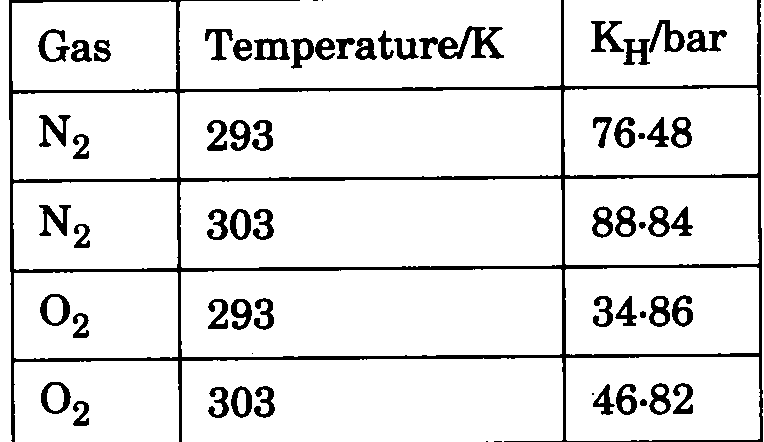
Consider the following table regarding Henry’s Law constant values for N₂ and O₂ gas in water at different temperatures :
Which one of the following statements is correct in respect of the table given above ?
(a) N₂ is more soluble than O₂ and the solubility decreases with decrease in temperature.(b) O₂ is more soluble than N₂ and the solubility decreases with decrease in temperature.(c) N₂ is more soluble than O₂ and the solubility increases with decrease in temperature.(d) O₂ is more soluble than N₂ and the solubility increases with decrease in temperature.
Answer and explanation with the VKC plan
Q67 Electrochemistry / Kohlrausch’s law
If the limiting molar conductance values of Ba²⁺ and Cl⁻ are 127 S cm² mol⁻¹ and 76 S cm² mol⁻¹ respectively, then molar conductance at infinite dilution for BaCl₂ will be :
(a) 203 S m² mol⁻¹(b) 279 S m² mol⁻¹(c) 203 × 10⁻⁴ S m² mol⁻¹(d) 279 × 10⁻⁴ S m² mol⁻¹
Answer and explanation with the VKC plan
Q68 Electrochemistry / conductivity
Which one of the following solutions has the least value of conductivity ?
(a) 0·01 M Na₂SO₄(b) 0·01 M KCl(c) 0·01 M HCl(d) 0·01 M CH₃COOH
Answer and explanation with the VKC plan
Q69 Electrochemistry / ionic mobility
A potential of 5·0 V is applied to two electrodes placed 10·0 cm apart. How far would a sodium ion be expected to move in 1 hour in a dilute solution of a sodium salt at 25°C ? (where, λ(Na⁺) = 50 S cm² mol⁻¹ and Faraday’s constant = 96500 C mol⁻¹)
(a) 1·13 cm(b) 0·93 cm(c) 0·56 cm(d) 0·46 cm
Answer and explanation with the VKC plan
Q70 Electrochemistry / Walden’s rule
Consider the following statements regarding Walden’s rule : Statement-1 : Walden’s rule is not applicable to ions of small size. Statement-2 : Small sized ions have high charge density, as a result they are highly solvated.
Which one of the following is correct in respect of the above statements ?
(a) Both Statement-1 and Statement-2 are true and Statement-2 is the correct explanation of Statement-1.(b) Both Statement-1 and Statement-2 are true, but Statement-2 is not the correct explanation of Statement-1.(c) Statement-1 is true, but Statement-2 is false.(d) Statement-1 is false, but Statement-2 is true.
Answer and explanation with the VKC plan
Q71 Electrochemistry / Kohlrausch plots
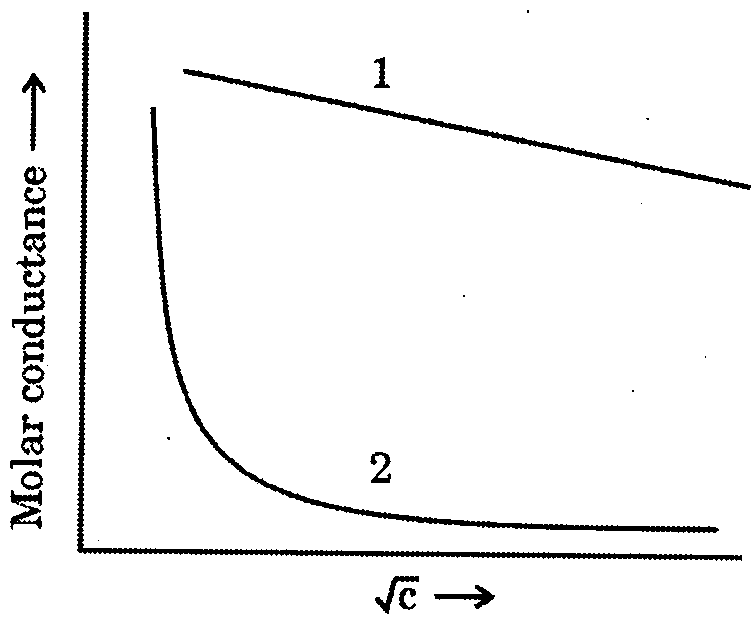
Consider the following graph showing variation of molar conductance with concentration :
The electrolytes associated with 1 and 2 respectively are :
(a) KCl and CH₃COOH(b) NH₄OH and CH₃COOH(c) CH₃COOH and NaCl(d) NaCl and KCl
Answer and explanation with the VKC plan
Q72 Electrochemistry / abnormal ionic mobility
Amide ion in liquid ammonia has abnormally high transport number because of :
(a) High frequency(b) Abnormally high charge density(c) Proton jump from one ammonia molecule to another(d) Decrease in viscosity
Answer and explanation with the VKC plan
Q73 Electrochemistry / Wien and Debye–Falkenhagen effects
Consider the following statements regarding Wien and Debye-Falkenhagen effects :
In very high electric fields (E > 10⁷ V/m), an increase in conductivity is observed as the asymmetry effect disappears. In very high electric fields (E > 10⁷ V/m), an increase in conductivity is observed as the electrophoretic effect disappears. At high frequencies, a decrease in conductivity is observed as the electrophoretic effect disappears. At high frequencies, an increase in conductivity is observed as the asymmetry effect and electrophoretic effect disappear. Which of the statements give above are correct ?
(a) 1 and 3 only(b) 2 and 3 only(c) 1, 3 and 4(d) 1 and 4 only
Answer and explanation with the VKC plan
Q74 Electrochemistry / solubility from conductance
The conductivity and molar conductance of a saturated solution of BaSO₄ are 3 × 10⁻⁶ S cm⁻¹ and 150 S cm² mol⁻¹, respectively. The K_sp for BaSO₄ will be :
(a) 2 × 10⁻¹⁰(b) 2 × 10⁻¹⁶(c) 4 × 10⁻¹⁰(d) 4 × 10⁻¹⁶
Answer and explanation with the VKC plan
Q75 Electrochemistry / Ostwald dilution law
The molar conductivity of acetic acid solution at infinite dilution is 390 S cm² mol⁻¹. The molar conductivity of 0·01 M acetic acid solution is : (where, dissociation constant of acetic acid is 1·8 × 10⁻⁵)
(a) 1·654 S cm² mol⁻¹(b) 1·853 S cm² mol⁻¹(c) 16·54 S cm² mol⁻¹(d) 18·53 S cm² mol⁻¹
Answer and explanation with the VKC plan
Q76 Electrochemistry / conductometric titration
In a conductometric titration of Hydrochloric Acid (HCl) against Ammonium Hydroxide (NH₄OH), with the increase of volume of NH₄OH, the conductance will :
(a) Fall first and after neutralization show no appreciable change.(b) Fall first and after neutralization rise sharply.(c) Rise slowly and after neutralization rise sharply.(d) Remain more or less the same and after neutralization rise sharply.
Answer and explanation with the VKC plan
Q77 Electrochemistry / conductometric titration
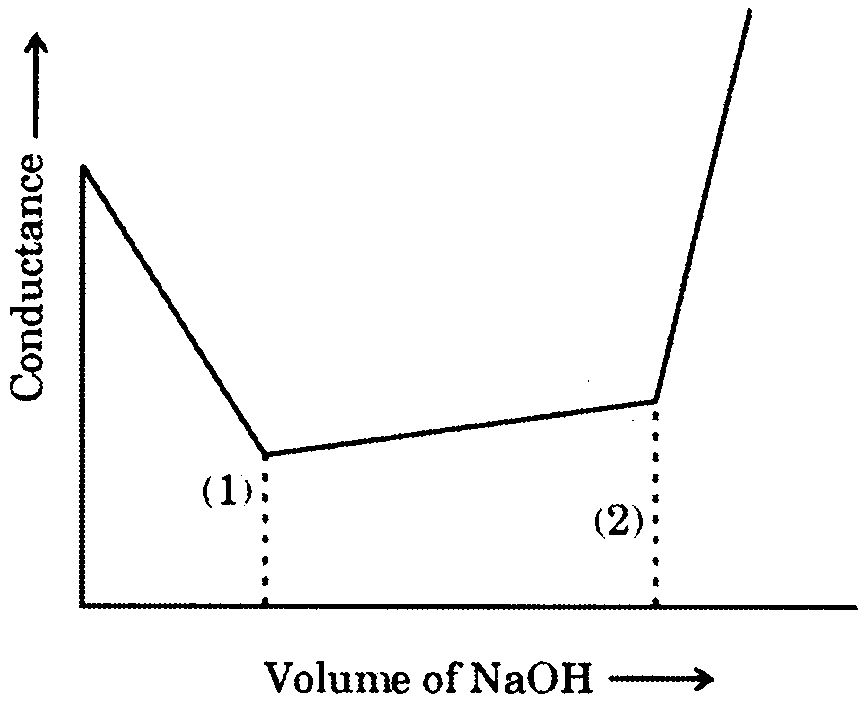
Consider the following conductometric titration of a mixture of HCl and CH₃COOH against NaOH. The volume corresponding to points (1) and (2) are 6·0 mL and 16·0 mL respectively. The volume of NaOH used for neutralisation of HCl and CH₃COOH are :
(a) 10·0 mL and 6·0 mL respectively(b) 6·0 mL and 16·0 mL respectively(c) 16·0 mL and 10·0 mL respectively(d) 6·0 mL and 10·0 mL respectively
Answer and explanation with the VKC plan
Q78 Electrochemistry / moving boundary method
Which of the following statements is/are correct regarding indicator electrolyte in the moving boundary method to determine the transport number of an ion ?
The anions must be different in both the indicator and principal electrolyte. The cation of the indicator electrolyte should move slower than the cation of the principal electrolyte. The indicator electrolyte should be more dense than the principal electrolyte. Select the correct answer using the code given below :
(a) 1, 2 and 3(b) 1 and 2 only(c) 2 and 3 only(d) 3 only
Answer and explanation with the VKC plan
Q79 Electrochemistry / transport number
A solution of 0·01 M electrolyte (AX) with conductivity 4 × 10⁻³ S cm⁻¹ is placed in a moving boundary cell of cross-sectional area 3·0 cm². It was electrolysed for 45 min. with a constant current of 3·0 mA. The observed boundary moved 2·0 cm. The transport number of the cation A⁺ is : (where, Faraday’s constant = 96500 C mol⁻¹)
(a) 0·30(b) 0·52(c) 0·71(d) 0·83
Answer and explanation with the VKC plan
Q80 Electrochemistry / transport number
Which one of the following statements regarding transport number of the Cl⁻ ion is correct ?
(a) Transport number of Cl⁻ ion in aqueous solution of HCl is lower than the transport number of Cl⁻ ion in aqueous solution of NaCl.(b) Transport number of Cl⁻ ion in aqueous solution of HCl is higher than the transport number of Cl⁻ ion in aqueous solution of NaCl.(c) Transport numbers of Cl⁻ ion in aqueous solutions of HCl and NaCl are equal.(d) The transport number of Cl⁻ ion is the same in aqueous solutions of NaCl and KCl.
Answer and explanation with the VKC plan
Q81 Organic / resonance and steric inhibition
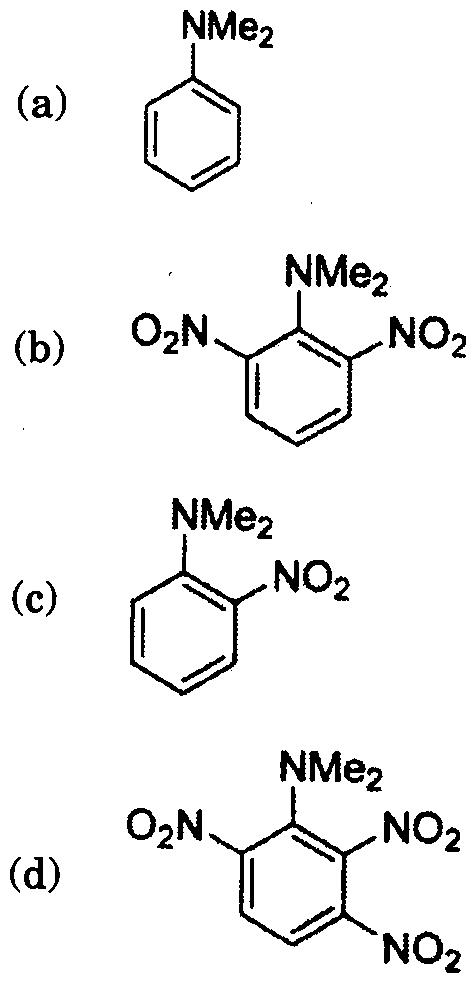
Which one of the following compounds is most stabilized by resonance ?
(a) N,N-Dimethylaniline (PhNMe₂)(b) 2,6-Dinitro-N,N-dimethylaniline(c) 2-Nitro-N,N-dimethylaniline(d) 2,3,6-Trinitro-N,N-dimethylaniline
Answer and explanation with the VKC plan
Q82 Organic / carbocation stability
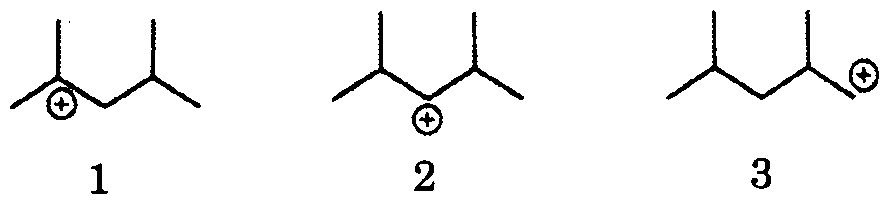
The relative order of stability of the following carbocations is :
(a) 3 < 2 < 1(b) 1 < 2 < 3(c) 2 < 3 < 1(d) 1 < 3 < 2
Answer and explanation with the VKC plan
Q83 Organic / heat of hydrogenation and conjugation
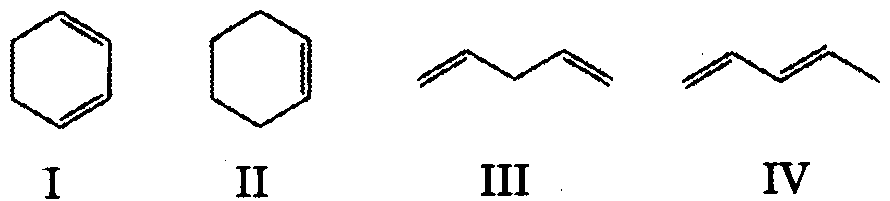
The correct order of heats of hydrogenation among the following alkenes (when hydrogenation is carried out in the presence of a platinum catalyst) is :
(a) I < II < IV < III(b) II < IV < I < III(c) II < I < IV < III(d) I < II < III < IV
Answer and explanation with the VKC plan
Q84 Organic / π molecular orbitals
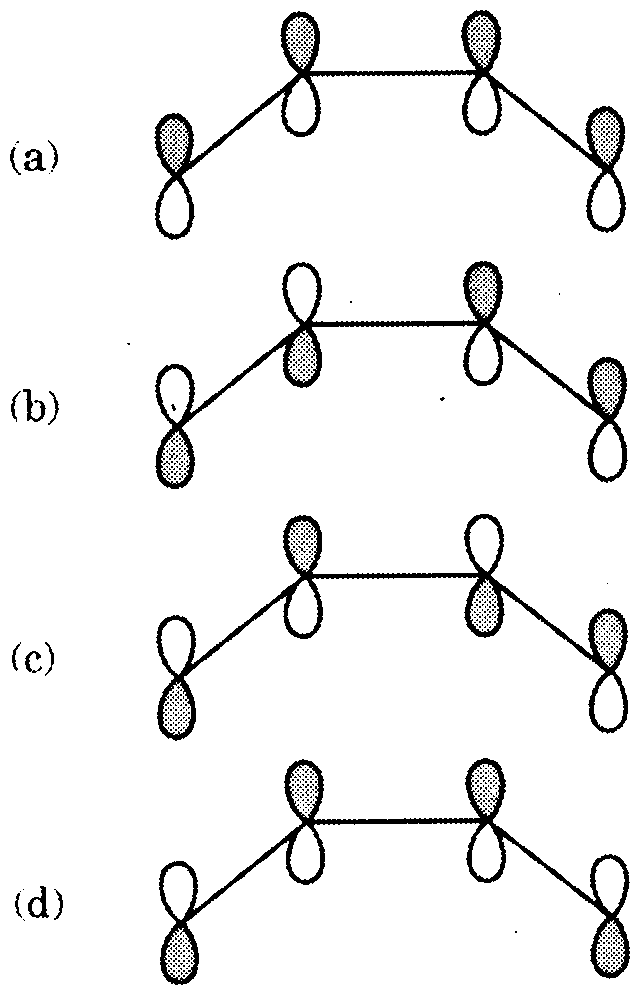
Which one of the following represents the high-energy Highest Occupied Molecular Orbital (HOMO) of 1,3-butadiene ?
(a) All four p orbitals in phase (no node)(b) C1, C2 in one phase and C3, C4 in the opposite phase (one node at the centre)(c) Phases alternate at every carbon (three nodes)(d) C2, C3 in one phase and C1, C4 in the opposite phase (two nodes)
Answer and explanation with the VKC plan
Q85 Organic / free radicals
Which one of the following statements regarding free radicals is not correct ?
(a) Carbon free radical is paramagnetic in nature.(b) Free radicals are formed by homolytic bond fission.(c) Stability order of free radicals for the following species is : H₂C=CHĊH₂ > Ph₃Ċ > Ph₂ĊH > PhĊH₂.(d) p-Benzoquinone acts as an inhibitor for free-radical reactions.
Answer and explanation with the VKC plan
Q86 Organic / carbocation stability
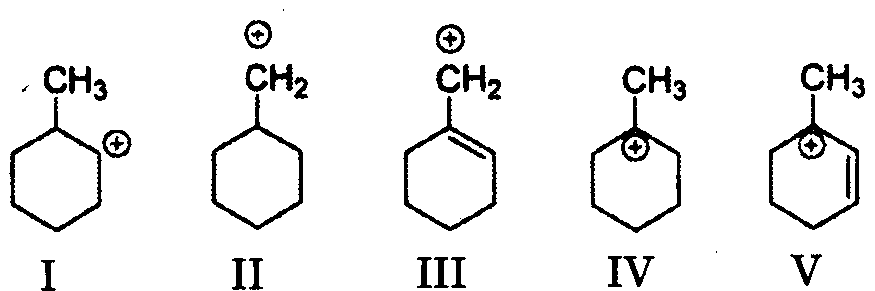
The correct order of stability of following carbocations is :
(a) IV > III > V > II > I(b) V > III > IV > I > II(c) II > I > IV > III > V(d) V > IV > III > II > I
Answer and explanation with the VKC plan
Q87 Stereochemistry / symmetry elements
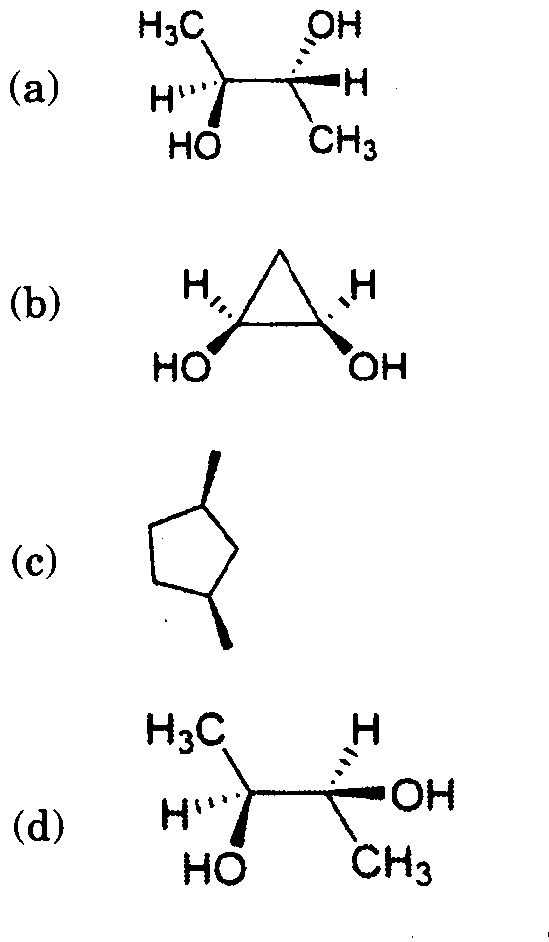
Which one of the following compounds does not contain plane of symmetry ?
(a) Butane-2,3-diol drawn as (2R,3S) (meso)(b) cis-Cyclopropane-1,2-diol(c) cis-1,3-Dimethylcyclopentane(d) Butane-2,3-diol drawn as (2S,3S)
Answer and explanation with the VKC plan
Q88 Stereochemistry / isomer relationships
The two compounds given below are :
(a) Identical(b) Constitutional isomers(c) Diastereomers(d) Enantiomers
Answer and explanation with the VKC plan
Q89 Stereochemistry / meso compounds
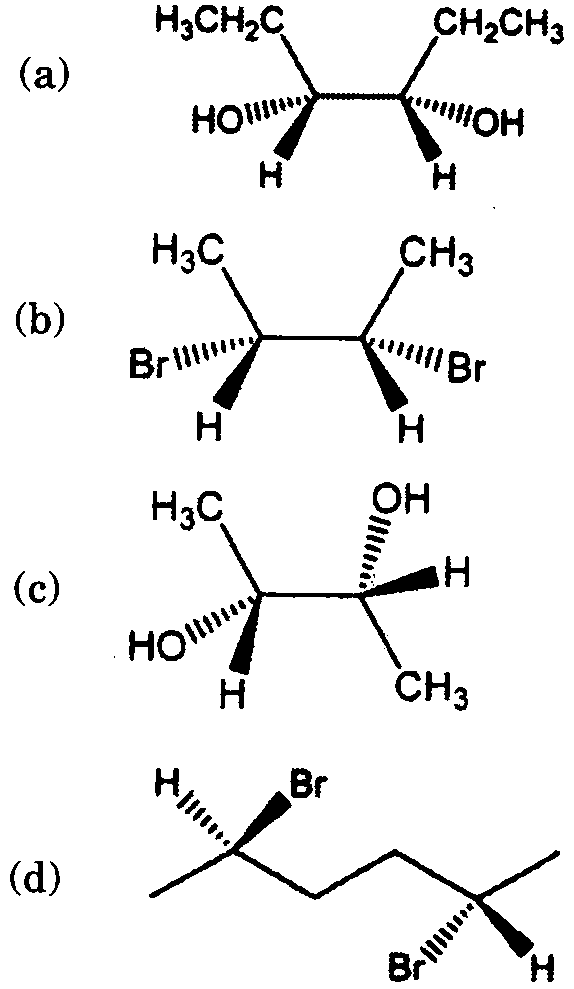
Which one of the following is not a meso compound ?
(a) Hexane-3,4-diol drawn as (3R,4S)(b) 2,3-Dibromobutane drawn as (2R,3S)(c) Butane-2,3-diol drawn as (2R,3R)(d) 2,5-Dibromohexane drawn as (2R,5S)
Answer and explanation with the VKC plan
Q90 Stereochemistry / CIP R,S
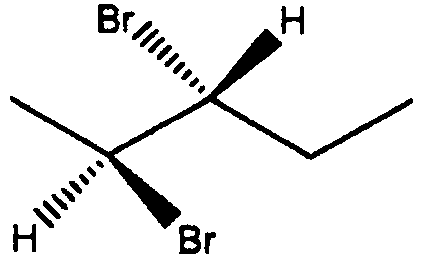
The correct IUPAC name of the following compound is :
(a) (2S, 3S)-2,3-dibromopentane(b) (2R, 3R)-2,3-dibromopentane(c) (2S, 3R)-2,3-dibromopentane(d) (2R, 3S)-2,3-dibromopentane
Answer and explanation with the VKC plan
Q91 Conformational analysis / cyclohexanes
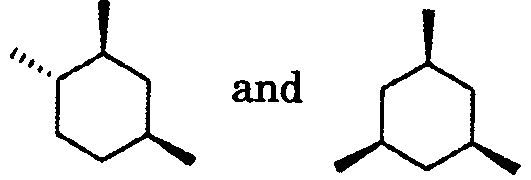
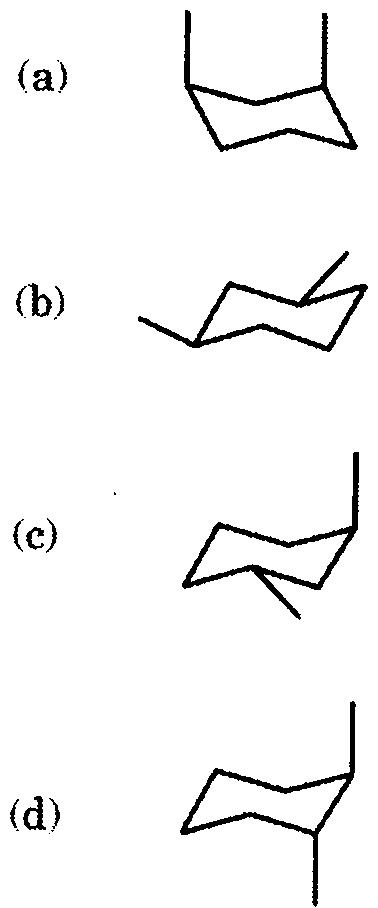
The most stable conformer of cis-1, 3-dimethylcyclohexane is :
(a) Chair with both CH₃ axial (same side)(b) Chair with both CH₃ equatorial(c) Chair with one CH₃ axial and one equatorial(d) Chair with CH₃ groups axial up and axial down on adjacent carbons
Answer and explanation with the VKC plan
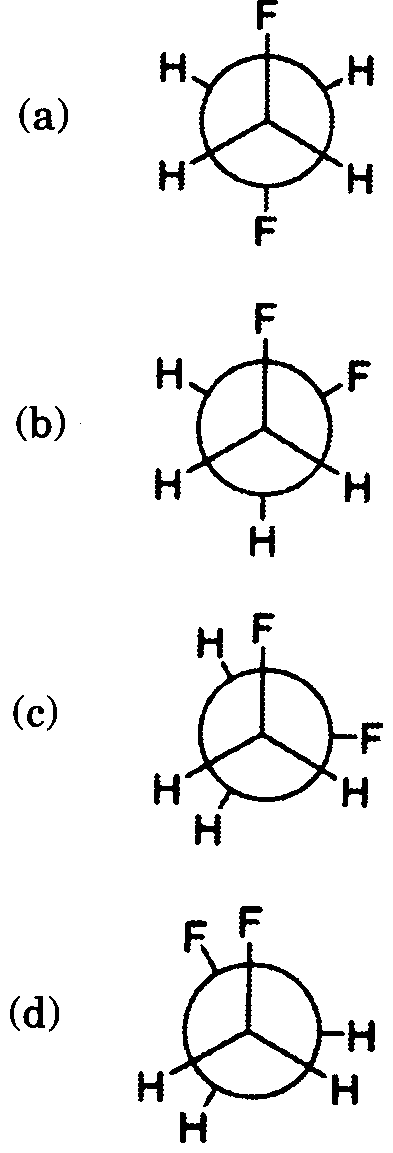
Q92 Conformational analysis / gauche effect
The most stable conformer of 1,2-difluoroethane in the gas phase is :
(a) Staggered anti (F–C–C–F dihedral 180°)(b) Staggered gauche (F–C–C–F dihedral 60°)(c) Eclipsed (F–C–C–F dihedral 120°)(d) Eclipsed (F–C–C–F dihedral 0°)
Answer and explanation with the VKC plan
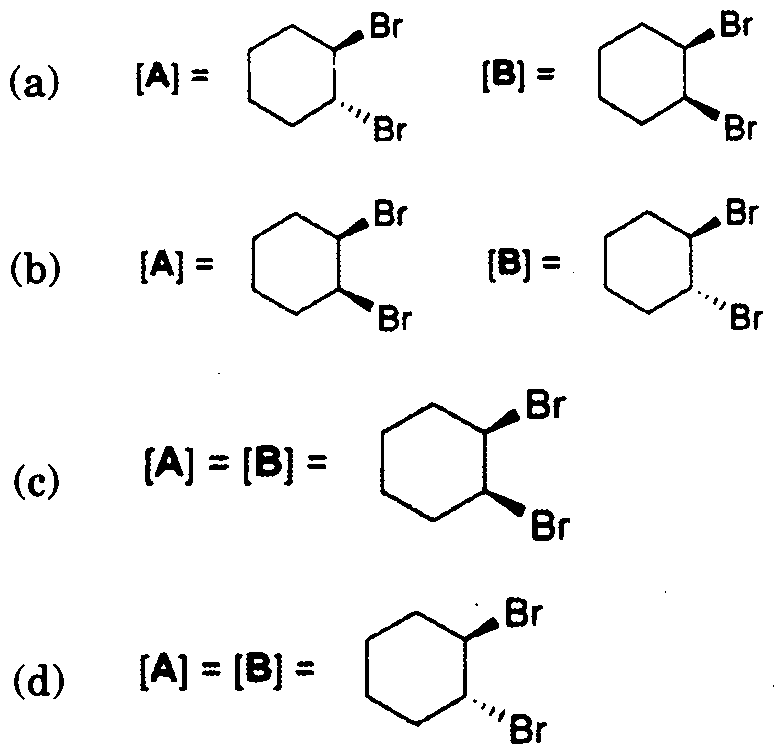
Q93 Organic / neighbouring group participation
The major products [A] and [B] formed in the following reactions are :
(a) [A] = trans-1,2-dibromocyclohexane; [B] = cis-1,2-dibromocyclohexane(b) [A] = cis-1,2-dibromocyclohexane; [B] = trans-1,2-dibromocyclohexane(c) [A] = [B] = cis-1,2-dibromocyclohexane(d) [A] = [B] = trans-1,2-dibromocyclohexane
Answer and explanation with the VKC plan
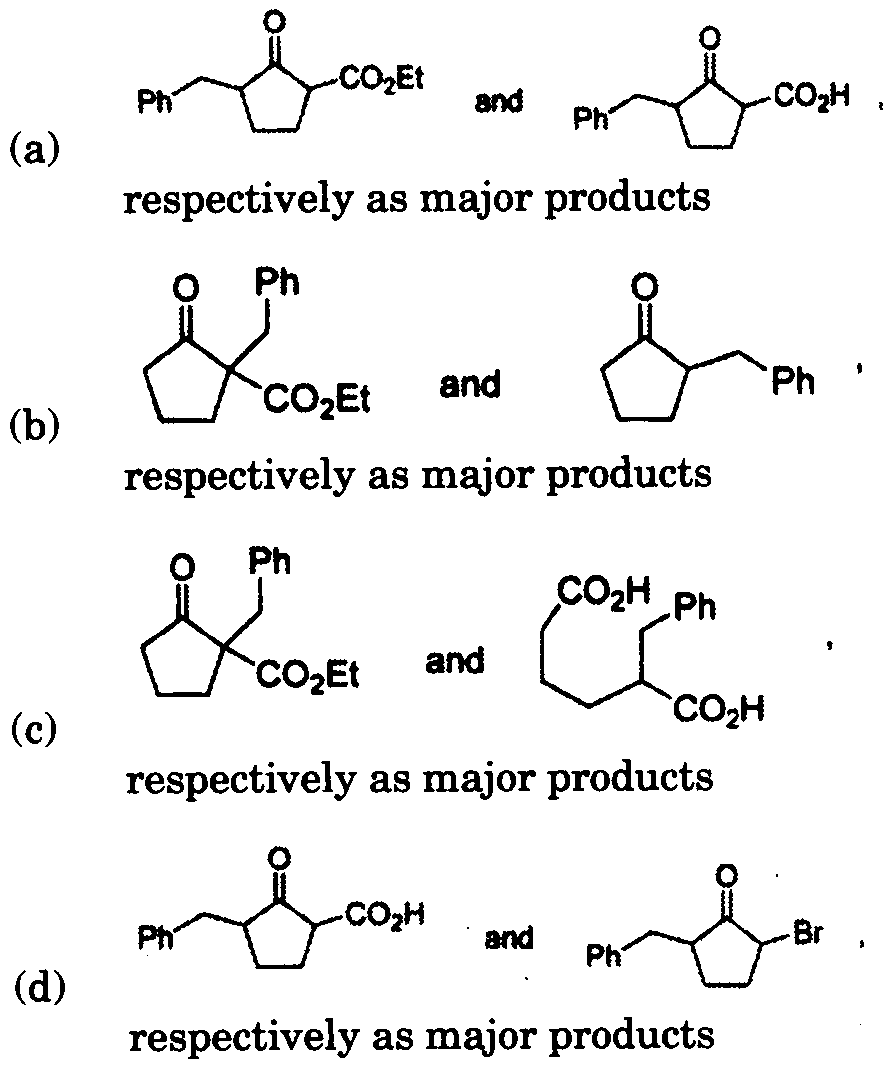
Q94 Organic / β-keto ester alkylation
In the given reaction sequence, products X and Y are :
(a) X = ethyl 3-benzyl-2-oxocyclopentanecarboxylate; Y = 3-benzyl-2-oxocyclopentanecarboxylic acid(b) X = ethyl 1-benzyl-2-oxocyclopentanecarboxylate; Y = 2-benzylcyclopentanone(c) X = ethyl 1-benzyl-2-oxocyclopentanecarboxylate; Y = 2-benzylhexanedioic acid(d) X = 3-benzyl-2-oxocyclopentanecarboxylic acid; Y = 2-benzyl-5-bromocyclopentanone
Answer and explanation with the VKC plan
Q95 Organic / ether cleavage
Deprotection of phenyl methyl ether with HI goes via :
(a) SN2 attack at sp³ carbon(b) SN1 attack at sp² carbon(c) SN2 attack at sp² carbon(d) SN1 attack at sp³ carbon
Answer and explanation with the VKC plan
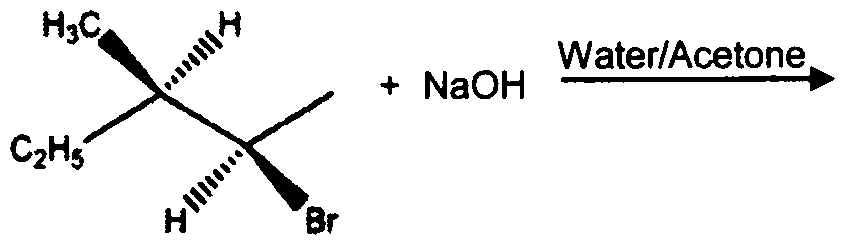
Q96 Stereochemistry / SN2 inversion
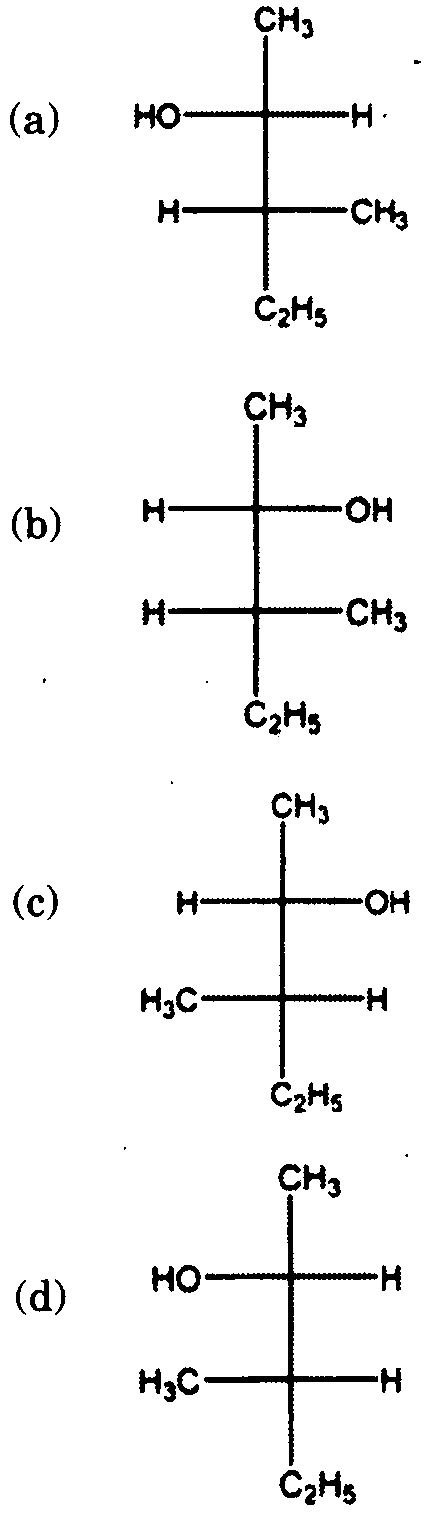
The product formed in the following reaction is :
(a) Fischer projection (CH₃ top, C₂H₅ bottom): C2 HO left, H right; C3 H left, CH₃ right — (2R,3R)-3-methylpentan-2-ol(b) Fischer projection: C2 H left, OH right; C3 H left, CH₃ right — (2S,3R)-3-methylpentan-2-ol(c) Fischer projection: C2 H left, OH right; C3 H₃C left, H right — (2S,3S)-3-methylpentan-2-ol(d) Fischer projection: C2 HO left, H right; C3 H₃C left, H right — (2R,3S)-3-methylpentan-2-ol
Answer and explanation with the VKC plan
Q97 Organic / SN2 reactivity
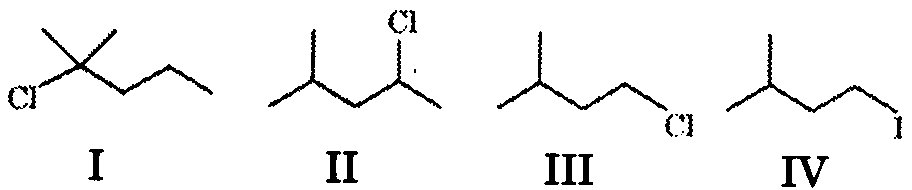
The correct order of reactivity of the following alkyl halides in SN2 reaction is :
(a) IV > III > II > I(b) I > III > II > IV(c) IV > III > I > II(d) II > I > IV > III
Answer and explanation with the VKC plan
Q98 Organic / SN1 and carbocation stability
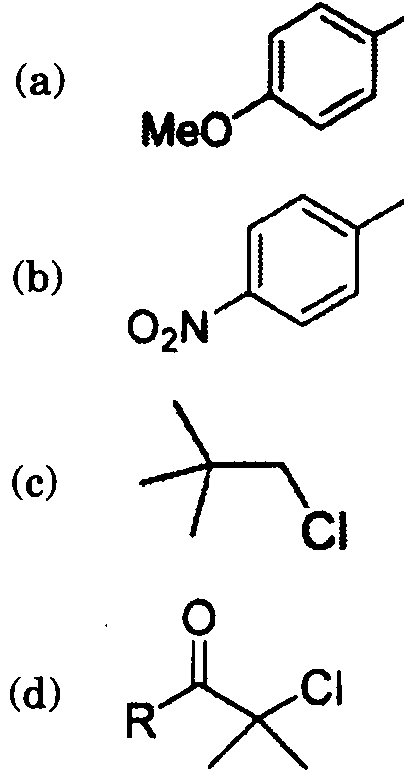
Which one of the following alkyl halides favours SN1 mechanism ?
(a) 4-Methoxybenzyl chloride(b) 4-Nitrobenzyl chloride(c) Neopentyl chloride (1-chloro-2,2-dimethylpropane)(d) α-Chloro ketone, RCOC(CH₃)₂Cl
Answer and explanation with the VKC plan
Q99 Organic / E2 regioselectivity
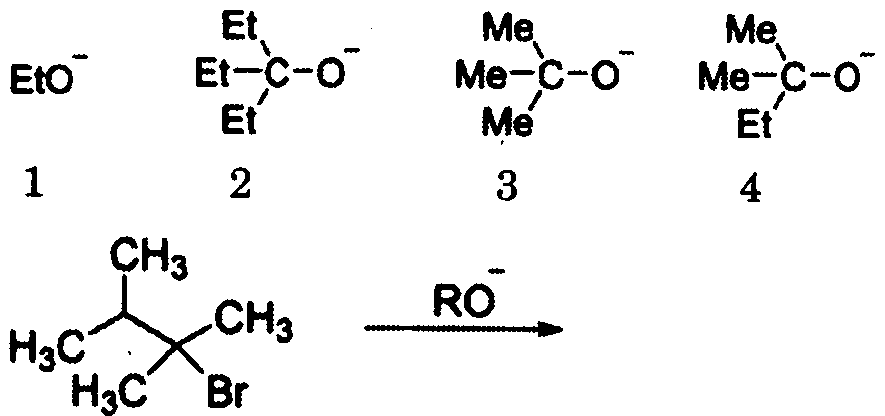
Consider the following bases :
EtO⁻ Et₃CO⁻ Me₃CO⁻ Me₂(Et)CO⁻ The reactivity order of bases for the formation of Zaitsev’s product in the following reaction is :
(a) 1 > 3 > 4 > 2(b) 4 > 2 > 3 > 1(c) 2 > 4 > 3 > 1(d) 1 > 3 > 2 > 4
Answer and explanation with the VKC plan
Q100 Organic / acid-catalysed dehydration
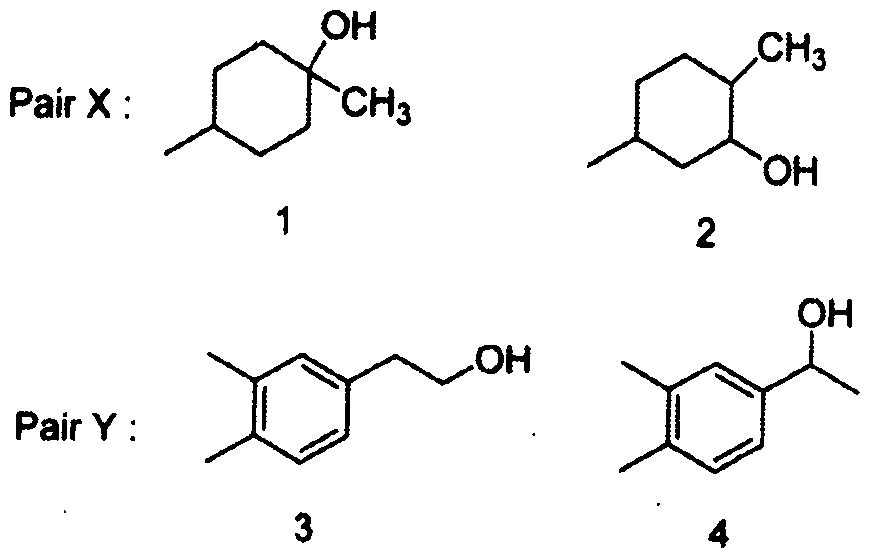
Which alcohol in each of the following pairs will undergo elimination reaction more rapidly when heated with conc. H₂SO₄ ?
(a) 1 and 3(b) 1 and 4(c) 2 and 3(d) 2 and 4
Answer and explanation with the VKC plan
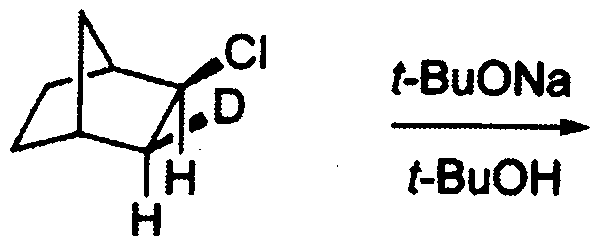
Q101 Organic / stereochemistry of E2 (norbornyl)
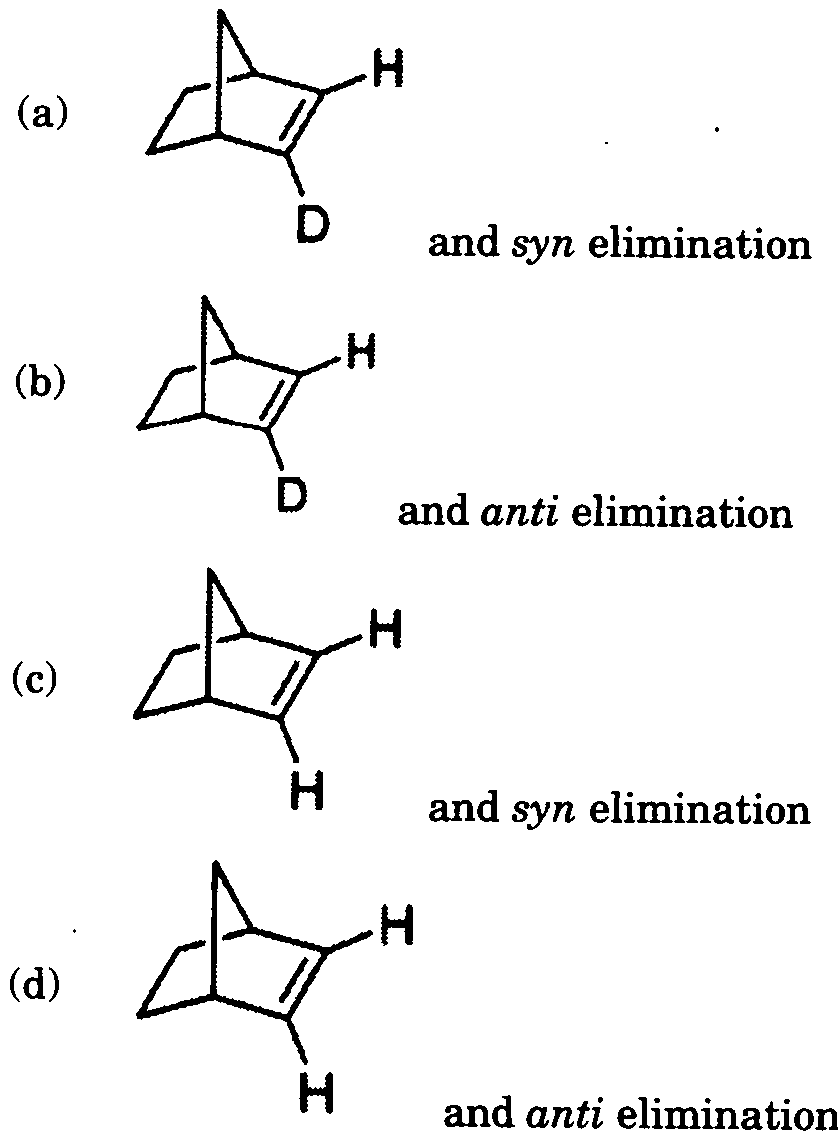
The major product formed and its mode of elimination in the following reaction is :
(a) Norbornene with H and D on the C=C, and syn elimination(b) Norbornene with H and D on the C=C, and anti elimination(c) Norbornene with H and H on the C=C, and syn elimination(d) Norbornene with H and H on the C=C, and anti elimination
Answer and explanation with the VKC plan
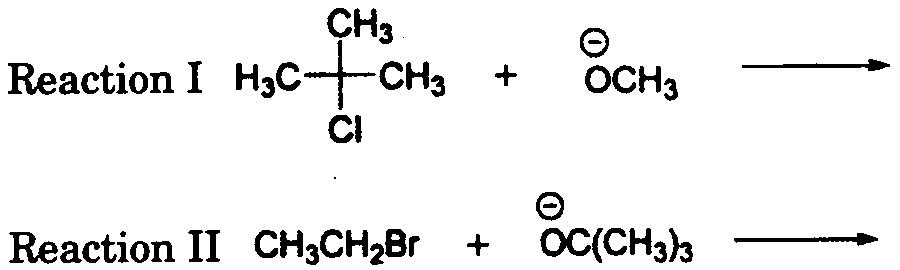
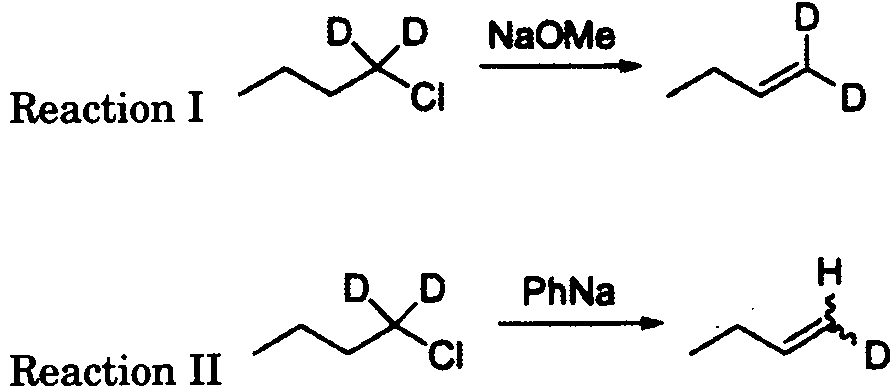
Q102 Organic / elimination mechanisms
Which type of elimination mechanism will occur in reactions I and II, respectively ?
Reaction I : (CH₃)₃C–Cl + ⁻OCH₃ ⟶ Reaction II : CH₃CH₂Br + ⁻OC(CH₃)₃ ⟶ (a) E1 and E1 mechanism(b) E2 and E2 mechanism(c) E1 and E2 mechanism(d) E2 and E1 mechanism
Answer and explanation with the VKC plan
Q103 Organic / α- and β-elimination
The correct elimination pathway for Reaction I and Reaction II are, respectively :
(a) α-elimination and β-elimination(b) β-elimination and α-elimination(c) α-elimination and α-elimination(d) β-elimination and β-elimination
Answer and explanation with the VKC plan
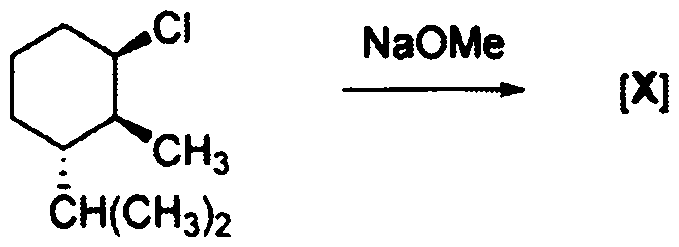
Q104 Organic / E2 in cyclohexanes
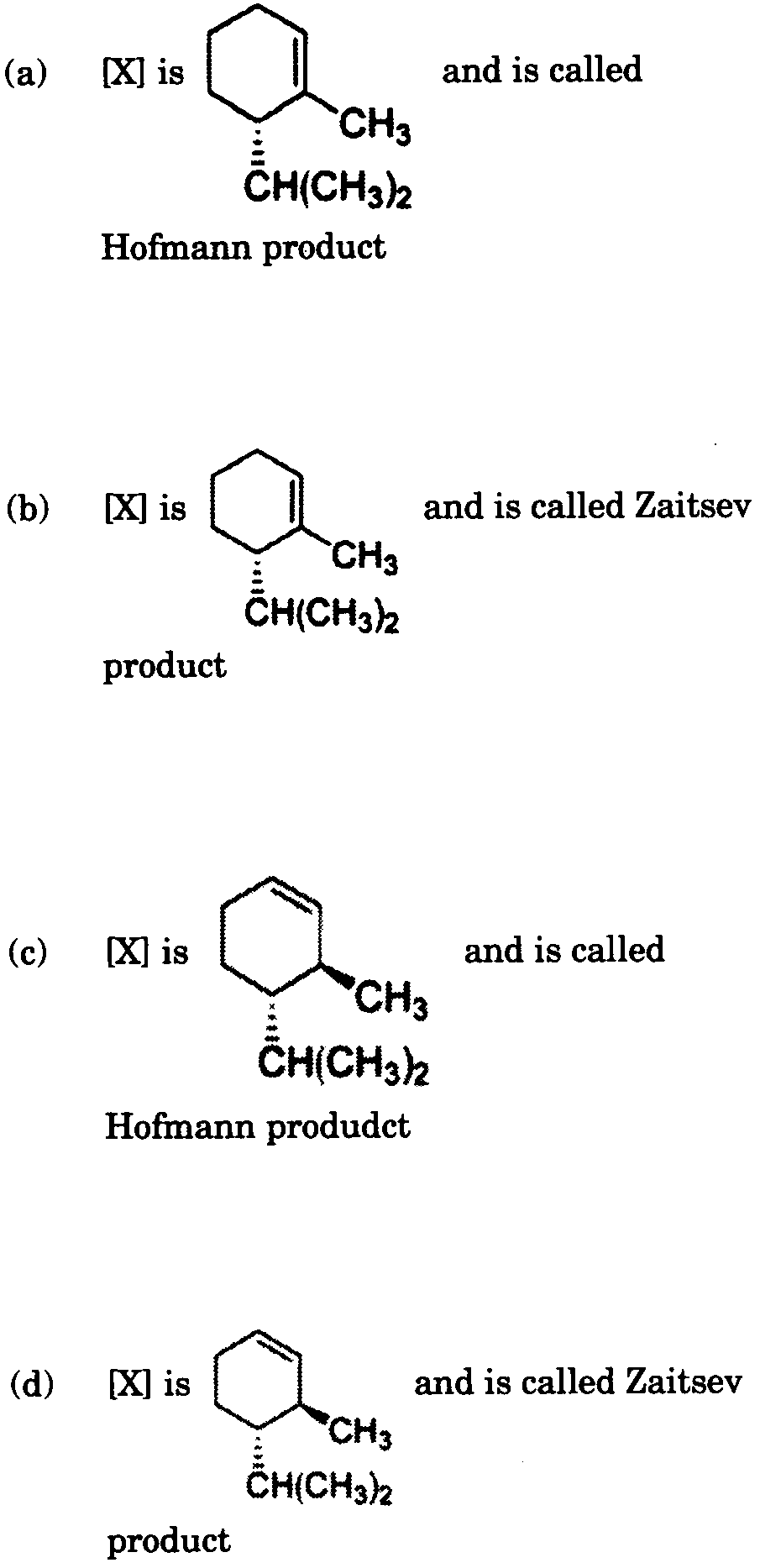
Which one of the following is true for the reaction given below ?
(a) [X] is 1-methyl-6-isopropylcyclohexene (C=C between the former C–Cl and C–CH₃ carbons) and is called Hofmann product(b) [X] is 1-methyl-6-isopropylcyclohexene (C=C between the former C–Cl and C–CH₃ carbons) and is called Zaitsev product(c) [X] is 3-methyl-4-isopropylcyclohexene (C=C on the other side of the former C–Cl carbon) and is called Hofmann produdct(d) [X] is 3-methyl-4-isopropylcyclohexene (C=C on the other side of the former C–Cl carbon) and is called Zaitsev product
Answer and explanation with the VKC plan
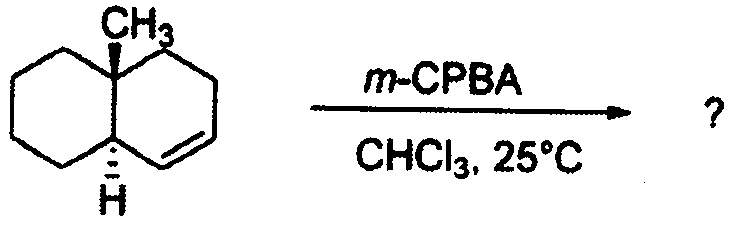
Q105 Organic / stereoselective epoxidation
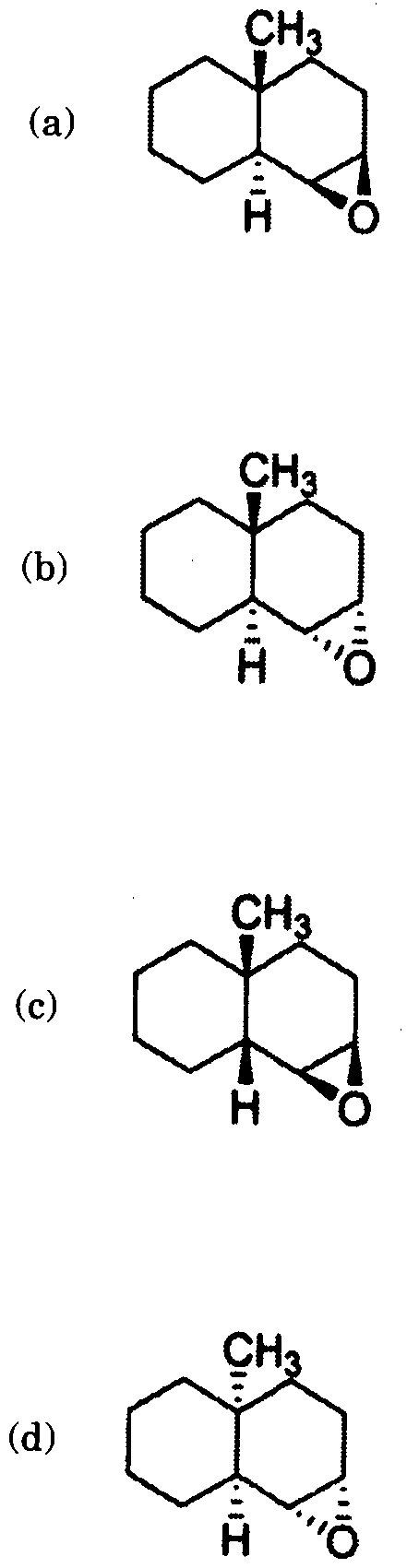
The major product formed in the following reaction is :
(a) trans-Fused epoxide with O on the β-face (same side as CH₃)(b) trans-Fused epoxide with O on the α-face (opposite to CH₃)(c) cis-Fused decalin epoxide with O on the β-face(d) Epoxide with CH₃ drawn α (inverted angular methyl) and O on the α-face
Answer and explanation with the VKC plan
Q106 Organic / Sharpless asymmetric epoxidation
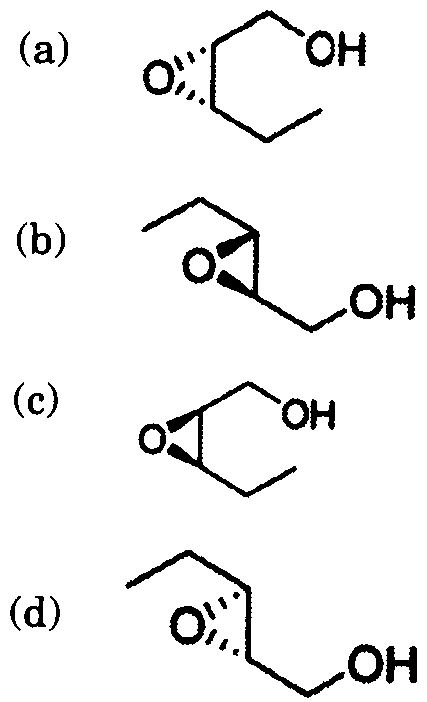
The major product formed in the following reaction is :
(a) cis-Epoxide drawn with O hashed: (2R,3S)-3-ethyloxiranylmethanol(b) trans-Epoxide with O wedged: (2R,3R)-3-ethyloxiranylmethanol(c) cis-Epoxide drawn with O wedged(d) trans-Epoxide with O hashed: (2S,3S)-3-ethyloxiranylmethanol
Answer and explanation with the VKC plan
Q107 Organic / Michael–Claisen (dimedone synthesis)
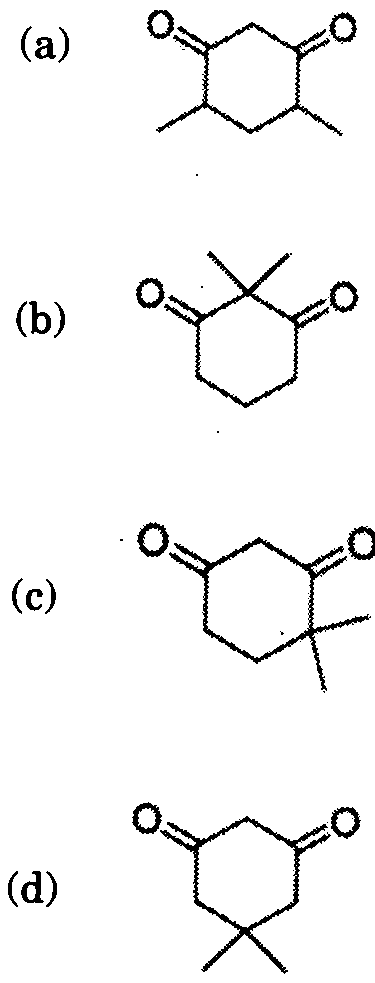
The product formed in the following reaction is :
(a) 4,6-Dimethylcyclohexane-1,3-dione(b) 2,2-Dimethylcyclohexane-1,3-dione(c) 4,4-Dimethylcyclohexane-1,3-dione(d) 5,5-Dimethylcyclohexane-1,3-dione
Answer and explanation with the VKC plan
Q108 Organic / hydration vs oxymercuration
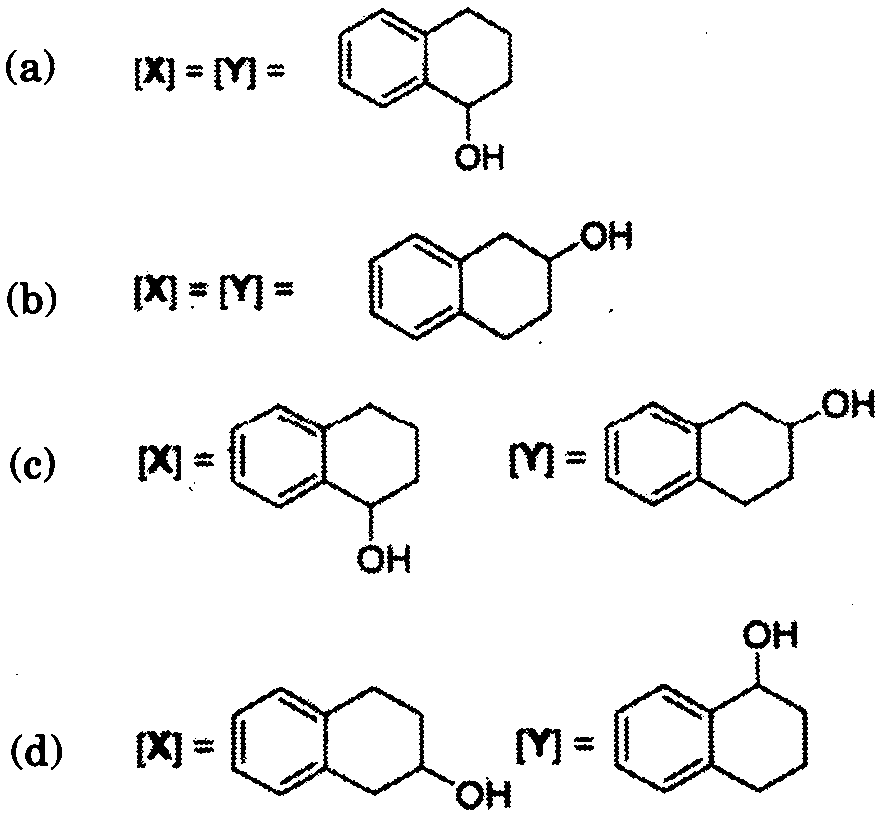
The major products [X] and [Y] formed in the following reactions are :
(a) [X] = [Y] = 1,2,3,4-tetrahydronaphthalen-1-ol(b) [X] = [Y] = 1,2,3,4-tetrahydronaphthalen-2-ol(c) [X] = 1,2,3,4-tetrahydronaphthalen-1-ol; [Y] = 1,2,3,4-tetrahydronaphthalen-2-ol(d) [X] = 1,2,3,4-tetrahydronaphthalen-2-ol; [Y] = 1,2,3,4-tetrahydronaphthalen-1-ol
Answer and explanation with the VKC plan
Q109 Organic / radical addition energetics (peroxide effect)
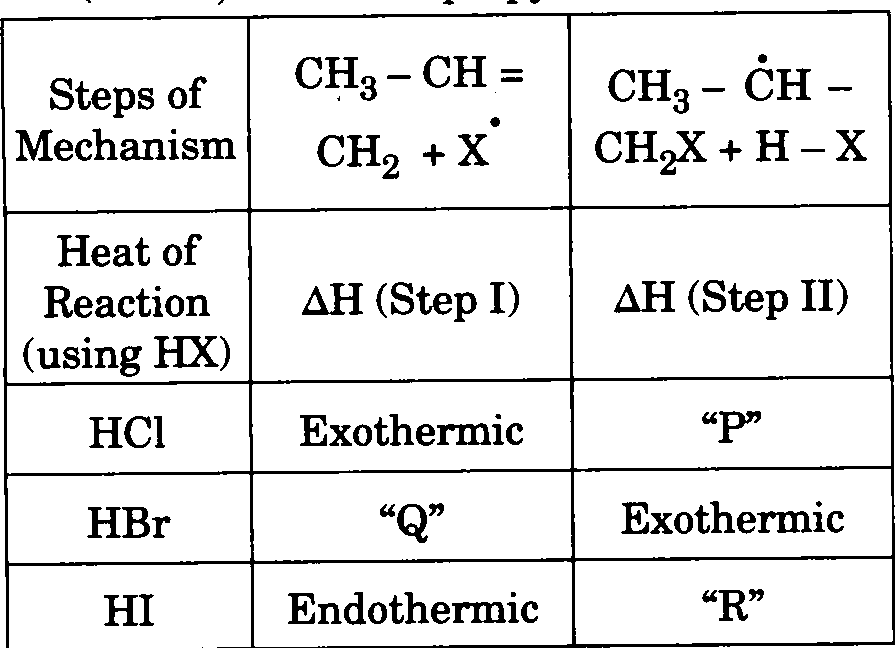
Identify the processes labelled as “P”, “Q” and “R” in the following table summarizing energetics of free radical addition of HX (X = Cl, Br or I) to propylene :
(a) P is Endothermic, Q is Exothermic, and R is Exothermic(b) P is Exothermic, Q is Exothermic, and R is Exothermic(c) P is Endothermic, Q is Exothermic, and R is Endothermic(d) P is Exothermic, Q is Endothermic, and R is Exothermic
Answer and explanation with the VKC plan
Q110 Organic / halohydrin formation and dehydration
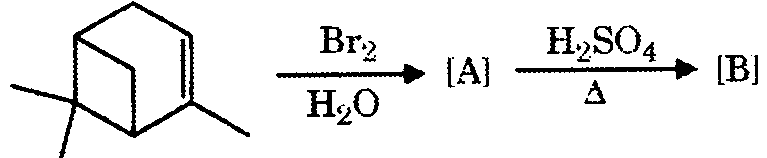
The products [A] and [B] formed in the following reaction sequence are :
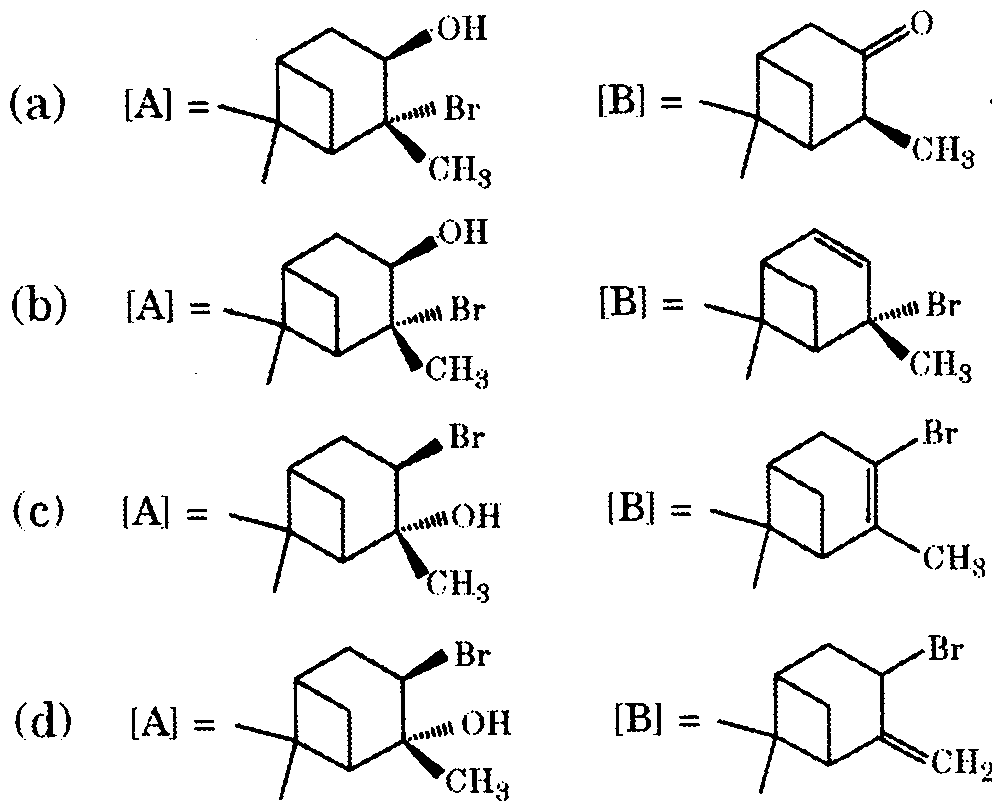
(a) [A] = bromohydrin with OH on C3 and Br on C2 (tertiary); [B] = pinocamphone-type ketone(b) [A] = bromohydrin with OH on C3 and Br on C2 (tertiary); [B] = allylic bromide with C3=C4 double bond(c) [A] = bromohydrin with Br on C3 and OH on C2 (tertiary); [B] = vinyl bromide with C2=C3 double bond (endocyclic)(d) [A] = bromohydrin with Br on C3 and OH on C2 (tertiary); [B] = allylic bromide with exocyclic C=CH₂
Answer and explanation with the VKC plan
Q111 Organic / synthesis and directing effects
Which one of the following is the correct sequence for synthesis of 1-bromo-3-(trichloromethyl)benzene ?
(a) Reaction of toluene with Br₂ and Fe, then treating with Cl₂ in presence of hν or heat(b) Reaction of toluene with Cl₂ and Fe, then treating with Br₂ in presence of hν or heat(c) Reaction of toluene with Cl₂ in presence of hν or heat, then treating with Br₂ and Fe(d) Reaction of trichloromethyl benzene with Cl₂ in presence of hν or heat
Answer and explanation with the VKC plan
Q112 Organic / Friedel–Crafts alkylation
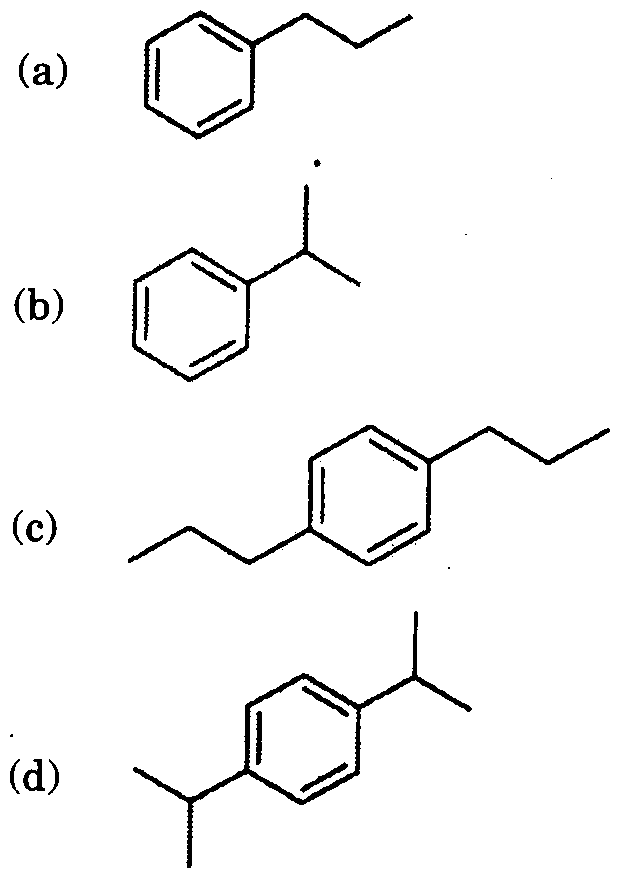
What is the major product when benzene reacts with n-propyl chloride in the presence of anhydrous AlCl₃ ?
(a) n-Propylbenzene(b) Isopropylbenzene (cumene)(c) 1,4-Di-n-propylbenzene(d) 1,4-Diisopropylbenzene
Answer and explanation with the VKC plan
Q113 Organic / electrophilic substitution and activating groups
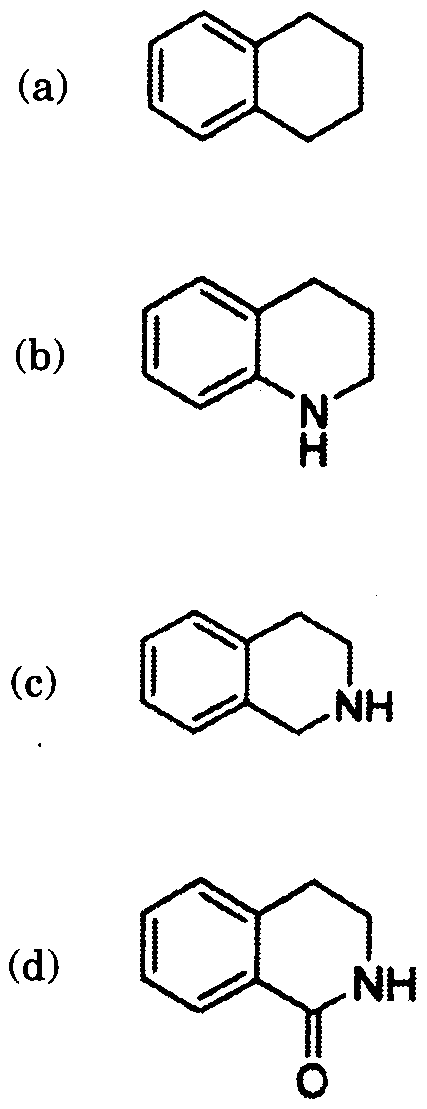
Which one of the following substrates undergoes bromination reaction on aromatic ring at fastest rate ?
(a) 1,2,3,4-Tetrahydronaphthalene (tetralin)(b) 1,2,3,4-Tetrahydroquinoline(c) 1,2,3,4-Tetrahydroisoquinoline(d) 3,4-Dihydroisoquinolin-1(2H)-one
Answer and explanation with the VKC plan
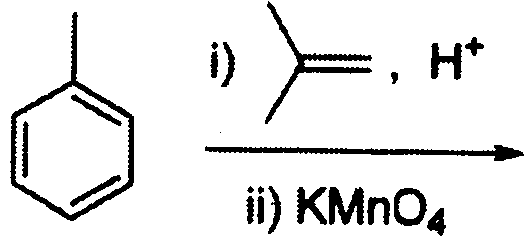
Q114 Organic / FC alkylation and side-chain oxidation
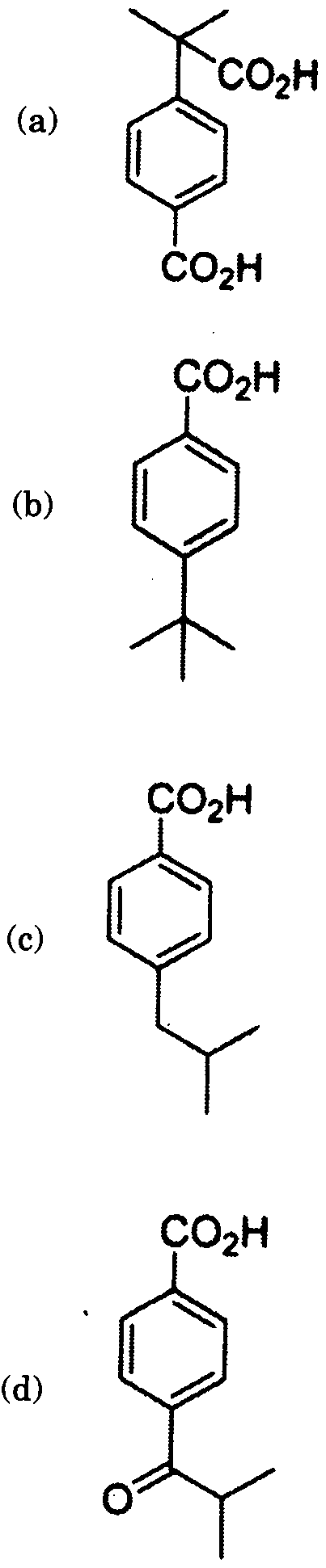
The major product formed in the following reaction sequence is :
(a) 4-(2-Carboxypropan-2-yl)benzoic acid(b) 4-tert-Butylbenzoic acid(c) 4-Isobutylbenzoic acid(d) 4-Isobutyrylbenzoic acid
Answer and explanation with the VKC plan
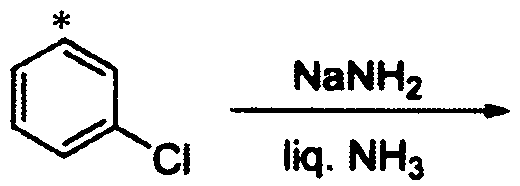
Q115 Organic / benzyne mechanism
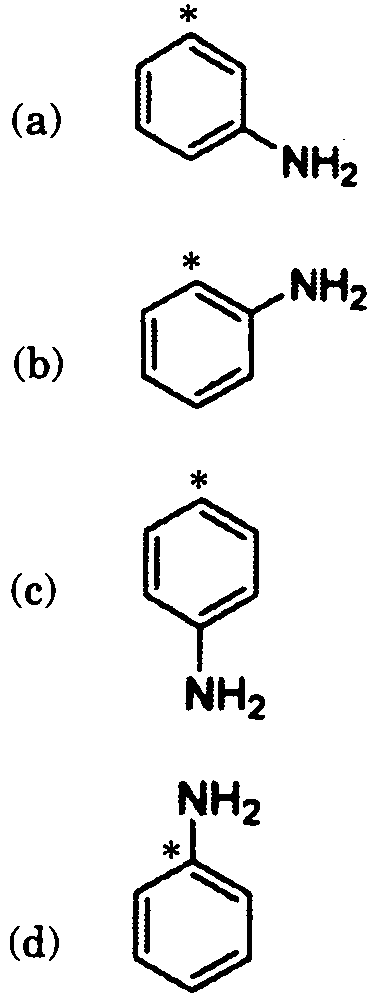
Which one of the following compounds will not be formed in the given reaction ? *indicates a ¹³C label
(a) Aniline with ¹³C meta to NH₂(b) Aniline with ¹³C ortho to NH₂(c) Aniline with ¹³C para to NH₂(d) Aniline with ¹³C at the carbon bearing NH₂ (ipso)
Answer and explanation with the VKC plan
Q116 Organic / synthesis planning
The correct sequence of reactions for accomplishing the following multi-step transformation is :
(a) (i) CH₃Cl/AlCl₃, (ii) KMnO₄, (iii) HNO₃/H₂SO₄(b) (i) HNO₃/H₂SO₄, (ii) CH₃Cl/AlCl₃, (iii) KMnO₄(c) (i) CH₃Cl/AlCl₃, (ii) HNO₃/H₂SO₄, (iii) KMnO₄(d) (i) HNO₃/H₂SO₄, (ii) CO/HCl/AlCl₃, (iii) KMnO₄
Answer and explanation with the VKC plan
Q117 Organic / pinacol rearrangement, crossover test
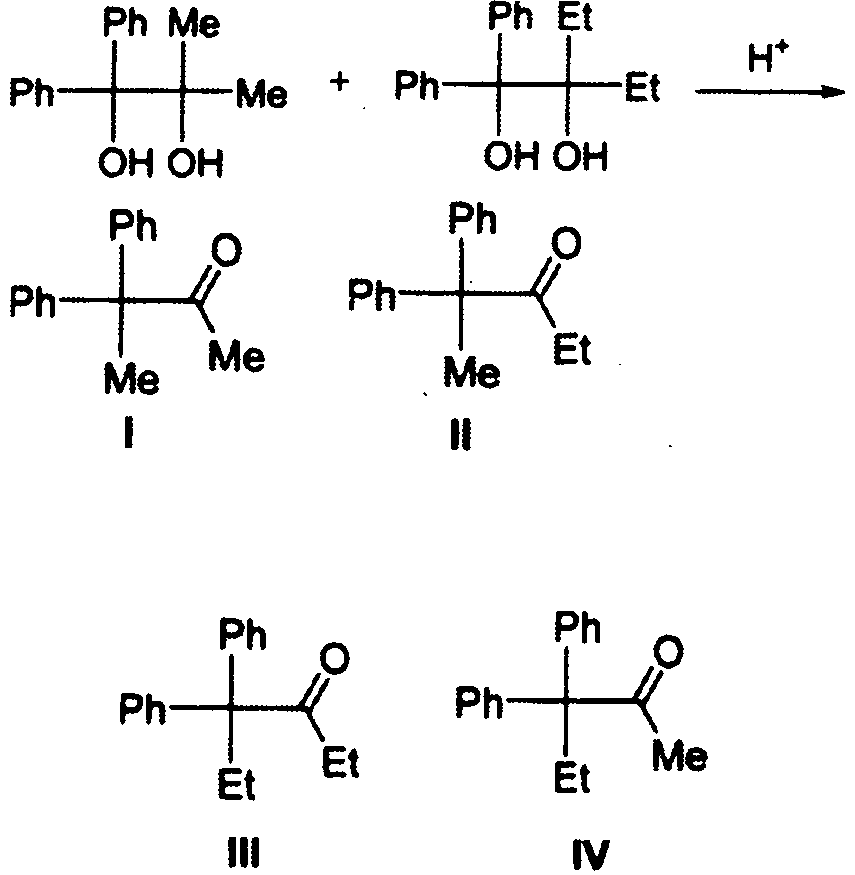
Which one of the following statements is true for the given reaction ?
(a) I and III are called cross-over products and are formed by intermolecular reaction.(b) II and IV are called cross-over products and are formed by intermolecular reaction.(c) II and IV are called cross-over products and are formed by intramolecular reaction.(d) I and III are called cross-over products and are formed by intramolecular reaction.
Answer and explanation with the VKC plan
Q118 Organic / Friedel–Crafts limitations
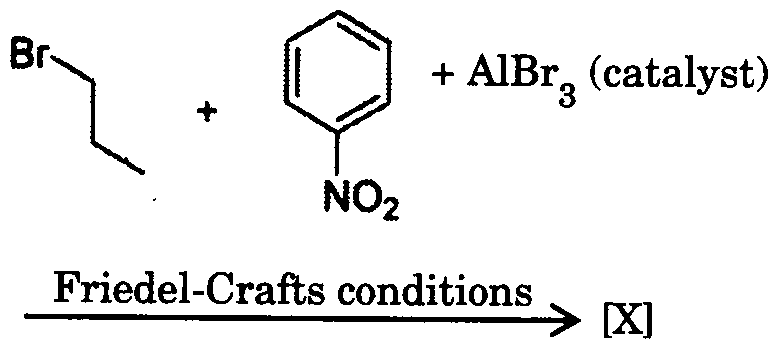
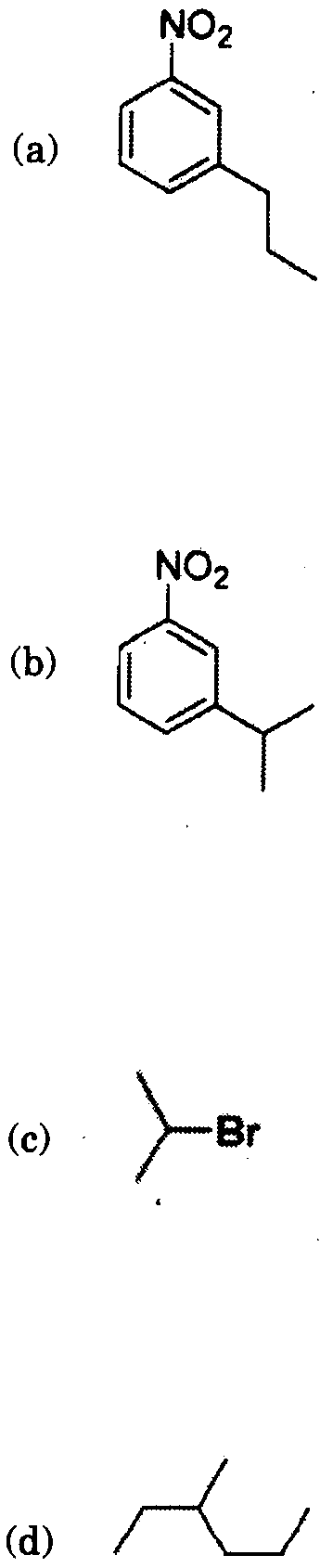
The final product [X] formed in the following reaction is :
(a) 1-Nitro-3-propylbenzene(b) 1-Isopropyl-3-nitrobenzene(c) 2-Bromopropane(d) 3-Methylhexane
Answer and explanation with the VKC plan
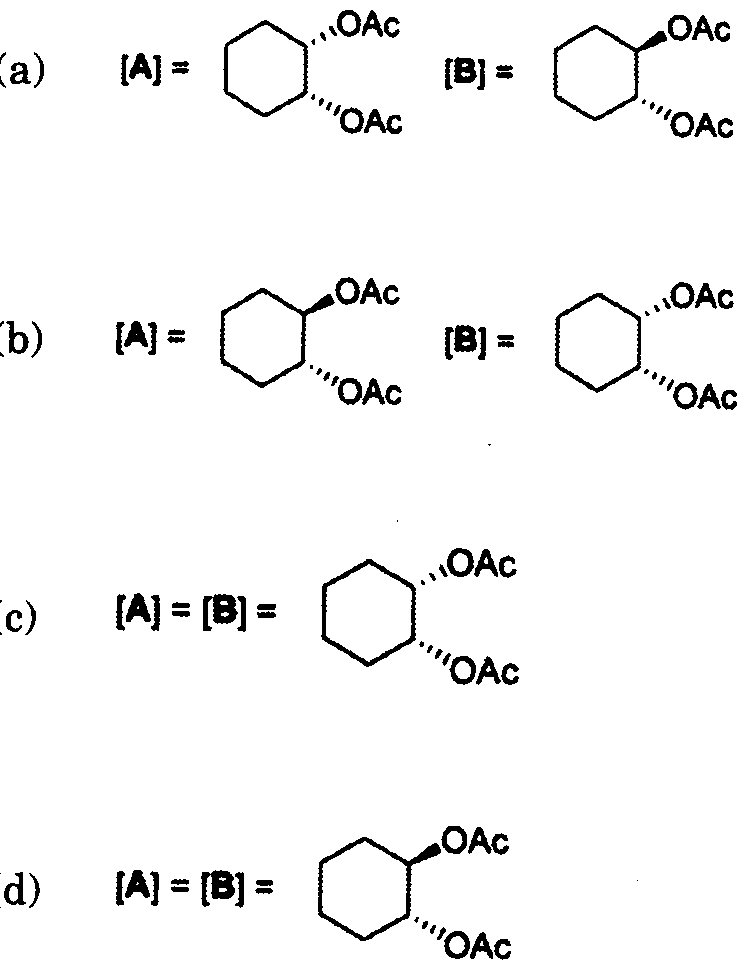
Q119 Organic / neighbouring group participation (Winstein)
The major products [A] and [B] formed in the following reactions are :
(a) [A] = cis-1,2-diacetoxycyclohexane; [B] = trans-1,2-diacetoxycyclohexane(b) [A] = trans-1,2-diacetoxycyclohexane; [B] = cis-1,2-diacetoxycyclohexane(c) [A] = [B] = cis-1,2-diacetoxycyclohexane(d) [A] = [B] = trans-1,2-diacetoxycyclohexane
Answer and explanation with the VKC plan
Q120 Organic / phenonium ion (aryl participation)
Consider the following solvolysis reaction : (where, Z is H or p-Cl or p-Me or p-OMe)
The extent of neighbouring group participation of phenyl group (from lower to higher) follows which one of the following order ?
(a) H < p-Cl < p-OMe < p-Me(b) p-OMe < p-Cl < p-Me < H(c) p-Cl < p-Me < H < p-OMe(d) p-Cl < H < p-Me < p-OMe
Answer and explanation with the VKC plan