Prelims Paper II 2022 question paper Solutions UPSC Combined Geo-Scientist, Prelims · 2022 · Paper II, Chemistry
UPSC Geo-Scientist Prelims 2022 Chemistry (Paper II): answer key and solutions
All 120 questions of the 2022 Combined Geo-Scientist Prelims Paper II (chemistry), each with the answer and a short explanation in the hint-sheet style: the key fact first, numericals worked with units. Tap a number in the key to jump to the question; every question also has its own page.
Answer key 1 a 2 b 3 c 4 a 5 a 6 b 7 a 8 a 9 a 10 d 11 a 12 d 13 b 14 c 15 d 16 a 17 c 18 a 19 d 20 c 21 c 22 c 23 a 24 d 25 d 26 b 27 c 28 b 29 b 30 c 31 b 32 c 33 d 34 c 35 c 36 b 37 d 38 c 39 d 40 c 41 d 42 a 43 c 44 c 45 a 46 b 47 a 48 b 49 b 50 c 51 a 52 a 53 a 54 d 55 a 56 c 57 d 58 a 59 b 60 d 61 b 62 a 63 a 64 b 65 b 66 d 67 b 68 b 69 b 70 c 71 b 72 a 73 c 74 a 75 b 76 c 77 a 78 d 79 c 80 a 81 a 82 d 83 b 84 a 85 b 86 d 87 c 88 d 89 a 90 c 91 a 92 a 93 c 94 d 95 b 96 b 97 b 98 c 99 a 100 c 101 b 102 b 103 a 104 a 105 b 106 d 107 c 108 d 109 a 110 d 111 a 112 b 113 a 114 b 115 b 116 c 117 a 118 d 119 a 120 b Question paper: read or download the 2022 Paper II paper . Solutions are original work by VKC; question paper belongs to UPSC.
Q1 Atomic structure / nodes
The numbers of radial nodes, planar angular nodes and non-planar angular nodes in 3d_z², 3s and 3pₓ orbitals are
(a) (0, 0, 2), (2, 0, 0), (1, 1, 0) respectively(b) (0, 2, 0), (2, 0, 0), (1, 1, 0) respectively(c) (2, 0, 0), (2, 0, 0), (0, 1, 1) respectively(d) (0, 2, 0), (0, 2, 0), (1, 1, 0) respectively
Radial nodes = n − l − 1; angular nodes = l. 3d_z² : radial 3−2−1 = 0; its two angular nodes are cones (non-planar), so (0, 0, 2). 3s : radial 2, no angular node → (2, 0, 0). 3pₓ : radial 1, one nodal plane (yz) → (1, 1, 0). → (a). Remember: d_z² is the only d orbital whose angular nodes are not planes.
Read every answer and explanation of this paper with VKC Basic
VKC Basic (₹999 for 6 months) opens every solved answer, the notes, the handbook and the daily answer archive. Every Mains test series includes it.
See what is included Already a member? Sign in
Q2 Atomic structure / wave function
The angular wave function for hydrogen atom depends upon the quantum number(s)
(a) n and l only(b) l and m_l only(c) m_l only(d) l, m_l and n
Answer and explanation with the VKC plan
Q3 Atomic structure / nodes
The total number of nodal planes possible for all the atomic orbitals with a value of principal quantum (n) = 3 is
(a) 8(b) 9(c) 11(d) 14
Answer and explanation with the VKC plan
Q4 Chemical bonding / covalent radius
The covalent radius of C atom is 0·77 Å and that of H atom is 0·37 Å. What is the internuclear distance between C and H atoms in CH₄ molecule?
(a) 1·14 Å(b) 1·20 Å(c) 1·25 Å(d) 1·41 Å
Answer and explanation with the VKC plan
Q5 Chemical bonding / covalent radius
The bond distance in Cl₂ molecule is 1·98 Å. What will be its covalent radius?
(a) 0·99 Å(b) 1·00 Å(c) 0·98 Å(d) 1·10 Å
Answer and explanation with the VKC plan
Q6 Periodic properties / ionic radius
Which one of the following represents the correct order of size among O²⁻, F⁻, Na⁺ and Mg²⁺ isoelectronic ions?
(a) O²⁻ < F⁻ < Na⁺ < Mg²⁺(b) Mg²⁺ < Na⁺ < F⁻ < O²⁻(c) Mg²⁺ < Na⁺ < O²⁻ < F⁻(d) O²⁻ < F⁻ < Mg²⁺ < Na⁺
Answer and explanation with the VKC plan
Q7 Carbon allotropes / graphite
Graphite is used as a dry lubricant in machines running at high temperature where oil cannot be used as lubricant, because
(a) graphite has layered structure and the layers are held by van der Waals' forces and cleaves easily between layers(b) graphite is a crystalline substance(c) graphite conducts electricity and is thermodynamically stable(d) each carbon atom in the hexagonal ring undergoes sp² hybridization
Answer and explanation with the VKC plan
Q8 Periodic properties / Slater's rules
The effective nuclear charges for 4s and 3d electrons in nickel are
(a) 4·05 and 7·55 respectively(b) 7·55 and 4·05 respectively(c) 4·75 and 7·95 respectively(d) 4·25 and 7·65 respectively
Answer and explanation with the VKC plan
Q9 Periodic properties / atomic radius
Consider the following statements regarding periodic properties of elements :
Statement-1 : Atomic radius increases down a group in the periodic table. Statement-2 : On descending a group, the valence electrons are found in orbitals of successively higher principal quantum number. Which one of the following is correct in respect of the above statements?
(a) Both Statement-1 and Statement-2 are true and Statement-2 is the correct explanation of Statement-1(b) Both Statement-1 and Statement-2 are true but Statement-2 is not the correct explanation of Statement-1(c) Statement-1 is true but Statement-2 is false(d) Statement-1 is false but Statement-2 is true
Answer and explanation with the VKC plan
Q10 Hydrogen / ortho-para hydrogen
Consider the following statements in respect of ortho and para form of hydrogen molecule :
Ortho hydrogen molecules have nuclear spin vectors parallel. At high temperature, hydrogen gas contains about 75% ortho hydrogen. In para form of hydrogen, nuclear spins exist in opposite manner. Para form has the lower energy and at absolute zero, the gas contains 100% of para form. Which of the statements given above are correct?
(a) 1 and 3 only(b) 2 and 4 only(c) 1, 3 and 4 only(d) 1, 2, 3 and 4
Answer and explanation with the VKC plan
Q11 Periodic properties / electron affinity
Which one of the following represents the correct order of electron gain enthalpy (electron affinity) among F, Cl, Br and I?
(a) Cl > F > Br > I(b) F > Cl > Br > I(c) I > Br > Cl > F(d) I > Br > F > Cl
Answer and explanation with the VKC plan
Q12 Atomic structure / electronic configuration
How many orbitals are there in an atom having atomic weight 23 and atomic number 11?
(a) 14(b) 12(c) 9(d) 6
Answer and explanation with the VKC plan
Q13 Coordination chemistry / magnetic moment
Which one of the following complexes will have the maximum spin-only value?
(a) [Cr(H₂O)₆]³⁺(b) [Fe(H₂O)₆]²⁺(c) [Cu(H₂O)₆]²⁺(d) [Zn(H₂O)₆]²⁺
Answer and explanation with the VKC plan
Q14 f-block / lanthanides
Consider the following statements regarding lanthanide series metals :
They are silvery white. They are electropositive. They are non-reactive. Which of the statements given above is/are correct?
(a) 1 only(b) 2 only(c) 1 and 2 only(d) 1, 2 and 3
Answer and explanation with the VKC plan
Q15 p-block / oxoacids of phosphorus
Which one of the following is not valid for oxoacids of phosphorus?
(a) All oxoacids contain tetrahedral four-coordinate phosphorus(b) All oxoacids contain at least one P=O unit and one P—OH group(c) Orthophosphoric acid is used in the manufacture of triple superphosphate(d) Hypophosphorous acid is a diprotic acid
Answer and explanation with the VKC plan
Q16 s-block / Fajans' rules
Consider the following statements regarding alkali metal halides :
Statement-1 : Among all alkali metal halides, lithium iodide (LiI) is the most covalent in nature. Statement-2 : Li⁺ being very small in size has high tendency to distort electron cloud around the negative large I⁻ ion. Which one of the following is correct in respect of the above statements?
(a) Both Statement-1 and Statement-2 are true and Statement-2 is the correct explanation of Statement-1(b) Both Statement-1 and Statement-2 are true and Statement-2 is not the correct explanation of Statement-1(c) Statement-1 is true but Statement-2 is false(d) Statement-1 is false but Statement-2 is true
Answer and explanation with the VKC plan
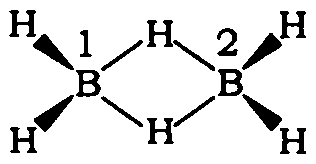
Q17 p-block / boranes
The hybridizations of B¹ and B² atoms in diborane are
(a) sp³ and sp² respectively(b) sp² and sp²(c) sp³ and sp³(d) sp² and sp³ respectively
Answer and explanation with the VKC plan
Q18 Chemical bonding / ionic bond
Which one of the following is correct regarding an ionic compound MX?
(a) High value of lattice energy of M⁺X⁻ ionic crystal(b) Electronegativity difference between M and X atoms is very small(c) High ionization energy of atom M(d) Low electron affinity of atom X
Answer and explanation with the VKC plan
Q19 s-block / lattice energy
Which one of the following represents the correct order of lattice energy of oxides among the given alkaline earth metals?
(a) BeO < MgO < CaO < SrO < BaO(b) BeO < SrO < MgO < CaO < BaO(c) BaO < MgO < CaO < SrO < BeO(d) BaO < SrO < CaO < MgO < BeO
Answer and explanation with the VKC plan
Q20 Chemical bonding / Fajans' rules
According to Fajans' rule, which one of the following conditions is necessary to form a covalent bond?
(a) Large cation and large anion(b) Small cation and small anion(c) Small cation and large anion(d) Large cation and small anion
Answer and explanation with the VKC plan
Q21 Solid state / crystal defects
Consider the following statements regarding defects in crystals :
Schottky defect occurs in highly ionic compounds where positive and negative ions are of similar size with high coordination number. Frenkel defect is found in ionic crystal having low coordination number and large difference in size between the positive and negative ions. Which of the statements given above is/are correct?
(a) 1 only(b) 2 only(c) Both 1 and 2(d) Neither 1 nor 2
Answer and explanation with the VKC plan
Q22 Chemical bonding / MO theory
Which one of the following represents the correct bond order among the given nitrogen species?
(a) N₂⁻ < N₂²⁻ < N₂(b) N₂⁻ < N₂ < N₂²⁻(c) N₂²⁻ < N₂⁻ < N₂(d) N₂ < N₂²⁻ < N₂⁻
Answer and explanation with the VKC plan
Q23 Chemical bonding / MO theory
Which one of the following is the correct electronic configuration of O₂²⁻?
(a) 1σ_g² 1σ_u² 2σ_g² 1π_u⁴ 1π_g⁴(b) 1σ_g² 1σ_u² 1π_u⁴ 2σ_g² 1π_g⁴(c) 1σ_g² 1σ_u² 1π_u⁴ 1π_g⁴ 2σ_g²(d) 1σ_u² 1σ_g² 2σ_g² 1π_u⁴ 1π_g⁴
Answer and explanation with the VKC plan
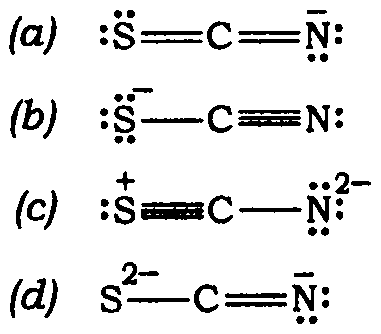
Q24 Chemical bonding / resonance and formal charge
Which one of the following is not a resonance structure of thiocyanate (SCN⁻)?
(a) :S̈=C=N̈:⁻ (S=C double, C=N double, formal charge −1 on N)(b) :S̈:⁻—C≡N: (S–C single, C≡N triple, formal charge −1 on S)(c) :S⁺≡C—N̈:²⁻ (S≡C triple, C–N single, +1 on S and −2 on N)(d) S²⁻—C=N̈:⁻ (S–C single, C=N double, −2 on S and −1 on N)
Answer and explanation with the VKC plan
Q25 Coordination chemistry / VBT
Which one of the following is an inner orbital complex that also shows diamagnetism?
(a) [Cr(NH₃)₆]²⁺(b) [Zn(NH₃)₆]²⁺(c) [Ni(NH₃)₆]²⁺(d) [Co(NH₃)₆]³⁺
Answer and explanation with the VKC plan
Q26 Coordination chemistry / ligands
Which one of the following is an example of neutral bidentate ligand?
(a) Oxalato(b) o-Phenanthroline(c) Glycinato(d) Nitrilotriacetate
Answer and explanation with the VKC plan
Q27 Coordination chemistry / IUPAC nomenclature
Which one of the following is the correct IUPAC name of K₃[Fe(CN)₅NO]?
(a) Tripotassium pentacyanonitrosylferrate(III)(b) Potassium pentacyanonitrosyliron(II)(c) Potassium pentacyanonitrosylferrate(II)(d) Tripotassium pentacyanonitrosyliron(III)
Answer and explanation with the VKC plan
Q28 Coordination chemistry / isomerism
The number of geometrical isomers that can exist for a square planar complex [Pt(Cl)(py)(NH₃)(NH₂OH)]⁺ is
(a) 2(b) 3(c) 4(d) 6
Answer and explanation with the VKC plan
Q29 Coordination chemistry / isomerism
Which of the following types of isomerism are exhibited by [Co(NH₃)₄(NO₂)₂]Cl?
(a) Linkage isomerism, geometrical isomerism and optical isomerism(b) Linkage isomerism, ionization isomerism and geometrical isomerism(c) Ionization isomerism, geometrical isomerism and optical isomerism(d) Linkage isomerism, ionization isomerism and optical isomerism
Answer and explanation with the VKC plan
Q30 Ionic equilibrium / ionic product of water
The molar equilibrium constant of pure water (K_w) at 25 °C is
(a) 1·0 × 10⁻⁷(b) 1·0(c) 1·0 × 10⁻¹⁴(d) 1·0 × 10⁷
Answer and explanation with the VKC plan
Q31 p-block / Lewis acidity of boron halides
Which one of the following represents the correct order of acidic strength among BBr₃, BCl₃, BF₃ and BI₃?
(a) BI₃ < BBr₃ < BCl₃ < BF₃(b) BF₃ < BCl₃ < BBr₃ < BI₃(c) BF₃ < BBr₃ < BCl₃ < BI₃(d) BF₃ < BCl₃ < BI₃ < BBr₃
Answer and explanation with the VKC plan
Q32 Electrochemistry / conductance
What is the degree of dissociation of a 0·01 M aqueous solution of acetic acid at 25 °C having a specific conductance 1·63 × 10⁻² S m⁻¹ and molar conductance of acetic acid at infinite dilution 390·7 × 10⁻⁴ S m² mol⁻¹?
(a) 1·82 × 10⁻⁵(b) 1·82 × 10⁵(c) 0·0417(d) 4·17
Answer and explanation with the VKC plan
Q33 Periodic properties / ionisation energy
Which of the following factors affect the ionization energy?
Atomic size Nuclear charge Type of electrons involved Select the correct answer using the code given below.
(a) 1 and 2 only(b) 1 and 3 only(c) 2 and 3 only(d) 1, 2 and 3
Answer and explanation with the VKC plan
Q34 Ionic equilibrium / pH
The pOH and pH of a 6 × 10⁻² M solution of NaOH will be (log 6 = 0·77)
(a) 6 and 8 respectively(b) 8 and 6 respectively(c) 1·23 and 12·77 respectively(d) 12·77 and 1·23 respectively
Answer and explanation with the VKC plan
Q35 Ionic equilibrium / buffers
Which one of the following is used for the calibration of pH electrodes?
(a) Acidic solution(b) Basic solution(c) Buffer solution(d) Water
Answer and explanation with the VKC plan
Q36 Ionic equilibrium / buffer pH
What will be the pH of a buffer solution, prepared by mixing of 10 mL of 0·1 M acetic acid and 10 mL of 0·01 M sodium acetate? (pK_a of acetic acid = 4·76)
(a) Approximately 2·6(b) Approximately 3·8(c) Approximately 4·2(d) Approximately 5·8
Answer and explanation with the VKC plan
Q37 Volumetric analysis / titration
25 mL of H₂SO₄ solution requires 48·75 mL of 0·02 M NaOH for complete titration. What will be the molarity of H₂SO₄?
(a) 0·0201 M(b) 0·0161 M(c) 0·0180 M(d) 0·0195 M
Answer and explanation with the VKC plan
Q38 Analytical chemistry / titrimetry
In which one of the following titrimetric analyses, AgNO₃ is used as a primary standard?
(a) Acid-base titration(b) Complexometric titration(c) Precipitation titration(d) Redox titration
Answer and explanation with the VKC plan
Q39 Analytical chemistry / primary standards
Which one of the following pairs about titrimetric quantitative estimation is not correctly matched?
(a) Complexometric titration : EDTA/Ca²⁺(b) Acid-base titration : Na₂CO₃/Na₂B₄O₇(c) Redox titration : K₂Cr₂O₇/KBrO₃(d) Precipitation titration : NaNO₃/KNO₂
Answer and explanation with the VKC plan
Q40 Analytical chemistry / indicators
1,10-Phenanthroline-iron(II) complex is
(a) acid-base indicator(b) metal ion indicator(c) redox indicator(d) internal indicator
Answer and explanation with the VKC plan
Q41 Gaseous state / kinetic theory
The pressure exerted by 10²⁰ gas particles, each of mass 10⁻²² g in a container of volume 1 dm³ and root mean square speed 10³ m s⁻¹, is
(a) 10 Pa(b) \(\frac{1}{3}\times 10\) Pa(c) 10⁴ Pa(d) \(\frac{1}{3}\times 10^4\) Pa
Answer and explanation with the VKC plan
Q42 Gaseous state / absolute temperature
Consider the following statements :
Statement-1 : At the zero of the absolute scale of temperature, the limiting value of pV [denoted by (pV_m)₀] is zero. Statement-2 : The temperature −273·15 °C is the natural or true zero. Which one of the following is correct in respect of the above statements?
(a) Both Statement-1 and Statement-2 are true(b) Statement-1 is true but Statement-2 is false(c) Statement-1 is false but Statement-2 is true(d) Both Statement-1 and Statement-2 are false
Answer and explanation with the VKC plan
Q43 Gaseous state / kinetic theory
The translational kinetic energy of an ideal gas is
(a) inversely proportional to the absolute temperature(b) independent of the absolute temperature(c) directly proportional to the absolute temperature(d) directly proportional to square root of the absolute temperature
Answer and explanation with the VKC plan
Q44 Gaseous state / molecular speeds
The temperature at which the average speed of hydrogen (H₂) equals that of oxygen (O₂) at 480 K is
(a) 10 K(b) 20 K(c) 30 K(d) 40 K
Answer and explanation with the VKC plan
Q45 Gaseous state / Maxwell distribution
Consider the following statements :
Statement-1 : The speed distribution of O₂ molecules at temperature T is the same as that of SO₂ molecules at temperature 2T. Statement-2 : The distribution of speeds, in general, depends upon the value of M/T. Which one of the following is correct in respect of the above statements?
(a) Both Statement-1 and Statement-2 are true and Statement-2 is the correct explanation of Statement-1(b) Both Statement-1 and Statement-2 are true and Statement-2 is not the correct explanation of Statement-1(c) Statement-1 is true but Statement-2 is false(d) Statement-1 is false but Statement-2 is true
Answer and explanation with the VKC plan
Q46 Gaseous state / mean free path
The mean free path of a gas is
(a) directly proportional to pressure (p) and inversely proportional to temperature (T)(b) directly proportional to T and inversely proportional to p(c) directly proportional to √T and inversely proportional to √p(d) directly proportional to √(pT)
Answer and explanation with the VKC plan
Q47 Gaseous state / Graham's law
The ratio of the rate of effusion of a nitrogen (N₂) molecule and a carbon dioxide (CO₂) molecule through a small hole at room temperature and one atmospheric pressure is
(a) \(\sqrt{\frac{11}{7}}\) : 1(b) \(\sqrt{\frac{7}{11}}\) : 1(c) \(\frac{11}{7}\) : 1(d) \(\frac{7}{11}\) : 1
Answer and explanation with the VKC plan
Q48 Thermodynamics / adiabatic process
For a reversible adiabatic expansion of an ideal gas, the plot of log p versus log V is a straight line of slope
(where \(\gamma = \frac{C_p}{C_V}\) )
(a) +γ(b) −γ(c) −1(d) +1
Answer and explanation with the VKC plan
Q49 Thermodynamics / extensive properties
Which one of the following represents a pair of extensive variables?
(a) Dipole moment and vapour pressure(b) Entropy and enthalpy(c) Free energy and concentration(d) Heat capacity and e.m.f. of a dry cell
Answer and explanation with the VKC plan
Q50 Thermodynamics / partial derivatives
If the internal energy (U) of a system is dependent on the pressure (p) and volume (V) of the system, then, according to the cyclic rule \(\left(\frac{\partial U}{\partial p}\right)_V\left(\frac{\partial p}{\partial V}\right)_U\left(\frac{\partial V}{\partial U}\right)_p\)
is equal to
(a) zero(b) +1(c) −1(d) ∞
Answer and explanation with the VKC plan
Q51 Thermodynamics / state functions
Which of the following are essential criteria of a state function?
The change in the value of a state function depends only on the initial and final states and not on the path taken to go from the initial to the final state. The cyclic integration involving a state function is zero. The state function has an exact differential. Entropy, enthalpy and chemical potential satisfy the requirements of state function. Select the correct answer using the code given below.
(a) 1, 2 and 3 only(b) 1 and 4 only(c) 2, 3 and 4 only(d) 1, 2, 3 and 4
Answer and explanation with the VKC plan
Q52 Thermodynamics / Joule-Thomson effect
Consider the following statements :
Statement-1 : For hydrogen gas at room temperature, there is heating in the Joule-Thomson expansion. Statement-2 : For hydrogen gas at room temperature, \(\frac{2a}{RT}\) < b (where a and b are the van der Waals' constants, R = universal gas constant). Which one of the following is correct in respect of the above statements?
(a) Both Statement-1 and Statement-2 are true and Statement-2 is the correct explanation of Statement-1(b) Both Statement-1 and Statement-2 are true and Statement-2 is not the correct explanation of Statement-1(c) Statement-1 is true but Statement-2 is false(d) Statement-1 is false but Statement-2 is true
Answer and explanation with the VKC plan
Q53 Thermodynamics / Joule-Thomson inversion
At the inversion temperature of a gas, the value of \(\left(\frac{\partial (pV)}{\partial p}\right)_T\) is
(a) positive and equal to the magnitude of \(\left(\frac{\partial U}{\partial V}\right)_T\left(\frac{\partial V}{\partial p}\right)_T\) (b) negative only(c) positive and is greater than the magnitude of \(\left(\frac{\partial U}{\partial V}\right)_T\left(\frac{\partial V}{\partial p}\right)_T\) (d) negative and is less than the magnitude of \(\left(\frac{\partial U}{\partial V}\right)_T\left(\frac{\partial V}{\partial p}\right)_T\)
Answer and explanation with the VKC plan
Q54 Thermodynamics / free expansion
For the adiabatic irreversible free expansion of an ideal gas
(a) w = 0 only(b) ΔU = 0 only(c) ΔU = 0, ΔT = 0, ΔH = 0 only(d) w = 0, ΔT = 0, ΔU = 0 and ΔH = 0
Answer and explanation with the VKC plan
Q55 Thermochemistry / enthalpy of solution
What will be the enthalpy change when one mole of HCl (g) is dissolved in a large amount of water at room temperature for the following change in state?
(a) −74·9 kJ mol⁻¹(b) −259·5 kJ mol⁻¹(c) +74·9 kJ mol⁻¹(d) +259·5 kJ mol⁻¹
Answer and explanation with the VKC plan
Q56 Thermodynamics / Carnot cycle
Consider the following statements regarding efficiency of a Carnot engine :
The efficiency of the heat engine is dependent on the working substance. The efficiency of a reversible heat engine is greater than that of an irreversible engine. With an increase in the difference of the temperature between the source and the sink, the efficiency increases (keeping the temperature of the sink constant). Which of the statements given above are correct?
(a) 1 and 2 only(b) 1 and 3 only(c) 2 and 3 only(d) 1, 2 and 3
Answer and explanation with the VKC plan
Q57 Thermodynamics / Maxwell relations
Which one of the following Maxwell thermodynamic relations is not correct?
(a) \(\left(\frac{\partial S}{\partial V}\right)_T = \left(\frac{\partial p}{\partial T}\right)_V\) (b) \(\left(\frac{\partial S}{\partial p}\right)_T = -\left(\frac{\partial V}{\partial T}\right)_p\) (c) \(\left(\frac{\partial T}{\partial p}\right)_S = \left(\frac{\partial V}{\partial S}\right)_p\) (d) \(\left(\frac{\partial T}{\partial V}\right)_S = \left(\frac{\partial p}{\partial S}\right)_V\)
Answer and explanation with the VKC plan
Q58 Thermodynamics / Clausius inequality
The values of \(\oint \frac{dq_{(rev.)}}{T}\) and \(\oint \frac{dq_{(irrev.)}}{T}\) for a system are respectively (where q = heat absorbed by the system at temperature T)
(a) zero and less than zero(b) less than zero and zero(c) greater than zero and zero(d) zero and greater than zero
Answer and explanation with the VKC plan
Q59 Thermodynamics / Gibbs-Helmholtz equation
Which one of the following expressions represents Gibbs-Helmholtz equation?
(a) \(\Delta_r G = \Delta_r H + T\left(\frac{\partial G}{\partial T}\right)_p\) (b) \(\Delta_r H = \Delta_r G - T\left(\frac{\partial (\Delta_r G)}{\partial T}\right)_p\) (c) \(\Delta_r A = \Delta_r U + p\left(\frac{\partial (\Delta_r A)}{\partial T}\right)_V\) (d) \(\Delta_r U = \Delta_r A + T\left(\frac{\partial (\Delta_r A)}{\partial T}\right)_p\)
Answer and explanation with the VKC plan
Q60 Thermodynamics / Gibbs-Helmholtz equation
The change in the Gibbs free energy (ΔG) at constant pressure (p) in a certain process is −83·7 kJ at 32 °C and −80·7 kJ at 42 °C. The value of the change in enthalpy of the process at 37 °C is
(a) −148·0 kJ(b) −82·2 kJ(c) +175·2 kJ(d) −175·2 kJ
Answer and explanation with the VKC plan
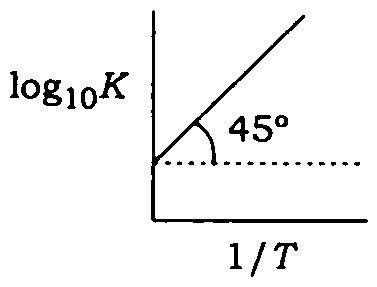
Q61 Chemical equilibrium / van 't Hoff equation
The variation of log₁₀K with 1/T is shown in the following graph in which the straight line is at 45° (where K is the equilibrium constant, R = 8·3 J K⁻¹ mol⁻¹; tan 45° = 1; ln 10 = 2·303) :
The value of ΔH° is approximately
(a) +19·1 J mol⁻¹(b) −19·1 J mol⁻¹(c) +8·3 J mol⁻¹(d) −8·3 J mol⁻¹
Answer and explanation with the VKC plan
Q62 Thermodynamics / spontaneity
Which one of the following is correct for an endothermic reaction A → B that proceeds spontaneously?
(a) ΔS is positive and TΔS > ΔH(b) ΔH is positive and ΔH > TΔS(c) ΔS is negative and TΔS > ΔH(d) ΔH is positive and TΔS = ΔH
Answer and explanation with the VKC plan
Q63 Solutions / colligative properties
Which one of the following solutions in water possesses the lowest vapour pressure?
(a) 0·1 M BaCl₂(b) 0·1 M NaCl(c) 0·1 M KCl(d) 0·1 M Urea
Answer and explanation with the VKC plan
Q64 Solutions / Raoult's law
The mass of a solute of molar mass 360 g mol⁻¹ that should be dissolved in 180 g of water to reduce its vapour pressure to 23 torr at 25 °C is approximately (the vapour pressure of water at 25 °C = 24 torr)
(a) 120 g(b) 150 g(c) 128 g(d) 114 g
Answer and explanation with the VKC plan
Q65 Solutions / Raoult's law
For a binary (A + B) ideal liquid solution, the total vapour pressure of the solution is given as
(where x_A and x_B are the mole fractions of the components A and B)
(a) p_total = p*_A + (p*_A − p*_B) x_A(b) p_total = p*_B + (p*_A − p*_B) x_A(c) p_total = p*_A + (p*_B − p*_A) x_A(d) p_total = p*_B + (p*_B − p*_A) x_B
Answer and explanation with the VKC plan
Q66 Solutions / osmotic pressure
A 0·002 M sugar solution in water is separated from pure water by an osmotic membrane. The osmotic pressure developed at 27 °C is (where R = 0·083 dm³ bar K⁻¹ mol⁻¹)
(a) 1·9 kPa(b) 2·5 kPa(c) 3·7 kPa(d) 5·0 kPa
Answer and explanation with the VKC plan
Q67 Solutions / depression of freezing point
A 0·1 molal solution of a monobasic acid HX is 10% ionized in water. The freezing point of the resultant solution is (where K_f for water = 1·86 K molal⁻¹)
(a) −0·45 °C(b) −0·205 °C(c) +0·45 °C(d) +0·312 °C
Answer and explanation with the VKC plan
Q68 Solutions / Henry's law
The Henry's law constants for the solubilities of O₂ and N₂ gases in water are 880 Pa and 440 Pa respectively at 25 °C. What will be the ratio of the mole fractions of O₂ and N₂ dissolved in water at 25 °C? (The mole fractions of O₂ and N₂ present in the atmosphere are 0·20 and 0·80 respectively)
(a) 0·25(b) 0·125(c) 0·20(d) 0·50
Answer and explanation with the VKC plan
Q69 Solutions / solubility of gases
Which of the following statements are not correct with respect to solubility of gases in a liquid solvent?
Gases which are easily liquefied are less stable in common solvents. Gases forming ions in water are more soluble in water. Under constant pressure, the solubility of a gas increases with rise in temperature. The solubility of a gas in a liquid is highly dependent on the pressure of the system. Select the correct answer using the code given below.
(a) 1 and 2(b) 1 and 3(c) 1 and 4(d) 3 and 4
Answer and explanation with the VKC plan
Q70 Electrochemistry / conductance
Which of the following statements about solutions of electrolytes is/are correct?
Conductivity of solution depends upon the size of the ions. Conductivity depends upon the viscosity of solution. Conductivity does not depend upon the solvation of ions present in solution. Conductivity of solution varies with the temperature. Select the correct answer using the code given below.
(a) 1 and 2 only(b) 3 only(c) 1, 2 and 4(d) 2, 3 and 4
Answer and explanation with the VKC plan
Q71 Electrochemistry / conductance
The resistance of a 0·10 N solution of an electrolyte occupying a volume between two platinum electrodes of cell constant 39 m⁻¹ is 30 Ω. The specific conductance and equivalent conductance of the solution will be respectively
(a) 0·013 Ω⁻¹ m⁻¹ and 1·3 Ω⁻¹ m² eq⁻¹(b) 1·3 Ω⁻¹ m⁻¹ and 0·013 Ω⁻¹ m² eq⁻¹(c) 2·5 Ω⁻¹ m⁻¹ and 0·25 Ω⁻¹ m² eq⁻¹(d) 1·3 Ω⁻¹ m⁻¹ and 130 Ω⁻¹ m² eq⁻¹
Answer and explanation with the VKC plan
Q72 Electrochemistry / Kohlrausch's law
Consider the following statements :
Statement-1 : Near the lower value of the concentration, Λ_m (molar conductivity) of CH₃COOH increases sharply on dilution. Statement-2 : Λ°_m (limiting molar conductivity) is obtained by using the Kohlrausch law of independent migration of ions. Which one of the following is correct in respect of the above statements?
(a) Both Statement-1 and Statement-2 are correct(b) Statement-1 is correct but Statement-2 is incorrect(c) Both Statement-1 and Statement-2 are incorrect(d) Statement-1 is incorrect but Statement-2 is correct
Answer and explanation with the VKC plan
Q73 Electrochemistry / ionic mobility
Which one of the following statements is correct with respect to ionic mobilities in solution?
(a) Ionic mobilities in solution have similar magnitudes as the speed of gaseous molecules in gas.(b) Solvation increases the ionic mobility in a solution.(c) Sodium ions have low ionic mobility due to extensive hydration of the Na⁺ ions in aqueous solution.(d) Ionic mobility reduces the degree of dissolution of strong electrolytes in solution.
Answer and explanation with the VKC plan
Q74 Electrochemistry / conductance and dilution
Consider the following statements :
Molar conductivity increases with dilution. Conductivity decreases with decrease in concentration. For strong electrolyte, the molar conductivity increases very sharply with decrease in concentration. Which of the statements given above is/are correct?
(a) 1 and 2(b) 1 and 3(c) 2 and 3(d) 3 only
Answer and explanation with the VKC plan
Q75 Electrochemistry / Debye-Hückel theory
Which one of the following statements is not correct in relation to the Debye-Hückel theory of electrolytic solutions?
(a) The Debye-Hückel theory assumes the ions in a solution to be in constant motion.(b) The Debye-Hückel limiting law is applicable for concentrated solutions only.(c) The ionic strength of a solution does not depend on the dielectric constant of the solvent.(d) The Debye-Hückel limiting law plots for NaCl and KCl should be identical.
Answer and explanation with the VKC plan
Q76 Electrochemistry / degree of dissociation
In a conductivity cell of cell constant 0·003 cm⁻¹ containing a 0·01 M solution of acetic acid, the resistance against ionic mobility is 20 Ω at 25 °C. The degree of dissociation of the acid is (where the molar conductance at infinite dilution = 390 × 10⁻⁴ Ω⁻¹ m² mol⁻¹ at 25 °C)
(a) 0·015(b) 0·027(c) 0·038(d) 0·047
Answer and explanation with the VKC plan
Q77 Electrochemistry / solubility from conductance
The specific conductance of a saturated solution of the sparingly soluble salt AgCl in water at 25 °C, after subtracting the specific conductance of pure water, is 1·82 × 10⁻⁴ Ω⁻¹ m⁻¹. What will be the approximate value of solubility of AgCl at this temperature, given that the molar conductance of AgCl at infinite dilution is 1·38 × 10⁻² Ω⁻¹ m² mol⁻¹?
(a) 1·32 × 10⁻² mol m⁻³(b) 1·43 × 10⁻⁵ mol m⁻³(c) 2·52 × 10⁻⁶ Ω⁻² m mol(d) 2·52 × 10⁻¹⁰ Ω⁻² m mol
Answer and explanation with the VKC plan
Q78 Electrochemistry / conductometric titrations
Which of the following statements regarding conductometric titrations involving acids and bases is/are not correct? [In each case, the base (alkali) is added to the acid contained in the conductivity cell as the titration progresses]
The electrical conductance depends only on the mobility, but not on the number of ions. The titration of a strong acid against a strong base yields a V-shaped plot. Titrations of a strong acid against a weak base and a weak acid against a strong base yield identical-shaped plots. In a titration involving a mixture of a strong acid and a weak acid against a strong base, the strong acid is neutralized first. Select the correct answer using the code given below.
(a) 1 and 4(b) 1 only(c) 2(d) 1 and 3
Answer and explanation with the VKC plan
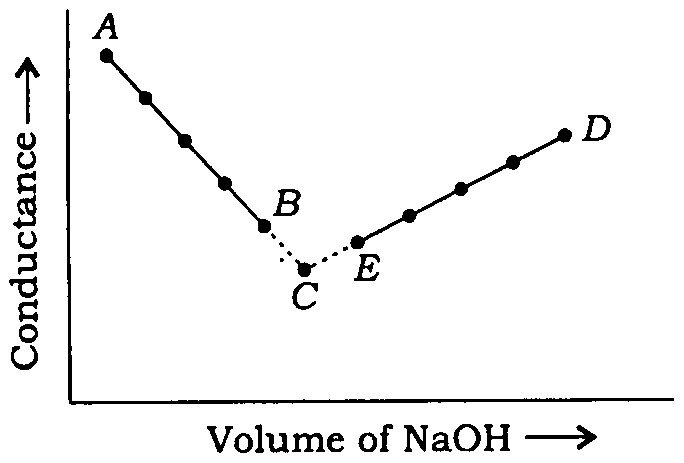
Q79 Electrochemistry / conductometric titrations
Consider the following conductometric titration curve of HCl with NaOH :
Which one of the following statements is not correct in respect of the given conductometric titration curve?
(a) At point B, the solution contains a mixture of HCl and NaCl salt.(b) At point C, the solution contains a mixture of NaOH and NaCl salt.(c) At point E, the solution contains a mixture of HCl and NaCl salt.(d) At point A, the solution contains HCl only.
Answer and explanation with the VKC plan
Q80 Electrochemistry / transport number
What will be the transport number of H⁺ ions in an aqueous solution of 0·050 M HCl using the moving boundary method, with CdCl₂ as the indicator electrode? Here, the boundary moves by 7·5 cm in a tube of cross-sectional area of 2·5 cm², upon flowing of 1·1 × 10⁻³ faraday of electricity in the circuit.
(a) 0·85(b) 0·17(c) 0·085(d) 0·72
Answer and explanation with the VKC plan
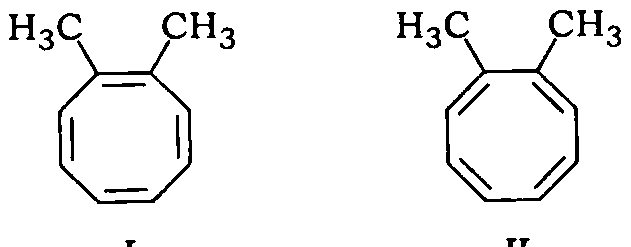
Q81 Aromaticity / cyclooctatetraene
Which one of the following statements is not true about the molecules I and II?
(a) The structures of I and II are simply two resonance forms of the same molecule.(b) The structures of I and II represent different molecules.(c) I and II are non-aromatic in nature.(d) The dianions of I and II are aromatic in nature.
Answer and explanation with the VKC plan
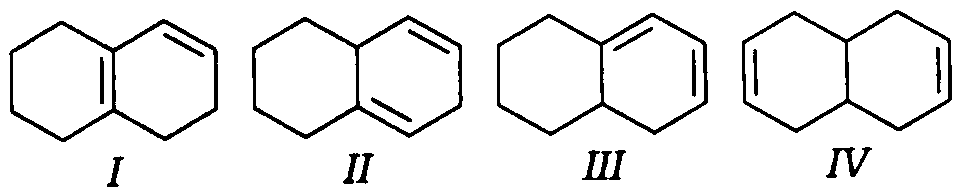
Q82 Hydrocarbons / stability of dienes
Rank the following dienes in order of increasing heat of hydrogenation :
(a) I < III < IV < II(b) IV < II < I < III(c) III < I < IV < II(d) I < III < II < IV
Answer and explanation with the VKC plan
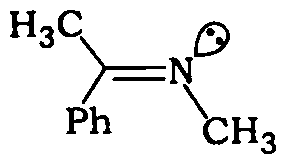
Q83 Organic basics / hybridisation
The hybridization of nitrogen present in the following imine is
(a) sp³(b) sp²(c) sp(d) sp³d
Answer and explanation with the VKC plan
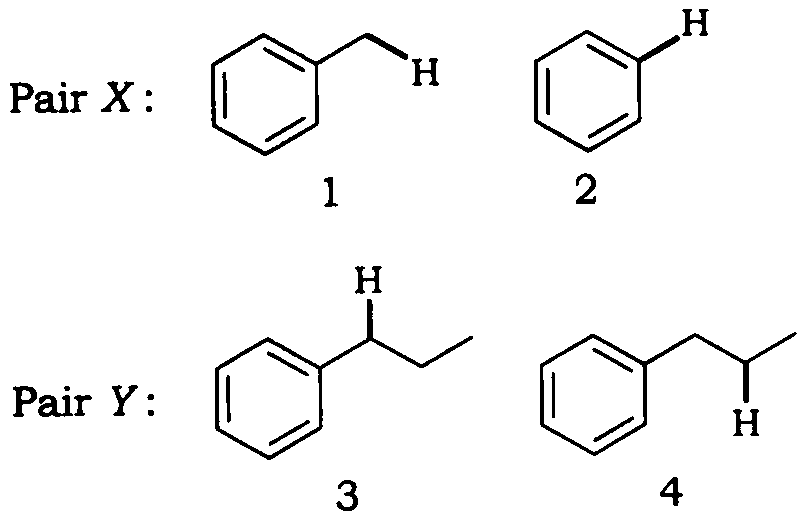
Q84 Reaction intermediates / free radical stability
Which of the indicated C—H bonds in each of the following pairs of compounds would yield a more stable free radical upon homolytic cleavage?
(a) 1 and 3(b) 1 and 4(c) 2 and 3(d) 2 and 4
Answer and explanation with the VKC plan
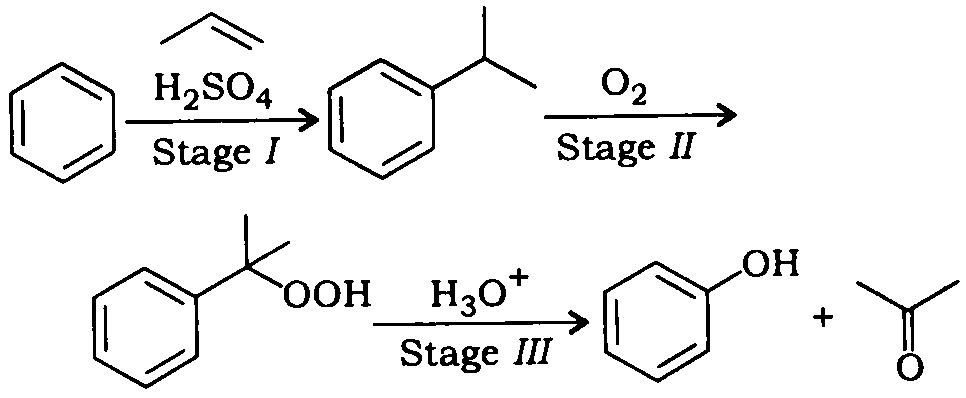
Q85 Named processes / cumene process
The mechanism of reactions at Stage I, Stage II and Stage III in the following reaction sequence is
(a) Stage I : Radical, Stage II : Radical, Stage III : Polar(b) Stage I : Polar, Stage II : Radical, Stage III : Polar(c) Stage I : Polar, Stage II : Polar, Stage III : Radical(d) Stage I : Radical, Stage II : Polar, Stage III : Polar
Answer and explanation with the VKC plan
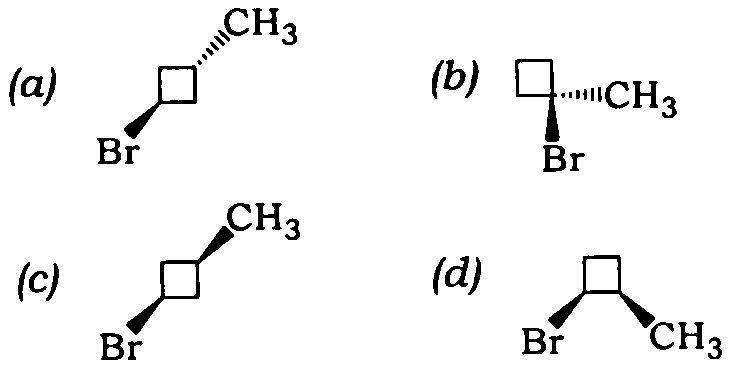
Q86 Stereochemistry / chirality
Which one of the following molecules is chiral?
(a) trans-1-bromo-3-methylcyclobutane (Br wedge, CH₃ hashed on opposite ring corners)(b) 1-bromo-1-methylcyclobutane (Br wedge, CH₃ hashed on the same carbon)(c) cis-1-bromo-3-methylcyclobutane (Br and CH₃ both wedged on opposite ring corners)(d) cis-1-bromo-2-methylcyclobutane (Br and CH₃ both wedged on adjacent carbons)
Answer and explanation with the VKC plan
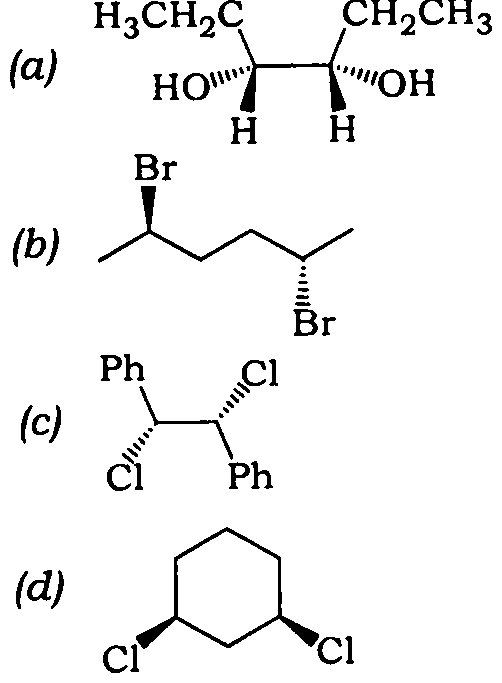
Q87 Stereochemistry / meso compounds
Which one of the following is not a meso compound?
(a) Hexane-3,4-diol drawn with both OH hashed and both H wedged (mirror-symmetric drawing)(b) 2,5-Dibromohexane drawn in zig-zag with one Br wedged and the other hashed(c) 1,2-Dichloro-1,2-diphenylethane drawn with both Cl hashed (Ph up on C1, Ph down on C2)(d) cis-1,3-Dichlorocyclohexane (both Cl wedged)
Answer and explanation with the VKC plan
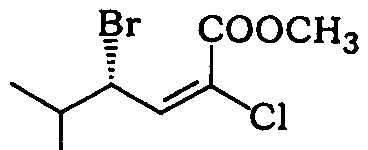
Q88 Stereochemistry / E-Z and R-S
The stereochemical notations for the following compound are
(a) 2Z, 4R(b) 2Z, 4S(c) 2E, 4R(d) 2E, 4S
Answer and explanation with the VKC plan
Q89 Stereochemistry / geometrical isomerism
Which one of the following compounds shows geometrical isomerism?
(a) Cyclooctene(b) Isoprene(c) 2,3-Dimethylpent-2-ene(d) 4-Methyl-1,3-pentadiene
Answer and explanation with the VKC plan
Q90 Conformations / torsional strain
The eclipsed conformation of CH₃CH₂Cl is 15 kJ/mol and is less stable than the staggered conformation. How much is H, Cl eclipsing interaction worth in destabilization? (where H, H eclipsing interaction worth = 4 kJ/mol)
(a) 8 kJ/mol(b) 11 kJ/mol(c) 7 kJ/mol(d) 12 kJ/mol
Answer and explanation with the VKC plan
Q91 Alcohols / carbocation rearrangement
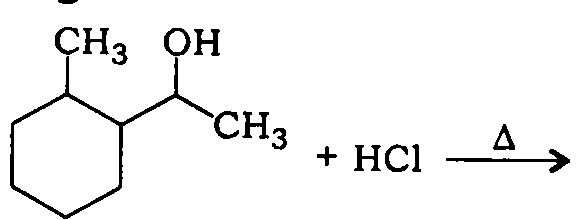
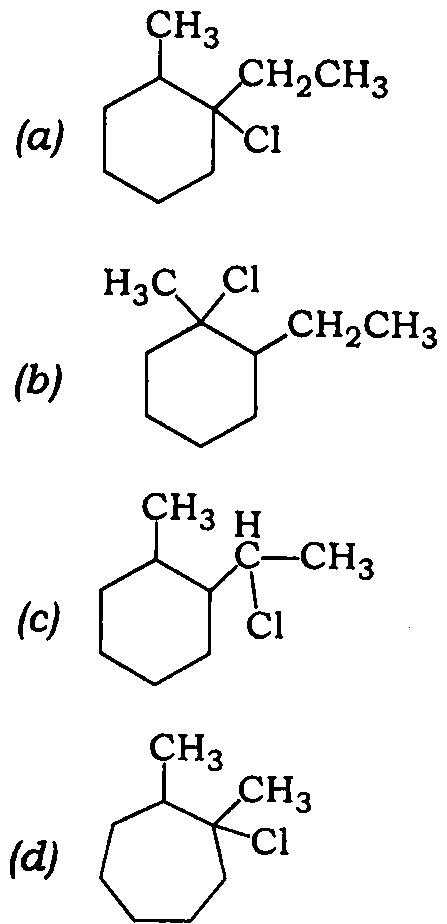
The major product formed in the following reaction is
(a) 1-chloro-1-ethyl-2-methylcyclohexane(b) 1-chloro-2-ethyl-1-methylcyclohexane(c) 1-(1-chloroethyl)-2-methylcyclohexane(d) 1-chloro-1,2-dimethylcycloheptane
Answer and explanation with the VKC plan
Q92 Reaction mechanism / neighbouring group participation
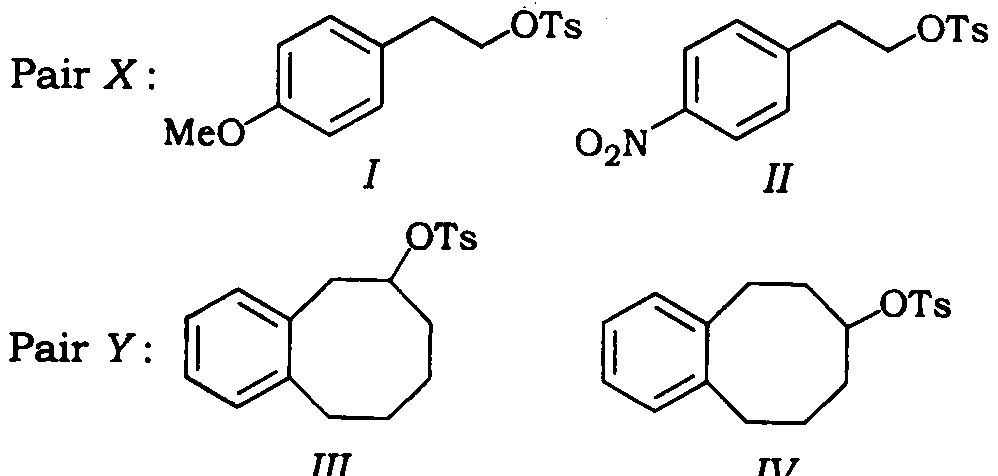
Which of the following substrates will be more reactive in solvolysis conditions using formic acid in Pair X and Pair Y respectively?
(a) I and III(b) I and IV(c) II and III(d) II and IV
Answer and explanation with the VKC plan
Q93 Reaction mechanism / SN1 and aromaticity
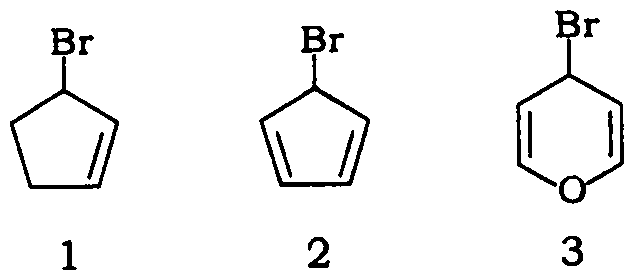
The relative order of reactivity of the following bromides in SN1 reaction is
(a) 3 > 2 > 1(b) 2 > 3 > 1(c) 3 > 1 > 2(d) 2 > 1 > 3
Answer and explanation with the VKC plan
Q94 Reaction mechanism / SN2
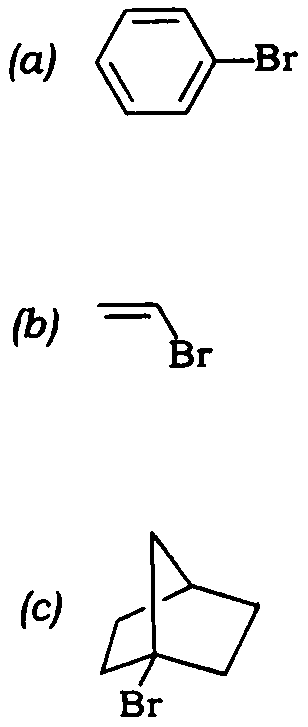
Which one of the following compounds would react most readily by SN2 mechanism?
(a) Bromobenzene(b) Vinyl bromide (CH₂=CH–Br)(c) 1-Bromobicyclo[2.2.1]heptane (bridgehead bromide)(d) None of the above
Answer and explanation with the VKC plan
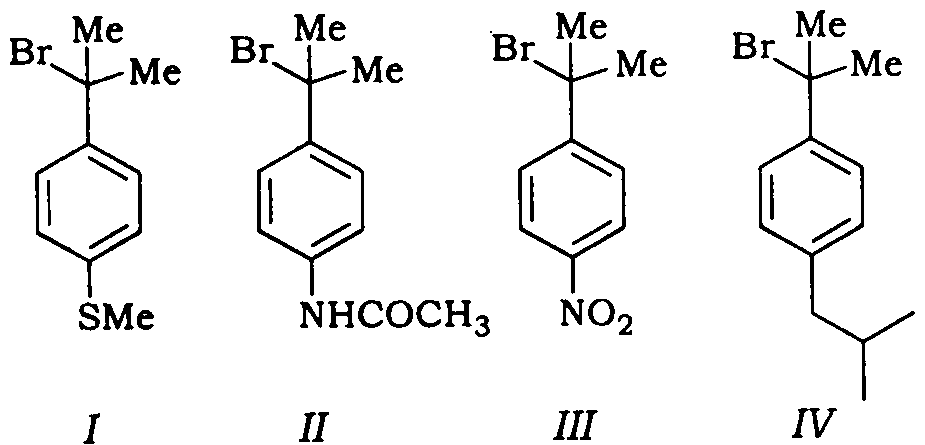
Q95 Reaction mechanism / substituent effects in SN1
Rank the following alkyl bromides from most reactive to least reactive in a solvolysis reaction using aqueous acetone :
(a) II > IV > I > III(b) I > II > IV > III(c) III > IV > II > I(d) III > IV > I > II
Answer and explanation with the VKC plan
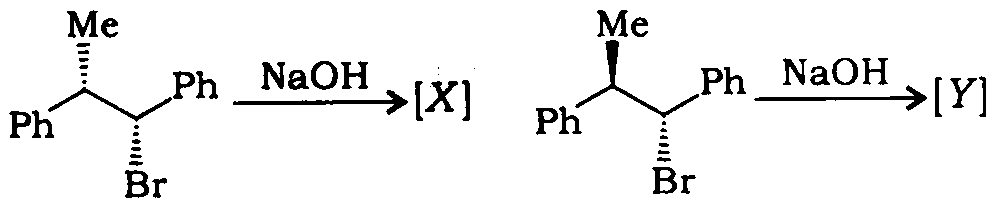
Q96 Elimination / stereospecific E2
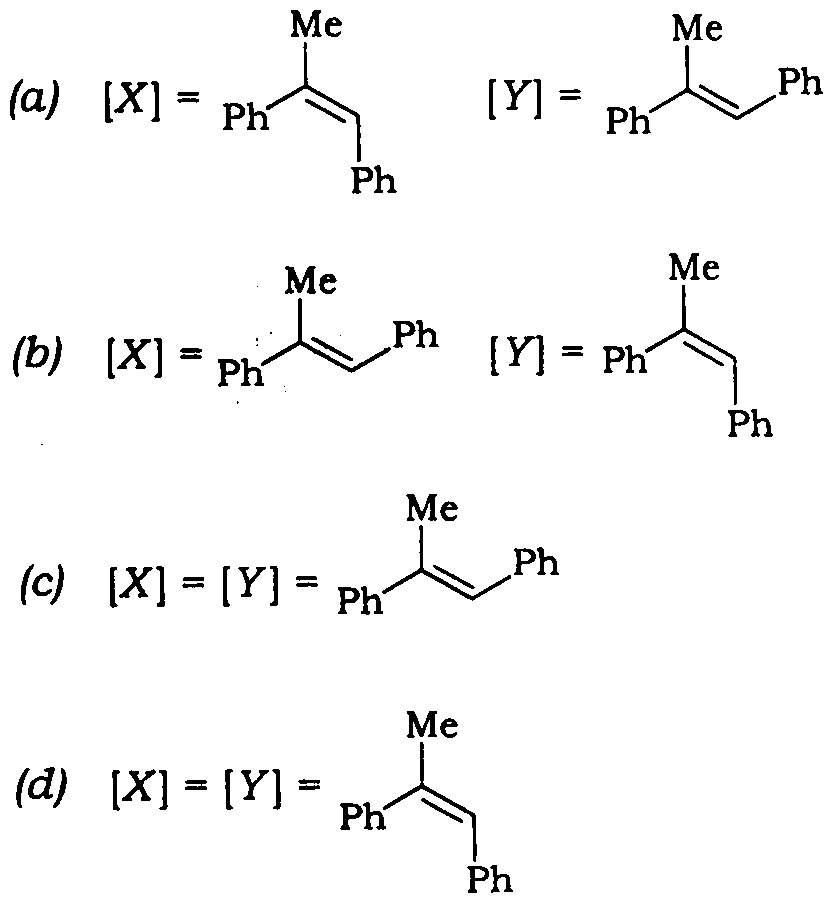
The major products [X] and [Y] formed in the following reactions are
(a) [X] = (Z)-1,2-diphenylpropene (Ph groups cis); [Y] = (E)-1,2-diphenylpropene (Ph groups trans)(b) [X] = (E)-1,2-diphenylpropene (Ph groups trans); [Y] = (Z)-1,2-diphenylpropene (Ph groups cis)(c) [X] = [Y] = (E)-1,2-diphenylpropene (Ph groups trans)(d) [X] = [Y] = (Z)-1,2-diphenylpropene (Ph groups cis)
Answer and explanation with the VKC plan
Q97 Elimination / E2 in cyclohexanes
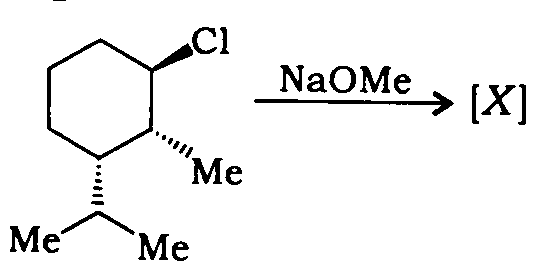
Which one of the following is true for the reaction given below?
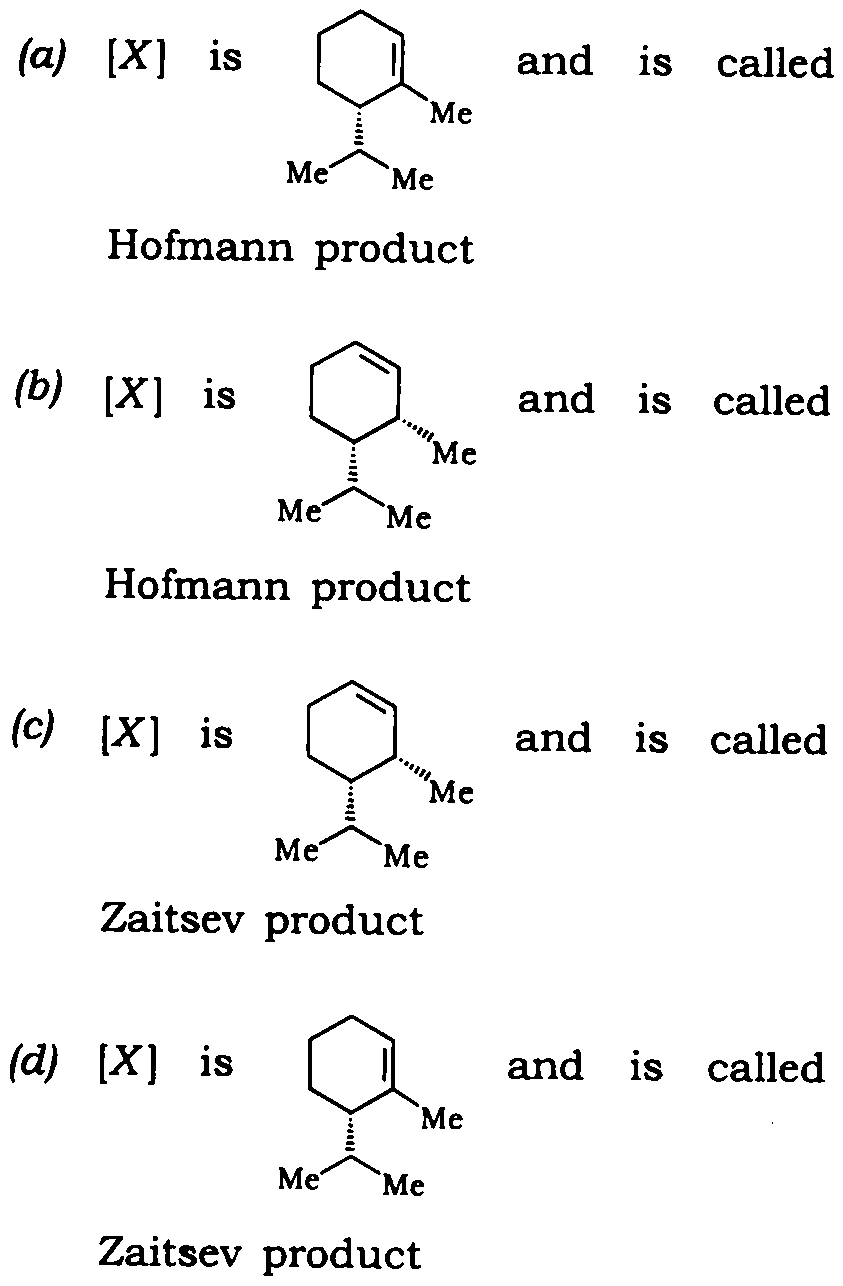
(a) [X] is 1-methyl-6-isopropylcyclohexene (double bond at the Me-bearing carbon) and is called Hofmann product(b) [X] is 3-methyl-4-isopropylcyclohexene (double bond away from the Me-bearing carbon) and is called Hofmann product(c) [X] is 3-methyl-4-isopropylcyclohexene (double bond away from the Me-bearing carbon) and is called Zaitsev product(d) [X] is 1-methyl-6-isopropylcyclohexene (double bond at the Me-bearing carbon) and is called Zaitsev product
Answer and explanation with the VKC plan
Q98 Elimination / E1 kinetics
Which of the following statements are true about the kinetics of E1 reaction of an alkyl halide in presence of base?
The rate of E1 reaction doubles by doubling the concentration of the alkyl halide. The rate of E1 reaction doubles by doubling the concentration of the base. The rate of E1 reaction decreases by changing the alkyl halide from (CH₃)₃CBr to CH₃CH₂CH₂Br. The rate of E1 reaction increases by changing the solvent from DMSO to CH₃OH. Select the correct answer using the code given below.
(a) 1, 2 and 3(b) 2, 3 and 4(c) 1, 3 and 4(d) 1 and 2 only
Answer and explanation with the VKC plan
Q99 Stereochemistry / anti debromination
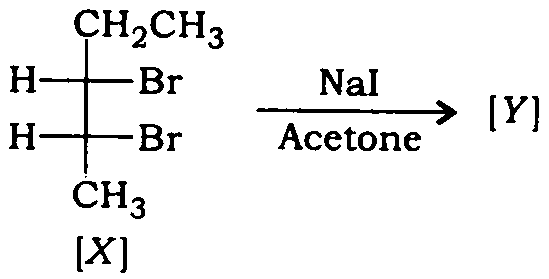
The IUPAC names of the substrate [X] and the product [Y] formed in the following reaction are
(a) [X] is (2R, 3S)-2,3-dibromopentane and [Y] is (E)-pent-2-ene(b) [X] is (2R, 3S)-2,3-dibromopentane and [Y] is (Z)-pent-2-ene(c) [X] is (2S, 3S)-2,3-dibromopentane and [Y] is (E)-pent-2-ene(d) [X] is (2R, 3R)-2,3-dibromopentane and [Y] is (Z)-pent-2-ene
Answer and explanation with the VKC plan
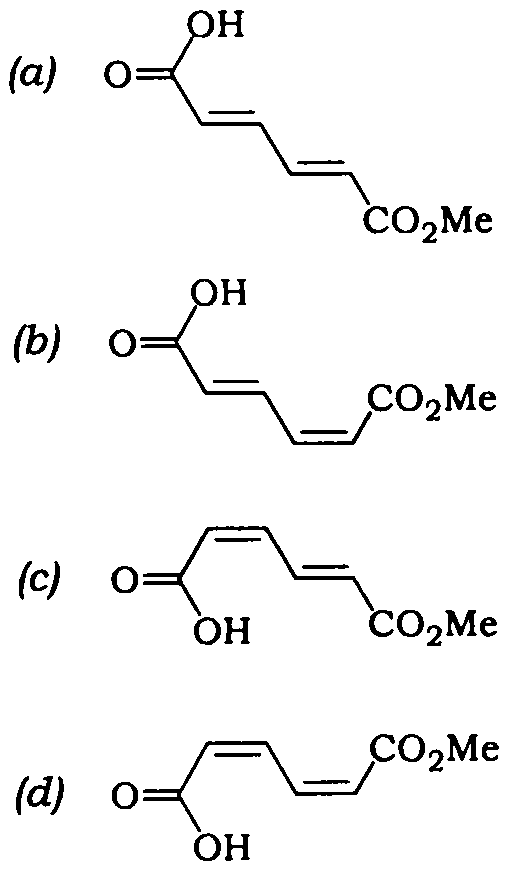
Q100 Carbonyl chemistry / E1cB ring opening
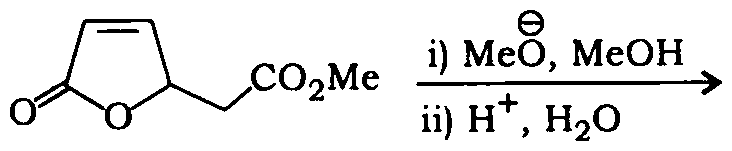
The major product formed in the following reaction sequence is
(a) (2E,4E)-6-methoxy-6-oxohexa-2,4-dienoic acid (both C=C trans)(b) (2E,4Z)-6-methoxy-6-oxohexa-2,4-dienoic acid (C=C next to COOH trans, next to CO₂Me cis)(c) (2Z,4E)-6-methoxy-6-oxohexa-2,4-dienoic acid (C=C next to COOH cis, next to CO₂Me trans)(d) (2Z,4Z)-6-methoxy-6-oxohexa-2,4-dienoic acid (both C=C cis)
Answer and explanation with the VKC plan
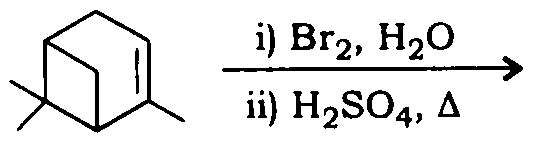
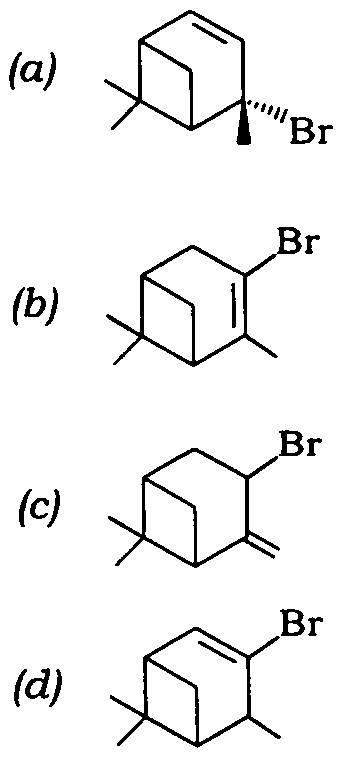
Q101 Alkenes / halohydrin and dehydration
The major product formed in the following reaction sequence is
(a) Bicyclic allylic bromide with Br on the quaternary C2 and C=C at C3–C4(b) 3-Bromo-α-pinene (Br on C3 of the endocyclic C2=C3 double bond, Me on C2)(c) 3-Bromo-β-pinene (Br on C3, exocyclic C=CH₂ at C2)(d) Bromo-alkene with Br on C3 of a C3=C4 double bond, Me on sp³ C2
Answer and explanation with the VKC plan
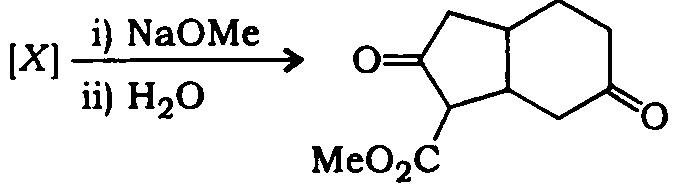
Q102 Carbonyl chemistry / intramolecular Michael addition
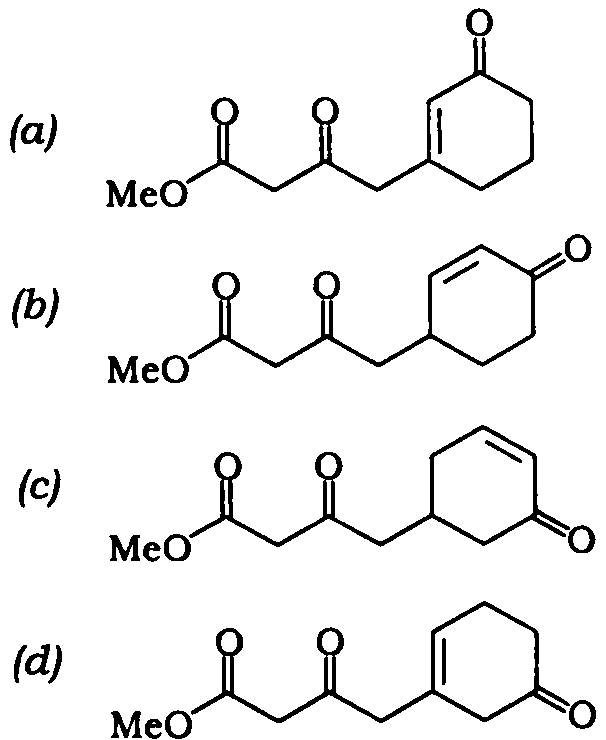
The precursor [X] in the following reaction is
(a) Methyl 3-oxo-4-(3-oxocyclohex-1-en-1-yl)butanoate (side chain on the β-carbon of the enone)(b) Methyl 3-oxo-4-(4-oxocyclohex-2-en-1-yl)butanoate (side chain on the γ-carbon of the enone)(c) Methyl 3-oxo-4-(5-oxocyclohex-3-en-1-yl)butanoate (side chain meta to C=O)(d) Methyl 3-oxo-4-(5-oxocyclohex-1-en-1-yl)butanoate (ring C=C not conjugated with the C=O)
Answer and explanation with the VKC plan
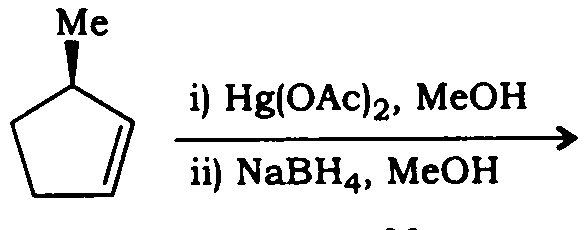
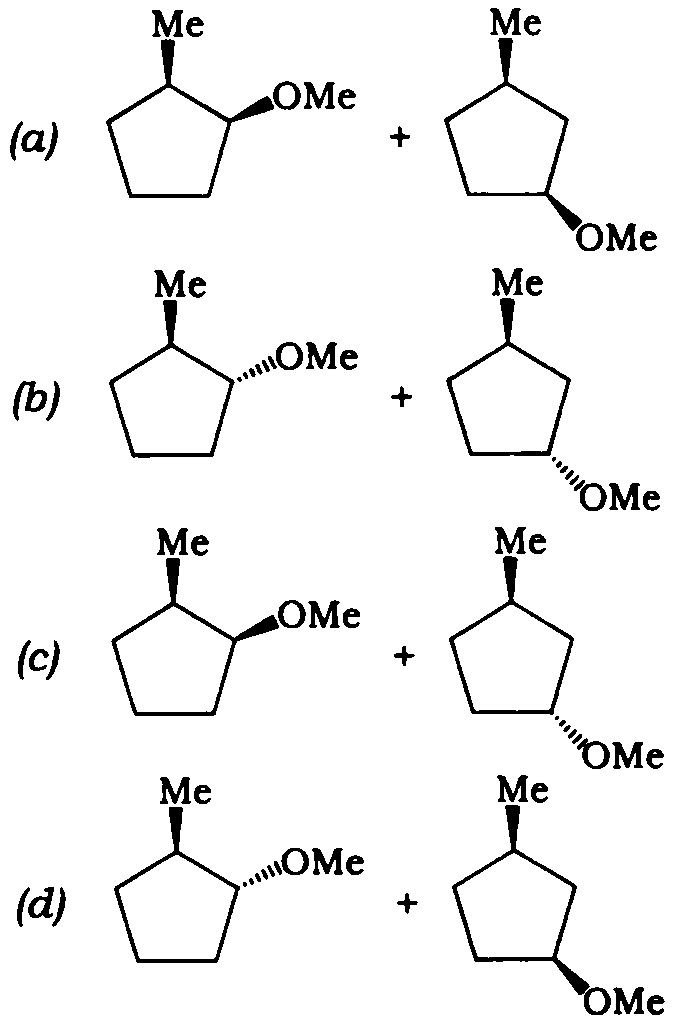
Q103 Alkenes / alkoxymercuration
The major products formed in the following reaction sequence are
(a) cis-1-methoxy-2-methylcyclopentane + cis-1-methoxy-3-methylcyclopentane (OMe on the same face as Me)(b) trans-1-methoxy-2-methylcyclopentane + trans-1-methoxy-3-methylcyclopentane(c) cis-1-methoxy-2-methylcyclopentane + trans-1-methoxy-3-methylcyclopentane(d) trans-1-methoxy-2-methylcyclopentane + cis-1-methoxy-3-methylcyclopentane
Answer and explanation with the VKC plan
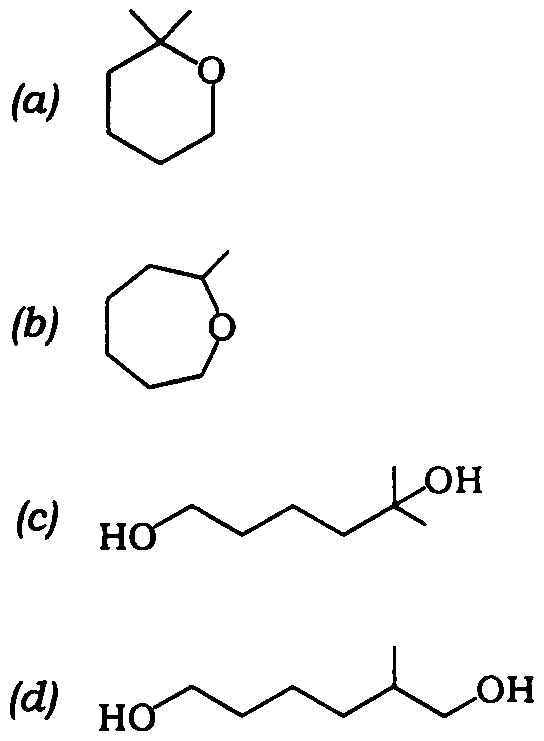
Q104 Alkenes / intramolecular oxymercuration
The major product formed in the following reaction sequence is
(a) 2,2-Dimethyltetrahydropyran (2,2-dimethyloxane)(b) 2-Methyloxepane(c) 5-Methylhexane-1,5-diol (tertiary OH)(d) 2-Methylhexane-1,6-diol (primary OH at the branch)
Answer and explanation with the VKC plan
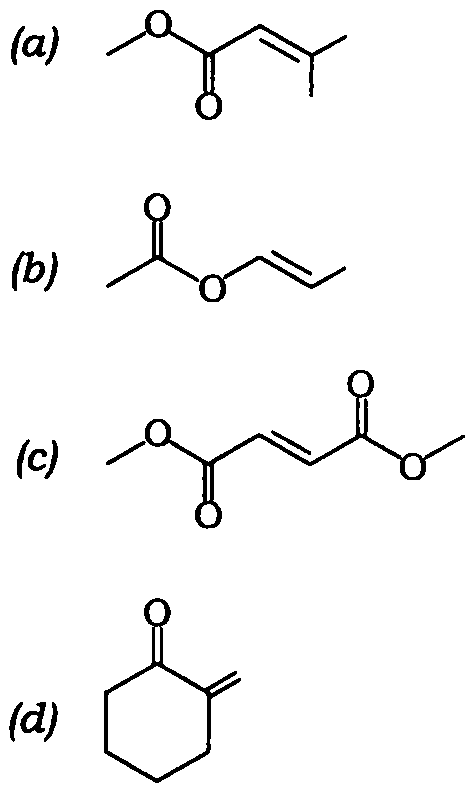
Q105 Carbonyl chemistry / Michael acceptors
Which one of the following compounds does not serve as Michael acceptor?
(a) Methyl 3-methylbut-2-enoate(b) Prop-1-enyl acetate (CH₃COO–CH=CH–CH₃)(c) Dimethyl fumarate(d) 2-Methylenecyclohexanone
Answer and explanation with the VKC plan
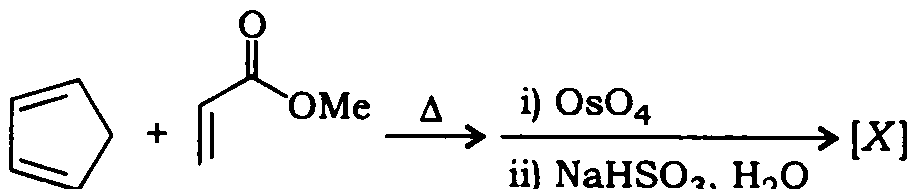
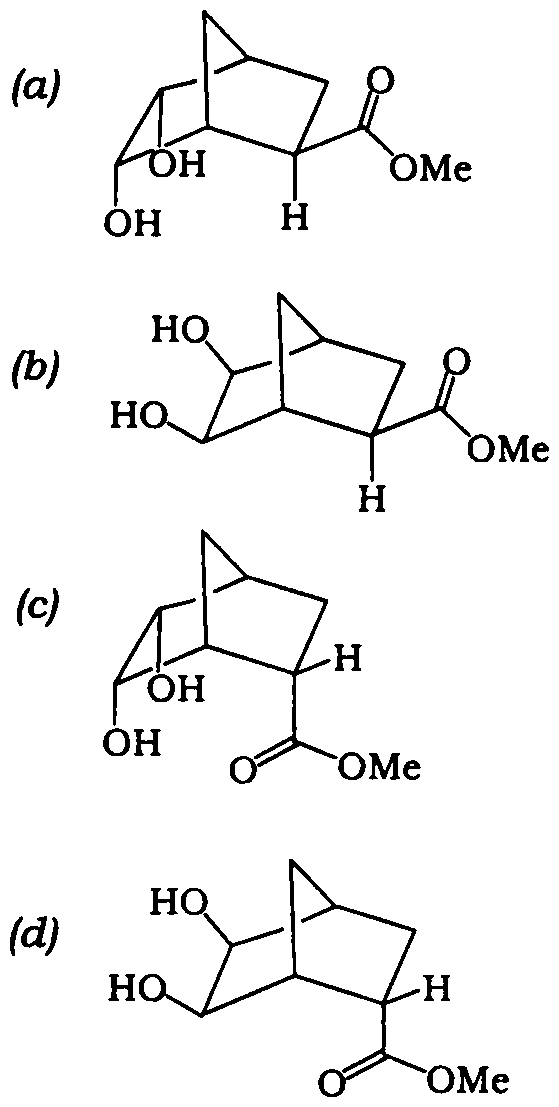
Q106 Pericyclic / Diels-Alder and dihydroxylation
The final product [X] formed in the following reaction sequence is
(a) Norbornane-diol with endo diol and exo ester(b) Norbornane-diol with exo diol and exo ester(c) Norbornane-diol with endo diol and endo ester(d) Norbornane-diol with exo diol and endo ester
Answer and explanation with the VKC plan
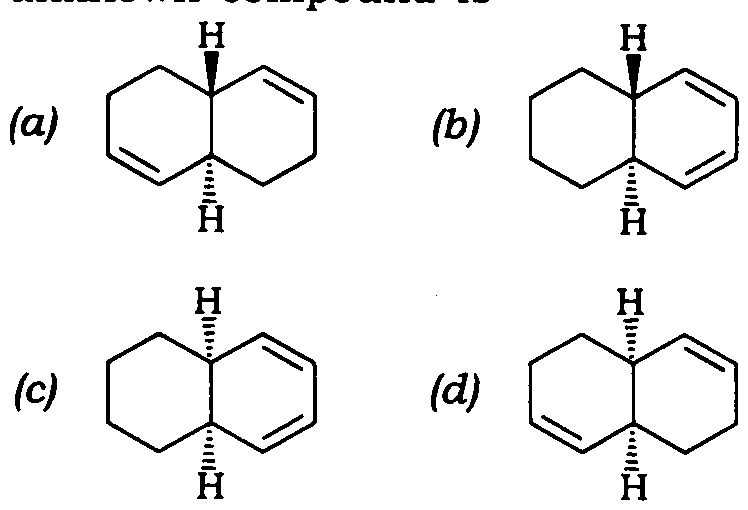
Q107 Structure determination / oxidative cleavage
An unknown compound with molecular formula C₁₀H₁₄ decolorizes bromine in carbon tetrachloride. When treated with warm, concentrated potassium permanganate, this compound gives cis-cyclohexane-1,2-dicarboxylic acid and oxalic acid. The structure for the unknown compound is
(a) trans-fused hexahydronaphthalene with one C=C in each ring(b) trans-fused 4a,5,6,7,8,8a-hexahydronaphthalene (conjugated diene in one ring)(c) cis-fused 4a,5,6,7,8,8a-hexahydronaphthalene (conjugated diene in one ring)(d) cis-fused hexahydronaphthalene with one C=C in each ring
Answer and explanation with the VKC plan
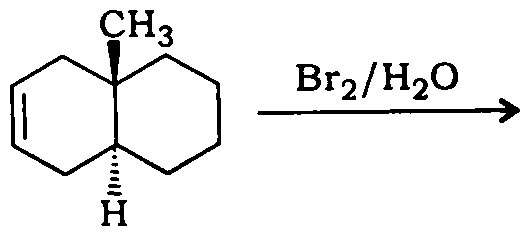
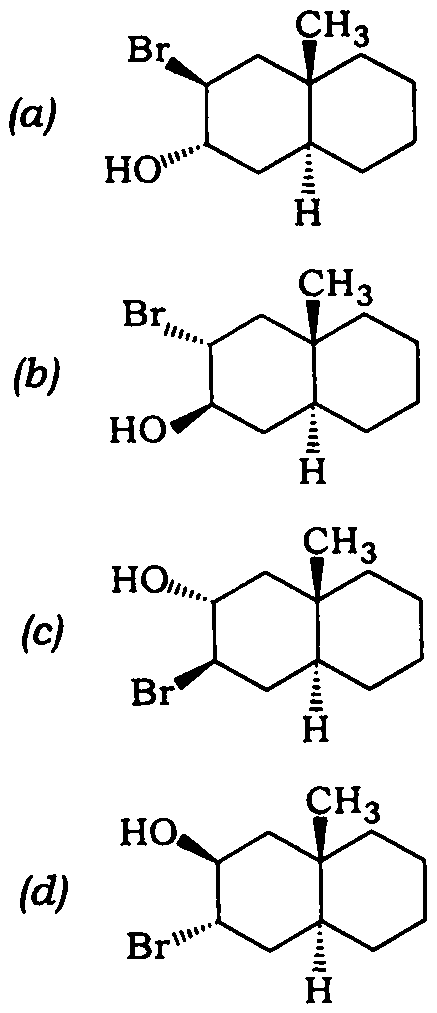
Q108 Alkenes / stereochemistry of bromohydrin formation
The major product formed in the following reaction is
(a) Bromohydrin with Br β (wedge) at C2 and OH α (hash) at C3(b) Bromohydrin with Br α (hash) at C2 and OH β (wedge) at C3(c) Bromohydrin with OH α (hash) at C2 and Br β (wedge) at C3(d) Bromohydrin with OH β (wedge) at C2 and Br α (hash) at C3
Answer and explanation with the VKC plan
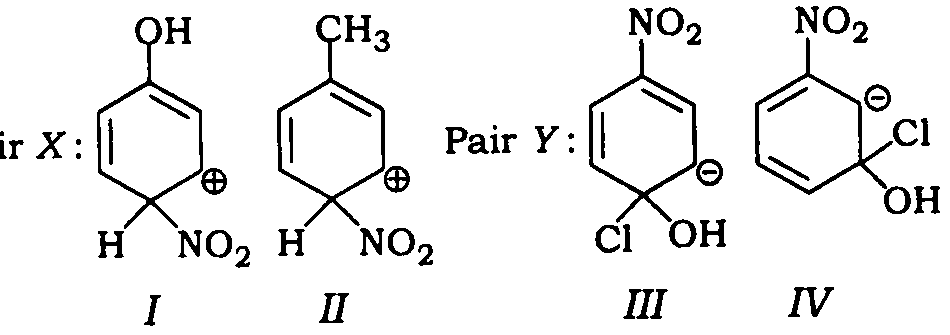
Q109 Reaction intermediates / arenium and Meisenheimer complexes
Which is the most stable intermediate in the following Pair X and Pair Y respectively?
(a) I and III(b) I and IV(c) II and III(d) II and IV
Answer and explanation with the VKC plan
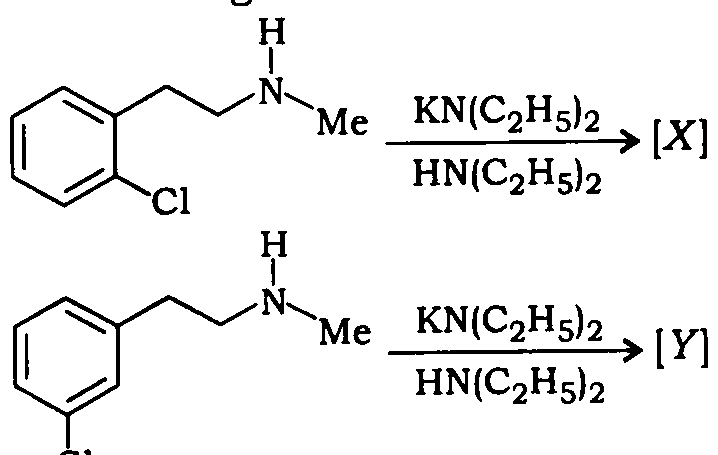
Q110 Aromatic substitution / benzyne
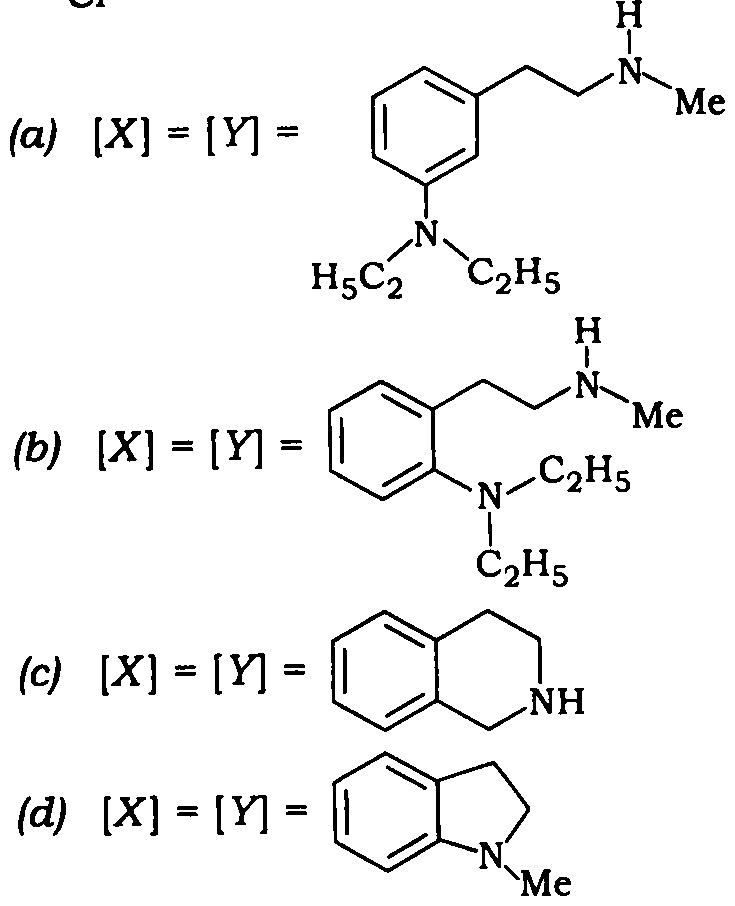
The major products [X] and [Y] formed in the following reactions are
(a) [X] = [Y] = N,N-diethyl-3-[2-(methylamino)ethyl]aniline(b) [X] = [Y] = N,N-diethyl-2-[2-(methylamino)ethyl]aniline(c) [X] = [Y] = 1,2,3,4-tetrahydroisoquinoline(d) [X] = [Y] = 1-methylindoline
Answer and explanation with the VKC plan
Q111 Aromatic substitution / SNAr
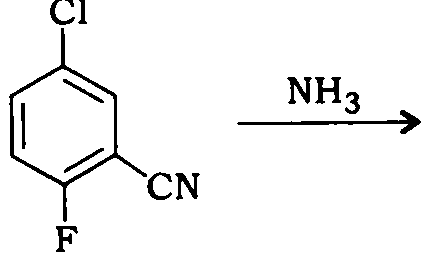
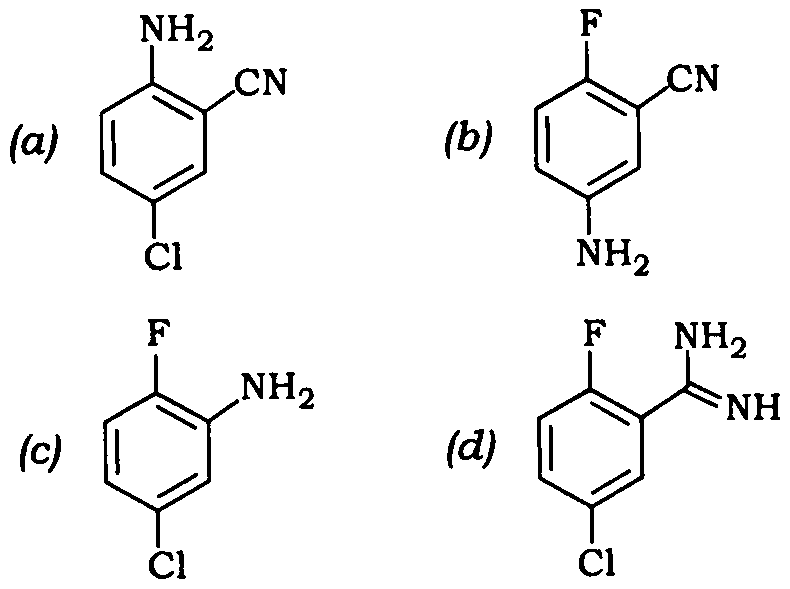
The major product formed in the following reaction is
(a) 2-Amino-5-chlorobenzonitrile(b) 5-Amino-2-fluorobenzonitrile(c) 5-Chloro-2-fluoroaniline(d) 5-Chloro-2-fluorobenzamidine
Answer and explanation with the VKC plan
Q112 Aromatic substitution / steric effects
Arrange the following alkyl benzenes in decreasing order of percentage of ortho/para ratio of products formed in nitration reaction :
I. Toluene II. Cumene III. tert-Butylbenzene IV. Ethylbenzene (a) II > III > I > IV(b) I > IV > II > III(c) III > II > IV > I(d) IV > II > III > I
Answer and explanation with the VKC plan
Q113 Aromatic substitution / Friedel-Crafts alkylation
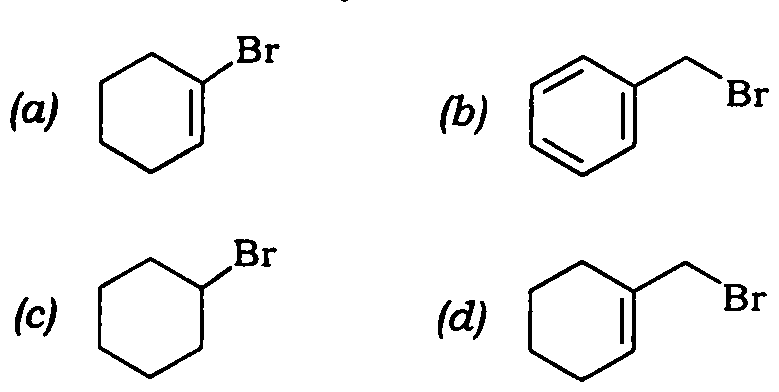
Which one of the following substrates does not participate in Friedel-Crafts alkylation of benzene using AlCl₃ as Lewis acid catalyst?
(a) 1-Bromocyclohexene(b) Benzyl bromide(c) Bromocyclohexane(d) 1-(Bromomethyl)cyclohexene
Answer and explanation with the VKC plan
Q114 Aromatic substitution / SNAr
Which one of the following statements is not true about the reactivity towards aromatic nucleophilic substitution reaction?
(a) 2-Chloropyridine is more reactive than chlorobenzene.(b) Iodobenzene is more reactive than fluorobenzene.(c) 2-Chloronitrobenzene is more reactive than 3-Chloronitrobenzene.(d) 2-Chloropyridine is more reactive than 3-Chloropyridine.
Answer and explanation with the VKC plan
Q115 Synthesis / aromatic substitution sequence
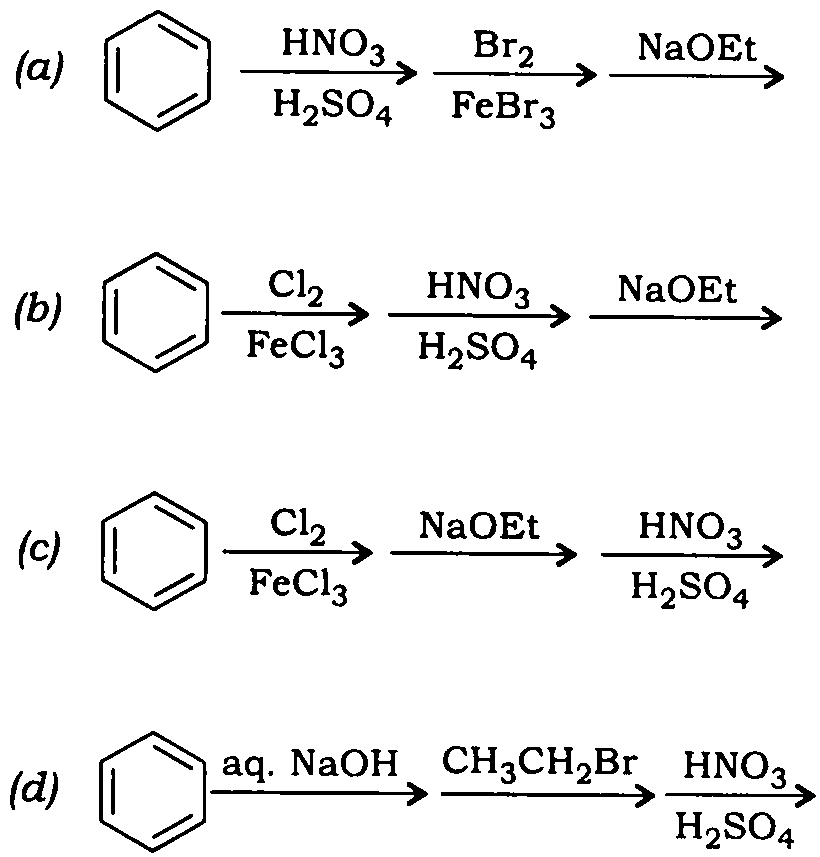
Which one of the following is the correct sequence of events for the preparation of ethyl 2,4-dinitrophenyl ether?
(a) Benzene → HNO₃/H₂SO₄ → Br₂/FeBr₃ → NaOEt(b) Benzene → Cl₂/FeCl₃ → HNO₃/H₂SO₄ → NaOEt(c) Benzene → Cl₂/FeCl₃ → NaOEt → HNO₃/H₂SO₄(d) Benzene → aq. NaOH → CH₃CH₂Br → HNO₃/H₂SO₄
Answer and explanation with the VKC plan
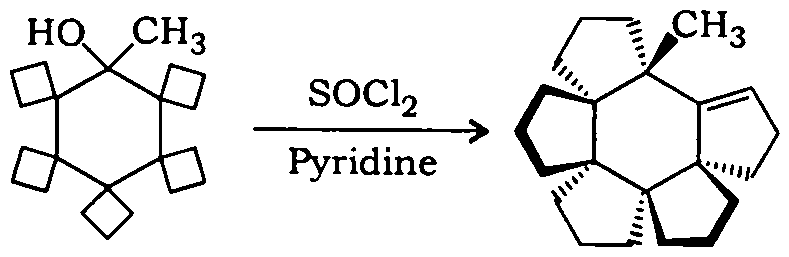
Q116 Carbocation rearrangement / ring expansion cascade
The number of [1, 2]-rearrangements occurring in the following transformation is
(a) three(b) four(c) five(d) six
Answer and explanation with the VKC plan
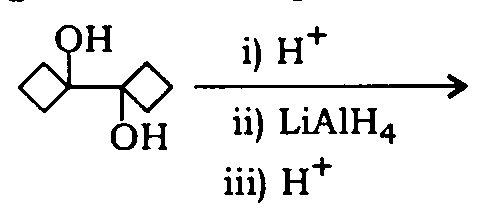
Q117 Carbocation rearrangement / pinacol and ring expansion
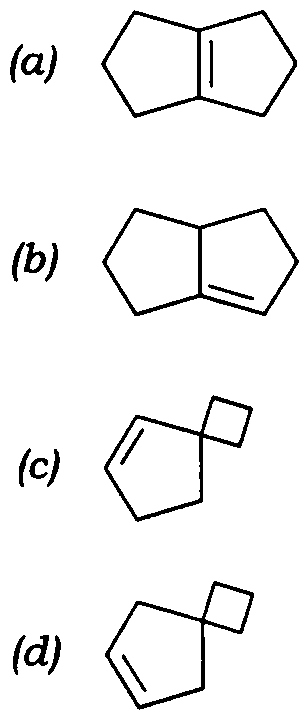
The major product formed in the following reaction sequence is
(a) Bicyclo[3.3.0]oct-1(5)-ene (C=C at the ring fusion)(b) Bicyclo[3.3.0]oct-1-ene (C=C from ring fusion into one ring)(c) Spiro[3.4]oct-5-ene (C=C next to the spiro carbon)(d) Spiro[3.4]oct-6-ene
Answer and explanation with the VKC plan
Q118 Carbocation rearrangement / semipinacol
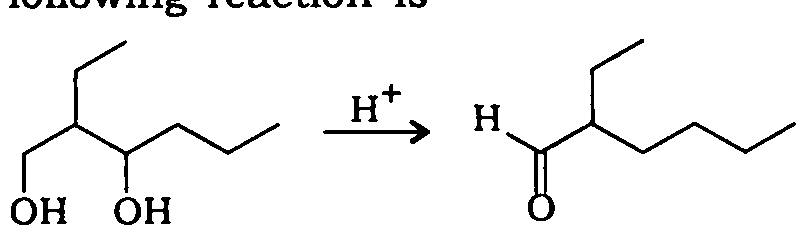
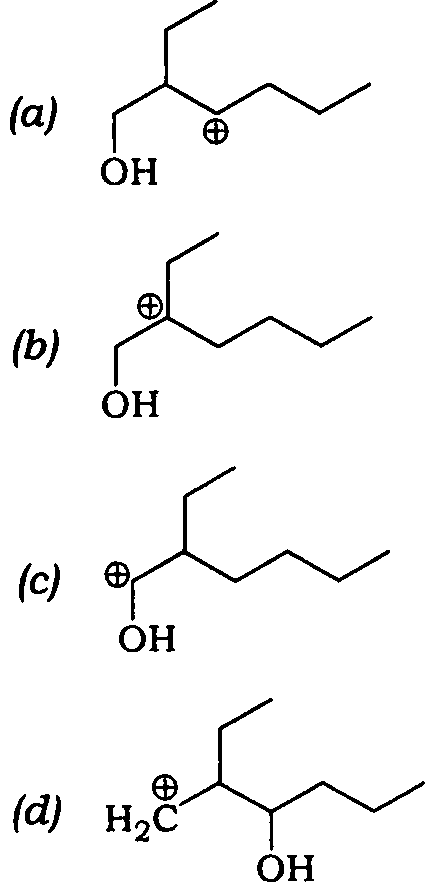
The intermediate which is less likely to be formed in the mechanism of the following reaction is
(a) Secondary cation at C3 (CH₂OH retained)(b) Tertiary cation at C2 (CH₂OH retained)(c) Protonated aldehyde (cation on the CH–OH carbon, C1)(d) Primary cation at C1 (H₂C⁺) with the C3–OH retained
Answer and explanation with the VKC plan
Q119 Reaction mechanism / neighbouring group participation
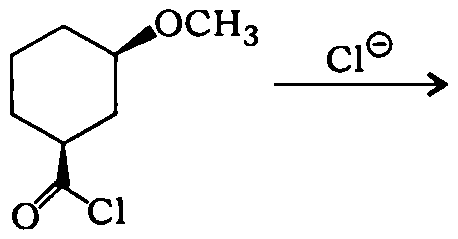
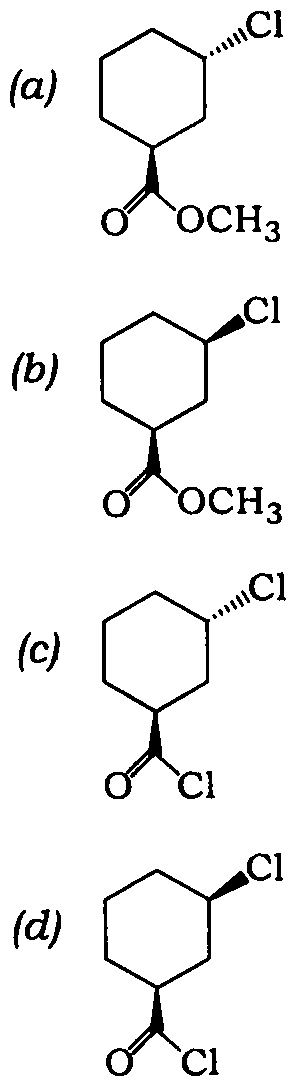
The product formed due to neighbouring group participation in the following reaction is
(a) trans-Methyl 3-chlorocyclohexanecarboxylate (Cl hashed, CO₂CH₃ wedge)(b) cis-Methyl 3-chlorocyclohexanecarboxylate (Cl and CO₂CH₃ both wedge)(c) trans-3-Chlorocyclohexanecarbonyl chloride(d) cis-3-Chlorocyclohexanecarbonyl chloride
Answer and explanation with the VKC plan
Q120 Reaction mechanism / neighbouring group participation by halogen
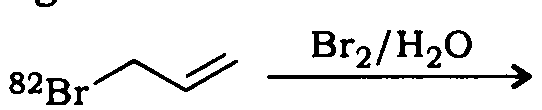
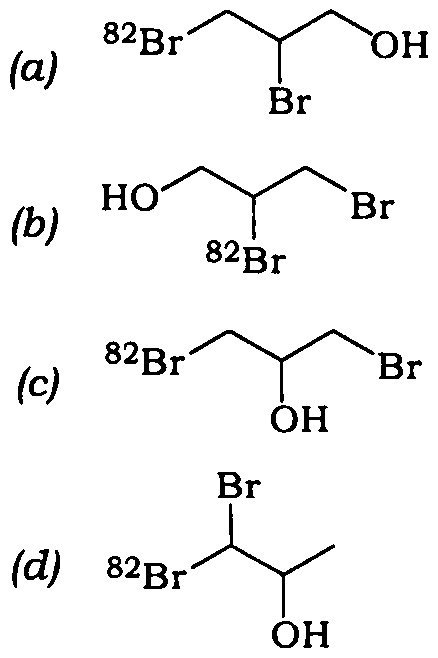
The major product formed in the following reaction is
(a) ⁸²BrCH₂–CH(Br)–CH₂OH(b) HOCH₂–CH(⁸²Br)–CH₂Br(c) ⁸²BrCH₂–CH(OH)–CH₂Br(d) ⁸²BrCH₂–CH(Br)–CH(OH)CH₃
Answer and explanation with the VKC plan